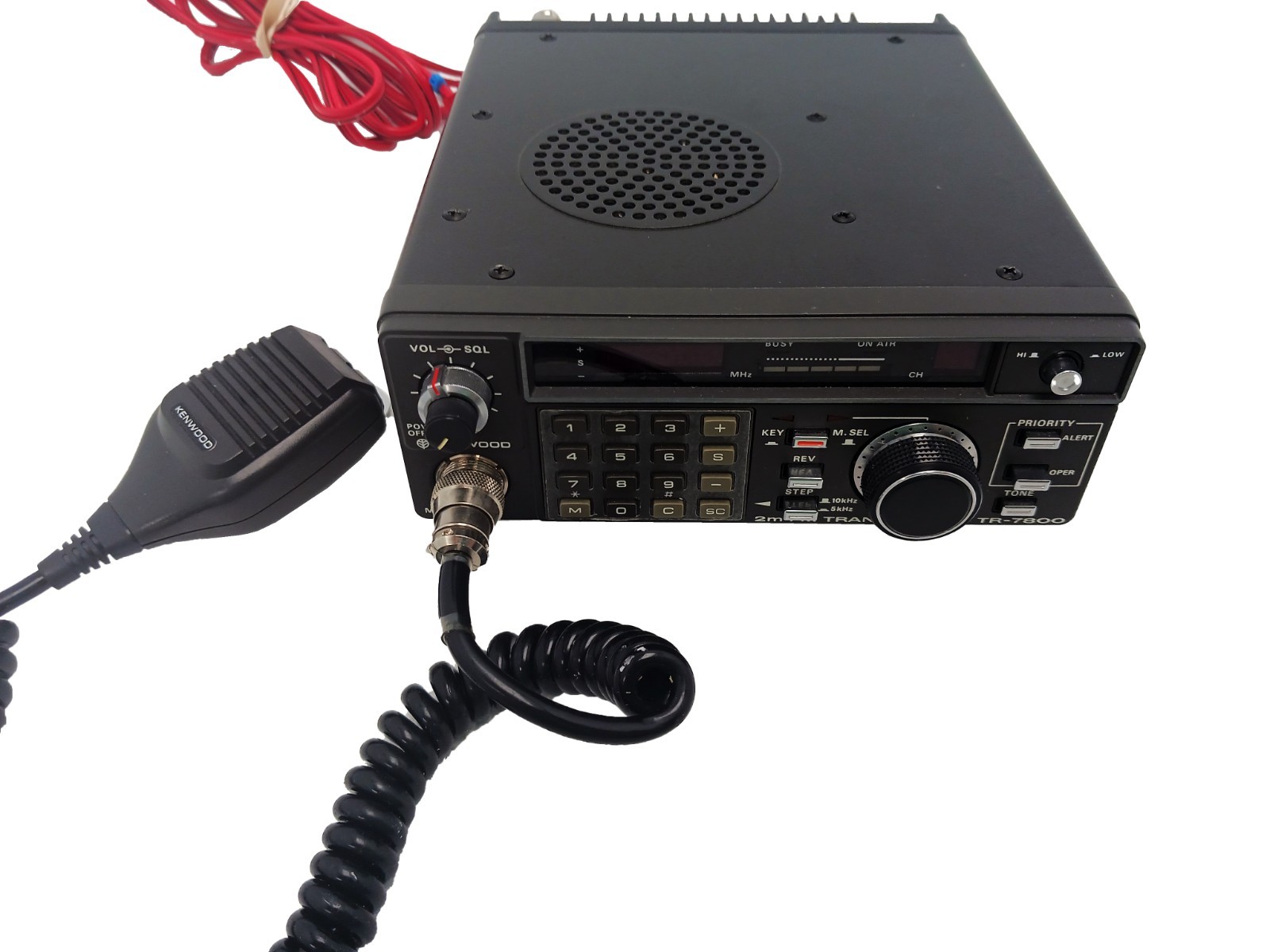

Photos from current listings. Actual item, color, and included accessories may vary.
Kenwood 2 Meter Radio Buying Guide
Kenwood 2-meter radios are VHF (144–148 MHz) FM transceivers spanning legacy analog mobiles like the TR-7800 to modern 50W+ digital mobiles and HTs. The core trade-off is generation: older analog-only rigs are inexpensive but lack CTCSS/DCS, memory capacity, and narrowband compliance, while current models add digital modes, wideband receive, and PC programmability. The decision rule: buy a late-model or current-generation Kenwood if you need repeater access, digital voice, or long-term parts support; treat vintage analog mobiles as collectible or budget simplex-only rigs.
Key takeaways
- Power tier defines range and heat: modern Kenwood VHF mobiles output 50–65W (high) with selectable 5–10W low, while legacy mobiles like the TR-7800 typically top out around 25W.
- Narrowband compliance matters: post-2013 FCC Part 90 narrowband rules pushed 2.5 kHz deviation; current Kenwood models support wide/narrow switching, many vintage rigs are wideband-only.
- CTCSS/DCS tone encoding is the repeater-access gate: modern Kenwood mobiles and HTs include built-in QT/DQT tone squelch, whereas early analog mobiles often require an outboard tone board or lack it entirely.
At a glance
- Category
- Ham Radio Transceivers
- Last updated
- Nov 28, 2026
Current offers
Highlights
- Power tier defines range and heat: modern Kenwood VHF mobiles output 50–65W (high) with selectable 5–10W low, while legacy mobiles like the TR-7800 typically top out around 25W.
- Narrowband compliance matters: post-2013 FCC Part 90 narrowband rules pushed 2.5 kHz deviation; current Kenwood models support wide/narrow switching, many vintage rigs are wideband-only.
- CTCSS/DCS tone encoding is the repeater-access gate: modern Kenwood mobiles and HTs include built-in QT/DQT tone squelch, whereas early analog mobiles often require an outboard tone board or lack it entirely.
- Digital voice architecture splits the line: Kenwood's current VHF mobiles support DMR or its proprietary NXDN depending on series, so pick the digital mode your local repeaters actually carry before choosing a model.
Best use cases
- Best fit: local 2m repeater and simplex operation — choose a current 50W+ mobile with built-in CTCSS/DCS and 100+ memory channels; skip vintage analog mobiles that lack tone encoding.
- Best fit: base station with a rooftop vertical — pair a 50–65W mobile with a regulated 13.8V DC power supply rated at 20A+ continuous; skip 25W legacy mobiles if you need full repeater coverage.
- Wrong fit: digital voice on a budget — if your area runs DMR or NXDN, buying an analog-only TR-7800 means no digital talkgroups; budget for a current digital-capable Kenwood instead.
- Best fit: portable/emergency backup — a 5–6W Kenwood HT with 2m coverage and AA battery case option; skip mobile rigs for go-bag use unless you also carry a 12V battery and antenna.
Buying tips
- Match power to feedline loss: 50W out through 50 ft of RG-8X loses roughly half the signal; step up to 65W or LMR-400 coax rather than accepting a 25W legacy radio.
- Verify tone support before buying any used Kenwood mobile: built-in CTCSS/DCS is standard on current TM-series mobiles but absent or optional on TR-series analog rigs.
- Check DC power requirements: 50W mobiles draw 10–14A at full power, so a 13.8V supply must be rated 20A+ continuous; HTs run 5–7.5V from a supplied or optional battery pack.
- Confirm the digital mode generation: Kenwood NX-series runs NXDN, while other current mobiles target DMR; buying the wrong digital architecture leaves you analog-only on local repeaters.
Specs
| Band / Frequency | 2m VHF 144–148 MHz FM |
|---|---|
| RF Power Tier | 25W legacy vs 50–65W current mobiles |
| Tone Encoding | CTCSS/DCS built-in vs none on vintage |
| DC Power Draw | 10–14A at 50W / 13.8V regulated |
Related searches
What to check before buying
- Measure your antenna run: coaxial length and type determine real ERP, so a 50W radio can underperform a 25W rig on short high-quality coax and vice versa.
- Verify DC supply headroom: confirm a 13.8V regulated supply at 20A+ continuous for 50W mobiles, or 12V battery capacity for field use.
- Check repeater tone requirements in your area: confirm CTCSS/DCS support is built in or planned, since many 2m repeaters require a 88.5 or 100 Hz tone.
- Confirm mobile mounting depth and heat clearance: 50W mobiles need open air around the chassis, and the mounting bracket footprint must fit your vehicle or shelf.
FAQ
Data sources: eBay / Amazon listings and product attribute feeds. Updated Nov 28, 2026.
Some links on this page are affiliate links. If you buy after clicking one, we may earn a commission at no extra cost to you. This does not change which products appear here or their order. Affiliate disclosure.