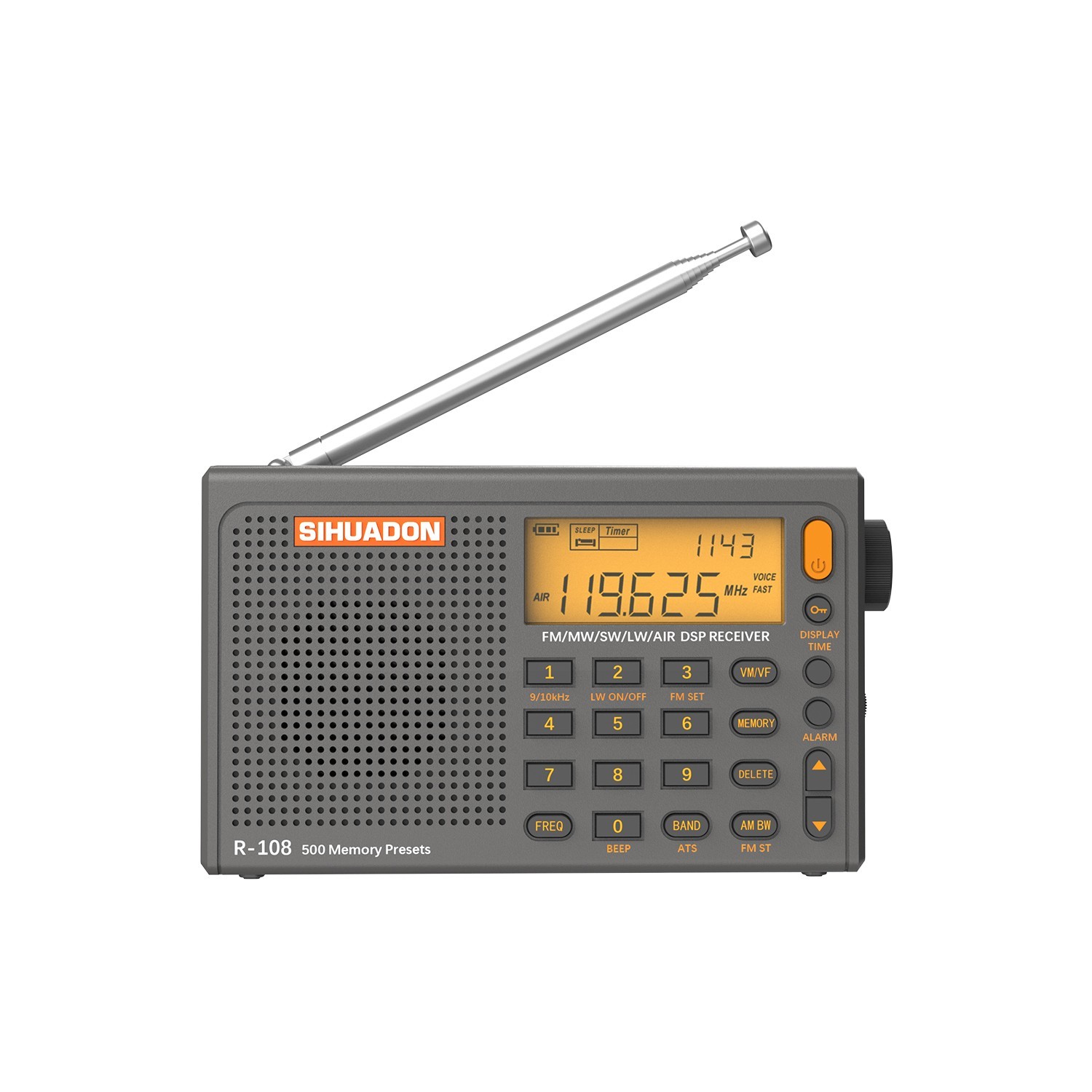

Photos from current listings. Actual item, color, and included accessories may vary.
Airband Receiver Buying Guide
Airband receivers let you monitor VHF aviation communications, but not all radios that claim 'airband' actually cover the full 108–137 MHz AM aviation band with the sensitivity and channel spacing needed for clear reception. Buyers often confuse wideband scanners with dedicated airband receivers or assume any shortwave radio will perform well on aircraft frequencies. The right choice depends on whether you need a simple portable for casual listening or a scanner with programmable banks and better selectivity.
Key takeaways
- Airband coverage requires VHF 108–137 MHz with AM demodulation; many inexpensive shortwave radios include this range but with wider filters and lower sensitivity than dedicated scanners.
- Channel spacing standard for aviation is 8.33 kHz in Europe and 25 kHz in the US; receivers with 25 kHz steps may miss channels on newer 8.33 kHz assignments.
- Sensitivity is typically specified in microvolts (µV) for 12 dB SINAD; airband receivers should achieve around 1–2 µV or better for usable range with a basic antenna.
At a glance
- Category
- Ham Radio Equipment
- Last updated
- Nov 25, 2026
Current offers
Highlights
- Airband coverage requires VHF 108–137 MHz with AM demodulation; many inexpensive shortwave radios include this range but with wider filters and lower sensitivity than dedicated scanners.
- Channel spacing standard for aviation is 8.33 kHz in Europe and 25 kHz in the US; receivers with 25 kHz steps may miss channels on newer 8.33 kHz assignments.
- Sensitivity is typically specified in microvolts (µV) for 12 dB SINAD; airband receivers should achieve around 1–2 µV or better for usable range with a basic antenna.
- Scanning speed and memory banks matter for active monitoring; dedicated scanners offer hundreds of channels and fast scan rates, while portable shortwave radios often have limited airband presets.
Best use cases
- Best fit: Casual listener near an airport who wants occasional tower/approach chatter—choose a portable shortwave radio with airband coverage and a decent telescopic antenna, like the XHDATA R108 class.
- Best fit: Enthusiast who wants to follow multiple frequencies and scan quickly—pick a dedicated airband scanner with programmable banks, 8.33 kHz spacing, and PC programming support.
- Wrong fit: Buying a basic shortwave radio expecting long-range airband reception—airband is line-of-sight VHF, so range is limited to roughly 20–50 miles depending on altitude and antenna; skip if you expect intercontinental listening.
- Wrong fit: Using a ham transceiver without airband AM receive—most amateur VHF/UHF radios do not demodulate AM, so they cannot receive aviation voice transmissions.
Buying tips
- Confirm the receiver covers 108–137 MHz with AM demodulation, not just FM; many wideband radios list airband but only in FM mode, which is useless for aviation.
- Check channel spacing: 8.33 kHz step support is essential for European listeners, while 25 kHz is sufficient for the US; avoid radios locked to 25 kHz if you plan to monitor overseas.
- Prioritize sensitivity and selectivity specs: look for around 1 µV or better for 12 dB SINAD and adjacent-channel rejection above 60 dB to handle strong local signals.
- Consider antenna options: a removable BNC or SMA antenna lets you connect an external airband antenna for better range; fixed whip antennas limit upgradeability.
Specs
| Frequency Coverage | 108–137 MHz (AM) |
|---|---|
| Channel Spacing | 25 kHz / 8.33 kHz |
| Sensitivity | ≤1–2 µV (12 dB SINAD) |
| Antenna Connector | BNC / SMA / fixed whip |
Related searches
What to check before buying
- Measure your listening location: airband is line-of-sight, so proximity to an airport (within 20–50 miles) and elevation significantly affect reception; use a rooftop or outdoor antenna if you are farther away.
- Verify power requirements: portables use AA batteries or built-in lithium-ion with USB charging; check that the included charger matches your local voltage (100–240 V) or that USB power is standard.
- Check connector type: if you plan to use an external antenna, ensure the radio has a standard BNC or SMA jack, not a proprietary or non-removable antenna.
- Confirm memory and scanning needs: if you want to monitor multiple frequencies, look for at least 100 programmable channels and a scan rate of 20+ channels per second.
FAQ
Data sources: eBay / Amazon listings and product attribute feeds. Updated Nov 25, 2026.
Some links on this page are affiliate links. If you buy after clicking one, we may earn a commission at no extra cost to you. This does not change which products appear here or their order. Affiliate disclosure.