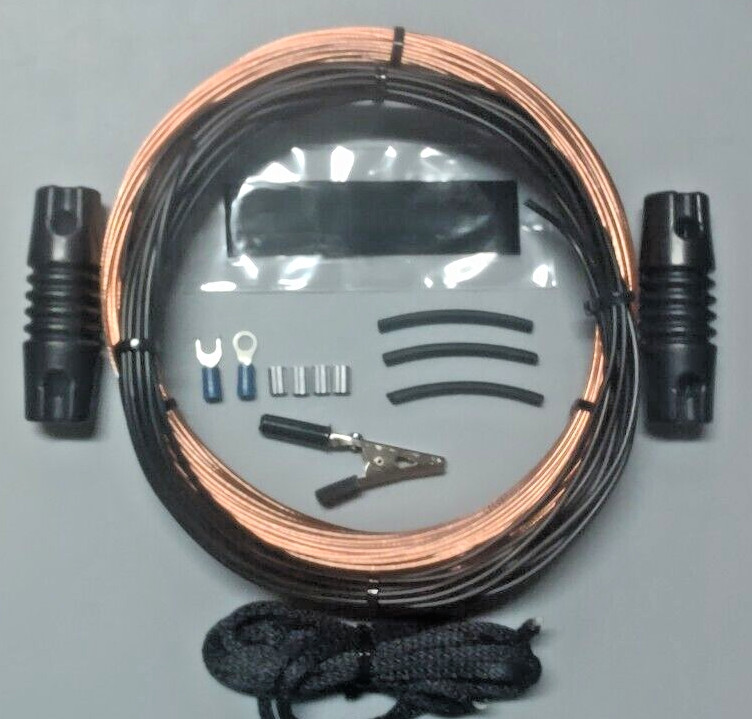

Photos from current listings. Actual item, color, and included accessories may vary.
Shortwave Antenna Buying Guide
A shortwave antenna is the passive conductor-and-transformer system that pulls weak HF signals (roughly 1.7–30 MHz) out of the air and matches them to your receiver's front end. The core trade-off is length and height versus noise pick-up: more wire equals more signal, but also more local interference unless you use a balanced feed, a common-mode choke, or a shielded active design. The decision rule is simple: choose a longwire, dipole, or active loop by your available span and noise floor—not by receiver brand—then buy the antenna that matches that geometry.
Key takeaways
- Longwire antennas are a random-length conductor typically 20–100 ft; reception improves with electrical length up to about a half-wavelength at the target band, and a 9:1 unun is the standard transformer for random-wire reception.
- Dipole and doublet designs are cut to a half-wavelength (468/f in MHz gives feet) and are inherently balanced—they reject common-mode noise without a transformer when fed with proper twin-lead or ladder line.
- Active loop and E-field whip antennas deliver wideband 1.7–30 MHz coverage in a small footprint, but their built-in preamp requires clean DC power and can overload near strong local AM/FM transmitters.
At a glance
- Category
- Ham Radio Antennas
- Last updated
- Nov 25, 2026
Current offers
Highlights
- Longwire antennas are a random-length conductor typically 20–100 ft; reception improves with electrical length up to about a half-wavelength at the target band, and a 9:1 unun is the standard transformer for random-wire reception.
- Dipole and doublet designs are cut to a half-wavelength (468/f in MHz gives feet) and are inherently balanced—they reject common-mode noise without a transformer when fed with proper twin-lead or ladder line.
- Active loop and E-field whip antennas deliver wideband 1.7–30 MHz coverage in a small footprint, but their built-in preamp requires clean DC power and can overload near strong local AM/FM transmitters.
- Bare copper longwire (as in 100 ft EZ-up kits) offers low DC resistance and easy field deployment, but bare wire requires insulators rated for the tension and a path clear of structures to avoid arcing and noise coupling.
Best use cases
- Best fit: a 100 ft bare-copper longwire with a 9:1 unun for a permanent backyard run between two trees—this gives strong low-band (160/80 m) reception where wire length matters most.
- Best fit: a pre-cut half-wavelength dipole for a single favorite band (e.g., 40 m) when you want maximum signal-to-noise on one frequency and have a flat span to hang it.
- Wrong fit to skip: an active loop or E-field whip if you are within a few hundred meters of a high-power AM broadcast tower—front-end overload will swamp weak shortwave signals; use a passive tuned loop or a dipole instead.
- Wrong fit to skip: a short 20 ft random wire if your goal is 80 m or 160 m DX—20 ft is far below a quarter-wavelength on those bands and will be inefficient without a good ground/counterpoise.
Buying tips
- Size the wire to your lowest target frequency: a quarter-wavelength at 3.5 MHz is about 67 ft, so 60–100 ft of conductor is the practical floor for 80 m reception.
- Choose a 9:1 unun for end-fed random wires and a 1:1 choke/balun for balanced dipoles; mismatching transformer ratio to antenna type raises SWR and reduces weak-signal sensitivity.
- Prefer 14–18 AWG copper or copper-clad steel for permanent outdoor runs—thinner wire stretches under wind load, while thick bare copper sags less and keeps DC resistance low.
- Terminate the receiver end with a coaxial choke (common-mode choke) to stop feedline shield pickup, which is the dominant noise source on longwire installations in suburban areas.
Specs
| Antenna Type | Longwire / Dipole / Active Loop |
|---|---|
| Frequency Coverage | 1.7–30 MHz (HF shortwave) |
| Feed Transformer | 9:1 Unun (end-fed) / 1:1 Choke (dipole) |
| Wire Gauge & Length | 14–18 AWG, 20–100 ft runs |
Related searches
What to check before buying
- Measure the longest unobstructed span between two support points (trees, poles, building corners) before choosing wire length—allow at least 10% sag and keep the wire at least 10 ft from power lines.
- Confirm your receiver's antenna input impedance and connector type (typically 50-ohm SO-239 or a high-impedance wire terminal) so the antenna's feed and transformer match without adapters.
- Check local climate and wind exposure: specify insulated or jacketed wire and UV-rated insulators if the run is permanent, and use a lightning arrestor at the entry point.
- Verify you have a ground or counterpoise path (earth rod or radial wire) for end-fed designs—without it, the coax shield becomes the antenna and noise coupling increases.
FAQ
Data sources: eBay / Amazon listings and product attribute feeds. Updated Nov 25, 2026.
Some links on this page are affiliate links. If you buy after clicking one, we may earn a commission at no extra cost to you. This does not change which products appear here or their order. Affiliate disclosure.