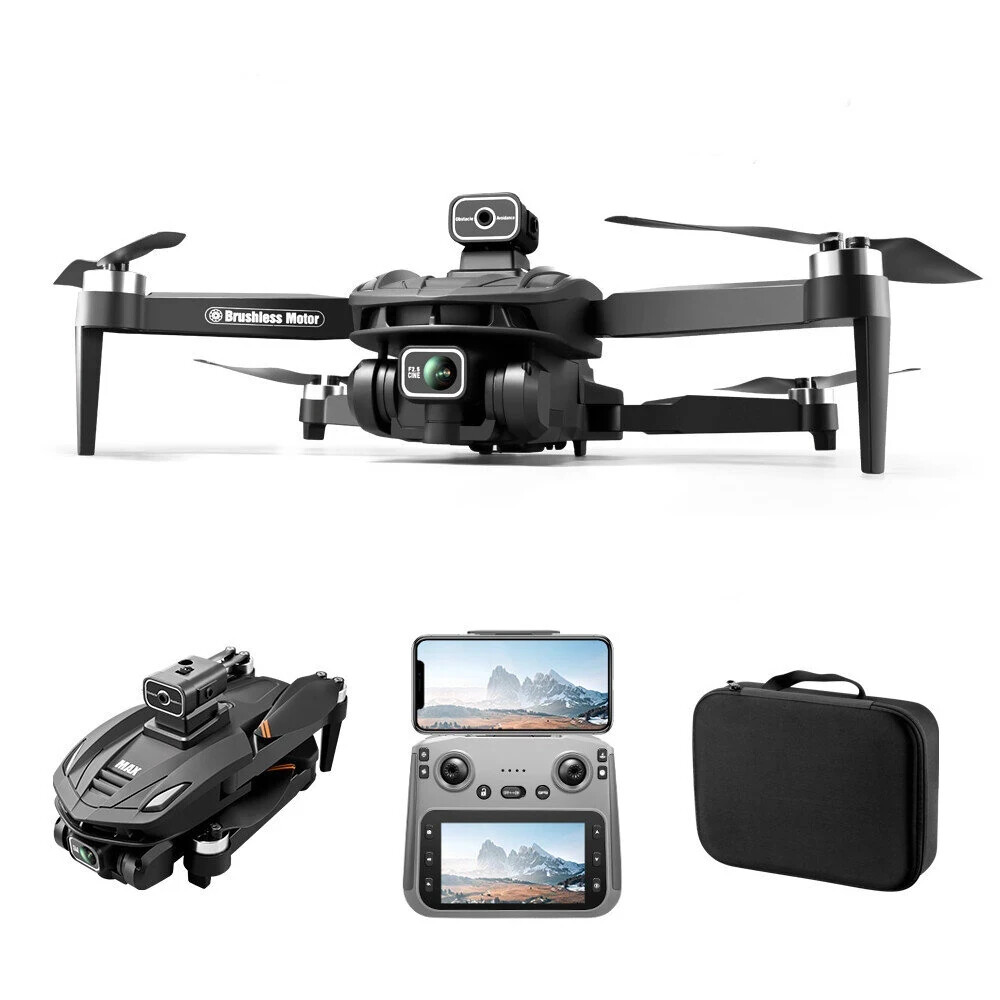

Photos from current listings. Actual item, color, and included accessories may vary.
Professional Drone With Camera And GPS Buying Guide
Professional drones with camera and GPS are GPS-stabilized quadcopters built for aerial imaging, where the decisive trade-off is sensor quality and gimbal stability versus flight time and wind resistance. A true imaging platform uses a brushless 3-axis gimbal, a 1/2.3-inch or larger sensor, and dual-band GPS; toy-grade '8K' labels on brushed motor airframes are marketing, not capability.
Median $156.89
Key takeaways
- Gimbal architecture is the real dividing line: brushless 3-axis mechanical stabilization delivers jello-free video, while electronic stabilization on fixed cameras smears detail in wind.
- Sensor size drives low-light and dynamic range more than resolution: 1/2.3-inch to 1-inch sensors with 20-48MP stills outperform tiny sensors claiming 6K-8K output.
- Dual-band GPS (GPS+GLONASS or GPS+Galileo) with optical flow and downward vision sensors enables stable hover and precise return-to-home in 10+ mph wind.
At a glance
- Category
- Drones & Consumer Robotics
- Last updated
- Nov 28, 2026
Current offers
Highlights
- Gimbal architecture is the real dividing line: brushless 3-axis mechanical stabilization delivers jello-free video, while electronic stabilization on fixed cameras smears detail in wind.
- Sensor size drives low-light and dynamic range more than resolution: 1/2.3-inch to 1-inch sensors with 20-48MP stills outperform tiny sensors claiming 6K-8K output.
- Dual-band GPS (GPS+GLONASS or GPS+Galileo) with optical flow and downward vision sensors enables stable hover and precise return-to-home in 10+ mph wind.
- Brushless motors and a 3S-4S LiPo battery class define a genuine aerial platform; brushed motors and 1S-2S packs signal a toy-grade airframe with poor wind hold.
Best use cases
- Best fit: real-estate and roof inspection work — pick a 1/2.3-inch or larger sensor with 3-axis gimbal, 25+ minute flight time, and dual-band GPS for repeatable hover shots.
- Best fit: travel and landscape stills — choose a sub-249g class with GPS and a stabilized camera to avoid registration in many jurisdictions while retaining GPS return-to-home.
- Wrong fit: buying a toy-grade '8K' labeled quadcopter for client work — brushed motors and fixed cameras cannot deliver stable footage, so skip these for any paid imaging.
- Wrong fit: flying a GPS drone in dense urban canyons expecting reliable positioning — GPS accuracy degrades near buildings; use optical-flow indoor modes instead and skip reliance on return-to-home there.
Buying tips
- Match battery capacity to real flight time: 3S-4S LiPo packs in the 2000-5000mAh range typically yield 20-35 minutes, while 1S packs under 1000mAh yield under 15 minutes.
- Check gimbal type before resolution: a 3-axis brushless gimbal with a 12MP 1/2.3-inch sensor beats a fixed 48MP camera without stabilization for video work.
- Confirm GPS constellation support: dual-band GPS+GLONASS or GPS+Galileo holds position better than GPS-only, which drifts in obstructed or high-interference areas.
- For sub-249g travel use, verify the all-up weight including battery and prop guards; adding guards or a larger battery can push a 249g-class drone over the registration threshold.
Specs
| Gimbal Type | 3-axis brushless vs fixed electronic |
|---|---|
| Sensor Class | 1/2.3-inch to 1-inch / 20-48MP |
| GPS Bands | Dual-band GPS+GLONASS vs GPS-only |
| Flight Time | 20-35 min (3S-4S LiPo 2000-5000mAh) |
Related searches
What to check before buying
- Measure your carrying case and backpack dimensions against the folded airframe size; professional drones rarely fold below 8-10 inches in their smallest dimension.
- Confirm your country's registration and remote-ID rules: drones at or above 250g typically require registration, and the 249g class is chosen specifically to stay below that line.
- Check local airspace and geofencing: GPS drones rely on firmware geofences, so verify your flying sites are not inside restricted zones before committing to a model.
- Verify your phone or tablet mounts and app compatibility — professional GPS drones require a companion app for waypoints and camera control, and iOS/Android support varies by generation.
FAQ
Data sources: eBay / Amazon listings and product attribute feeds. Updated Nov 28, 2026.
Some links on this page are affiliate links. If you buy after clicking one, we may earn a commission at no extra cost to you. This does not change which products appear here or their order. Affiliate disclosure.