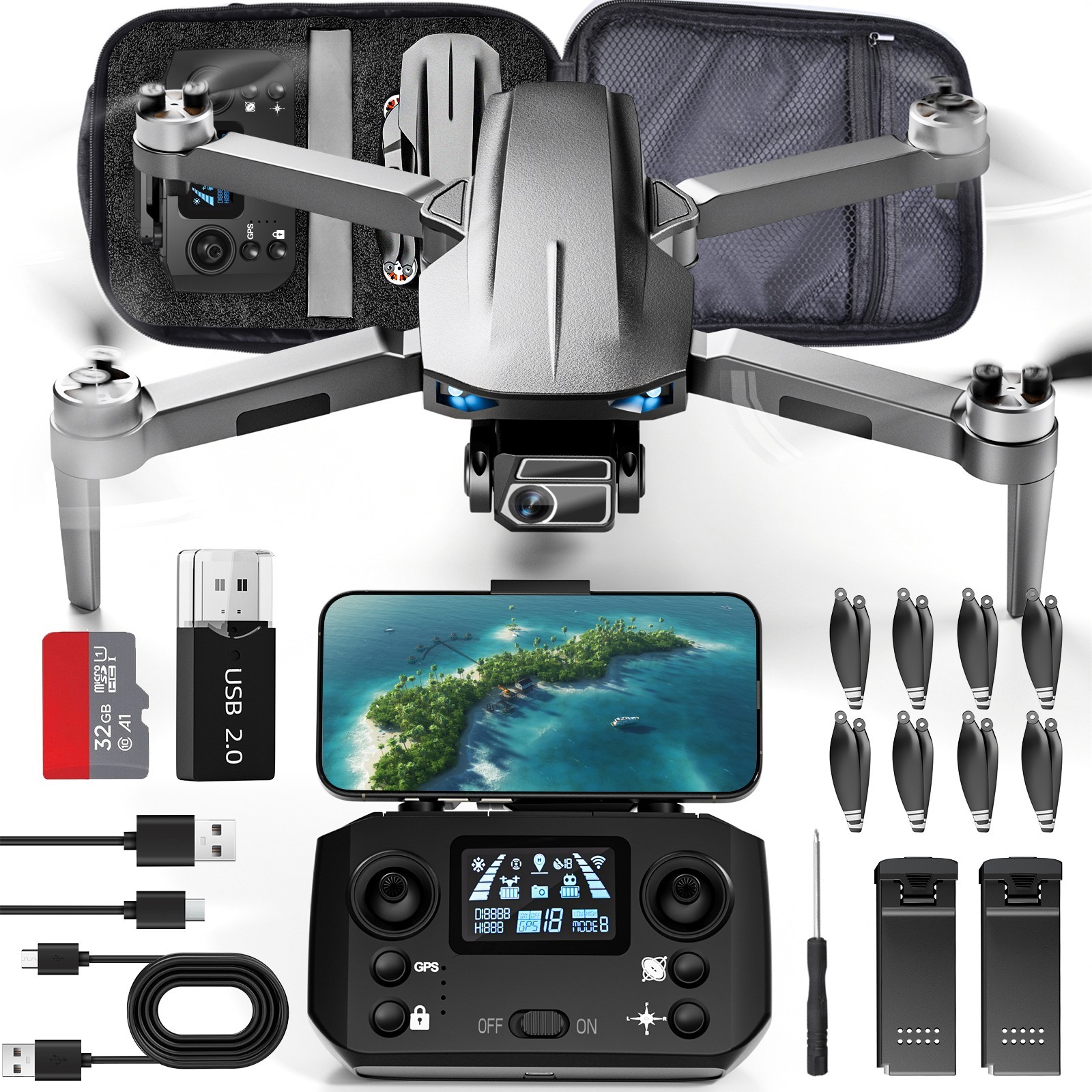

Photos from current listings. Actual item, color, and included accessories may vary.
Beginner Drone With Camera And GPS Buying Guide
A beginner drone with camera and GPS combines a stabilized camera, satellite navigation for position hold and return-to-home, and simplified flight modes. The core trade-off is GPS reliability and camera stabilization versus toy-grade drift and shaky footage, so buyers should prioritize a true GPS module and brushless gimbal over inflated resolution claims. The decision rule is simple: choose a model with explicit GPS/GLONASS, brushless motors, and a mechanical gimbal; skip anything marketed only by WiFi range and 4K interpolation.
Key takeaways
- True GPS drones use multi-constellation receivers (GPS + GLONASS) enabling position hold, return-to-home, and follow-me; toy drones rely on optical flow only and drift indoors.
- A mechanical 2-axis or 3-axis gimbal stabilizes footage; electronic image stabilization alone produces jello and rolling-shutter artifacts in wind.
- Foldable arms reduce packed volume for transport but add hinge wear points; fixed-arm designs are more rigid for beginners learning in wind.
At a glance
- Category
- Drones & Consumer Robotics
- Last updated
- Nov 28, 2026
Current offers
Highlights
- True GPS drones use multi-constellation receivers (GPS + GLONASS) enabling position hold, return-to-home, and follow-me; toy drones rely on optical flow only and drift indoors.
- A mechanical 2-axis or 3-axis gimbal stabilizes footage; electronic image stabilization alone produces jello and rolling-shutter artifacts in wind.
- Foldable arms reduce packed volume for transport but add hinge wear points; fixed-arm designs are more rigid for beginners learning in wind.
Best use cases
- Best fit: open-field beginners wanting stable photos and safe return-to-home should pick a GPS drone with brushless motors, a 2-axis gimbal, and 20+ minute real flight time.
- Wrong fit: indoor or tight-yard flyers should skip GPS models entirely—GPS lock fails under roofs and trees, causing drift or flyaway; choose a sub-250g optical-flow drone instead.
- Best fit: travel vloggers under 250g should prioritize a foldable GPS drone with a 3-axis gimbal and USB-C charging to stay under registration thresholds in many regions.
- Wrong fit: buyers expecting cinematic 4K from a single-lens budget drone should skip models advertising '4K' via interpolation; insist on native sensor resolution and a gimbal.
Buying tips
- Require explicit GPS + GLONASS in the spec list; 'GPS' alone without a constellation named often means a barometer or optical-flow substitute.
- Check motor type: brushless motors are rated in KV and last hundreds of flights; brushed motors wear out in tens of flights and cause altitude loss.
- Match battery capacity to claimed flight time conservatively—real flight is roughly 60-70% of marketing claims, so a 25-minute claim yields about 15-18 minutes.
- Verify gimbal type: a 2-axis mechanical gimbal stabilizes pitch and roll; 3-axis adds yaw and is required for smooth panning video.
Specs
| Navigation | GPS + GLONASS vs optical flow only |
|---|---|
| Motor Type | Brushless vs brushed DC |
| Gimbal | 2-axis / 3-axis mechanical vs EIS |
| Weight Class | Sub-250g vs above 250g |
Related searches
What to check before buying
- Confirm your local registration threshold—many regions require registration above 250g, so a sub-250g GPS drone avoids paperwork for beginners.
- Measure your flying area: GPS drones need 10+ satellite locks and 30+ meters of open clearance; small yards and dense neighborhoods cause return-to-home errors.
- Check phone compatibility for the controller app—most beginner GPS drones require a 5GHz-capable phone and a specific app version for live map and firmware updates.
- Verify included accessories: spare propellers, a propeller guard, and at least one extra battery are essential beginner parts that are often sold separately.
FAQ
Data sources: eBay / Amazon listings and product attribute feeds. Updated Nov 28, 2026.
Some links on this page are affiliate links. If you buy after clicking one, we may earn a commission at no extra cost to you. This does not change which products appear here or their order. Affiliate disclosure.