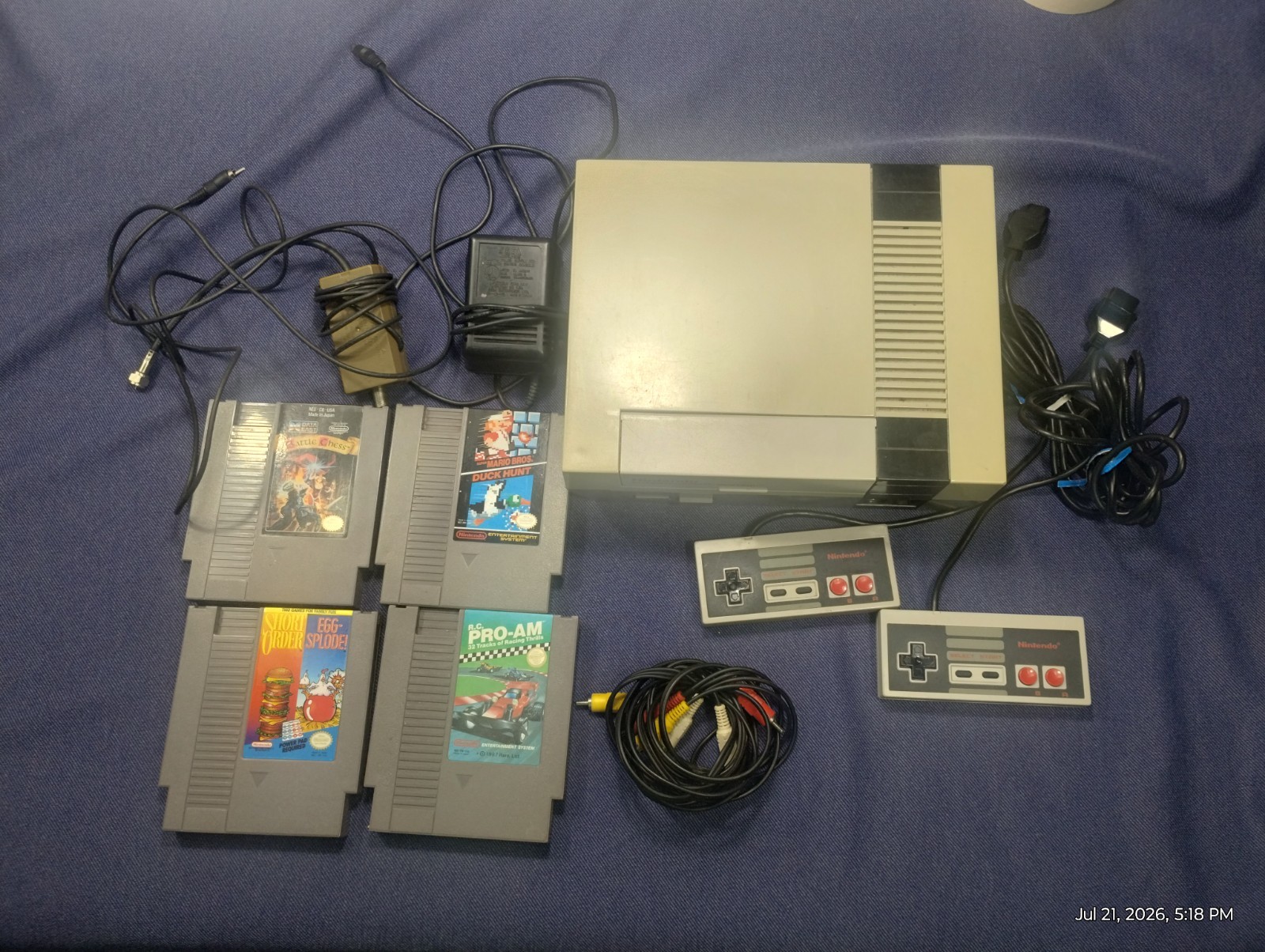

Photos from current listings. Actual item, color, and included accessories may vary.
Nintendo Vintage Console Buying Guide
Buying a vintage Nintendo console means choosing between the original NES, the top-loading NES-101, the SNES, and later retron-compatible clones—each with distinct cartridge slots, AV outputs, and reliability quirks. Most first-time buyers underestimate how much the front-loading NES's 72-pin connector and the SNES's aging capacitors affect daily playability. Focus on the exact model generation and cartridge compatibility, not cosmetic condition, because a clean-looking console with a worn connector will still blink.
Key takeaways
- Front-loading NES (NES-001) uses a zero-insertion-force 72-pin connector that wears out and causes the blinking screen; top-loading NES-101 uses a simpler straight-in slot for far better reliability.
- Original NES outputs RF only; NES-101 and SNES add composite AV, and the SNES also supports S-Video on early 1-chip models for sharper output on modern displays.
- Yobo and similar clone consoles accept NES and Genesis cartridges in one shell but often lack proper audio mixing and use NOAC (NES-on-a-chip) emulation with imperfect compatibility.
At a glance
- Category
- Console & Handheld Hardware
- Last updated
- Nov 29, 2026
Current offers
Highlights
- Front-loading NES (NES-001) uses a zero-insertion-force 72-pin connector that wears out and causes the blinking screen; top-loading NES-101 uses a simpler straight-in slot for far better reliability.
- Original NES outputs RF only; NES-101 and SNES add composite AV, and the SNES also supports S-Video on early 1-chip models for sharper output on modern displays.
- Yobo and similar clone consoles accept NES and Genesis cartridges in one shell but often lack proper audio mixing and use NOAC (NES-on-a-chip) emulation with imperfect compatibility.
- Original Nintendo hardware uses a 5V DC barrel jack with center-negative polarity; check the PSU label because reversed polarity or wrong voltage destroys the console instantly.
Best use cases
- Pick a top-loading NES-101 if you actually want to play NES cartridges regularly—the straight-in slot avoids the blinking-light ritual and the composite output works with modern TVs via an adapter.
- Choose an original front-loading NES-001 only if you want authentic 1985 aesthetics or plan to replace the 72-pin connector yourself; skip it if you are not comfortable with minor repairs.
- Buy a Yobo-style twin console only for casual nostalgia across NES and Genesis carts, but skip it if you care about accurate sound, savestates, or original hardware feel on a CRT.
- Avoid any vintage console bundle sold as 'tested' without a photo of the game actually running—working power and clean cartridges prove far more than a cosmetic listing.
Buying tips
- Prioritize the exact model number: NES-001 is front-loading, NES-101 is top-loading, and SNS-001 is the standard SNES—each uses different connectors, AV cables, and power supplies.
- Inspect the 72-pin connector on any front-loading NES; a replacement connector costs little but requires opening the shell, so factor that into condition grading.
- Check the power supply label for 5V DC center-negative output; missing or third-party PSUs are the most common cause of dead-on-arrival vintage consoles.
- Choose composite AV models over RF-only units whenever possible—RF modulators drift with age and produce fuzzy, rolling images on modern flat panels.
Specs
| Model Generation | NES-001 / NES-101 / SNS-001 |
|---|---|
| Cartridge Slot | 72-pin front-load vs straight-in |
| Video Output | RF / Composite / S-Video |
| Power Input | 5V DC center-negative barrel |
Related searches
What to check before buying
- Confirm your TV has composite, S-Video, or an HDMI upscaler path; RF-only output will not tune on most flat panels without an external modulator.
- Measure shelf or entertainment-center depth for the front-loading NES, which needs extra clearance for the cartridge door to swing open.
- Verify the listing includes the correct original power supply and AV cable—replacement PSUs are cheap but wrong polarity is a common failure.
- Check cartridge slot type before buying a bundle: NES, SNES, and Genesis carts are not interchangeable across original consoles.
FAQ
Data sources: eBay / Amazon listings and product attribute feeds. Updated Nov 29, 2026.
Some links on this page are affiliate links. If you buy after clicking one, we may earn a commission at no extra cost to you. This does not change which products appear here or their order. Affiliate disclosure.