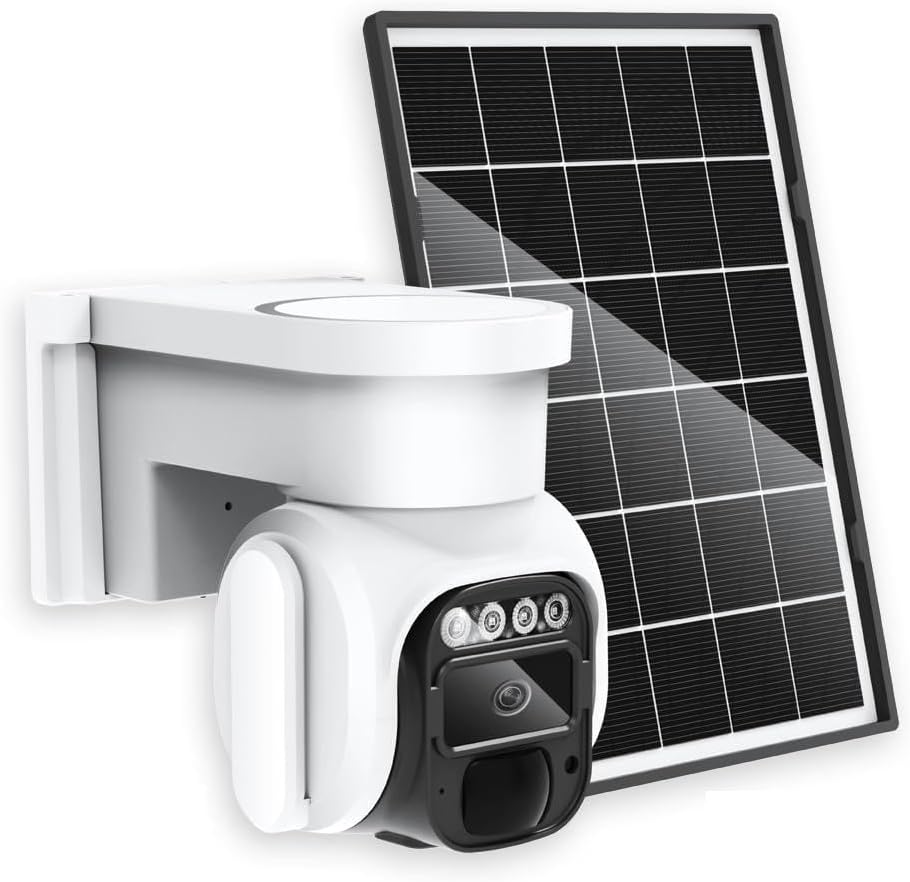

Photos from current listings. Actual item, color, and included accessories may vary.
Solar Outdoor Security Camera Buying Guide
Solar outdoor security cameras combine a photovoltaic panel, an internal lithium battery, and a Wi-Fi or 4G LTE radio to deliver untethered surveillance without trenching power cable. The core trade-off is between continuous-charge headroom (panel wattage vs. camera duty cycle) and radio architecture (Wi-Fi for LAN coverage, LTE for fully off-grid sites). Choose a camera whose solar panel and battery can sustain your required recording/streaming load through winter, not one that merely claims 'solar powered'.
Key takeaways
- Radio architecture splits into 2.4 GHz Wi-Fi (needs router coverage; lower recurring cost) and 4G LTE (needs a SIM data plan; works with zero network infrastructure).
- Panel sizing rule: a 5–6 W panel sustains roughly 10–20 motion events per day; 8–10 W panels are required for continuous or heavy pan/tilt usage.
- Battery chemistry matters: LiFePO4 cells tolerate wider temperature ranges and more charge cycles than standard Li-ion, extending outdoor service life.
At a glance
- Category
- Smart Home Electronics
- Last updated
- Nov 28, 2026
Current offers
Highlights
- Radio architecture splits into 2.4 GHz Wi-Fi (needs router coverage; lower recurring cost) and 4G LTE (needs a SIM data plan; works with zero network infrastructure).
- Panel sizing rule: a 5–6 W panel sustains roughly 10–20 motion events per day; 8–10 W panels are required for continuous or heavy pan/tilt usage.
- Battery chemistry matters: LiFePO4 cells tolerate wider temperature ranges and more charge cycles than standard Li-ion, extending outdoor service life.
- Pan/tilt motors increase standby drain; fixed-lens cameras typically achieve longer solar autonomy per watt than 360° motorized units.
Best use cases
- Best fit: suburban home with strong 2.4 GHz Wi-Fi at the mount point — choose a Wi-Fi solar camera with 2K resolution and PIR triggering to avoid 24/7 streaming drain.
- Best fit: remote gate, barn, or construction site with no power or internet — choose a 4G LTE solar camera with included SIM and local SD recording.
- Wrong fit: a location with less than 4 hours of direct winter sun — a solar-only camera will deplete; choose a wired or PoE camera instead.
- Wrong fit: monitoring a high-traffic porch requiring continuous recording — solar/battery cameras are event-triggered; select a wired mains or PoE system for 24/7 footage.
Buying tips
- Match panel wattage to duty cycle: require at least 5 W for standard PIR-triggered use and 8–10 W for pan/tilt or frequent live viewing.
- Confirm the camera records to a microSD card locally; cloud-only models incur recurring fees and fail without uplink.
- For Wi-Fi models, verify 2.4 GHz band support and plan for a signal strength of -70 dBm or better at the camera location; 5 GHz-only routers need a 2.4 GHz access point.
- For LTE models, check band compatibility with your carrier and budget for a data SIM; 2K event clips typically consume 300–500 MB per month under normal traffic.
Specs
| Radio Type | 2.4 GHz Wi-Fi vs 4G LTE |
|---|---|
| Solar Panel | 5–10 W monocrystalline |
| Battery Type | LiFePO4 vs Li-ion, 8,000–15,000 mAh |
| Resolution | 1080p / 2K / 4K |
Related searches
What to check before buying
- Measure the mounting location for at least 4 hours of direct sunlight daily, especially in December; shade reduces panel output by 50% or more.
- Confirm Wi-Fi signal at the mount point using a phone speed test; walls and metal siding attenuate 2.4 GHz significantly.
- Verify the camera's operating temperature range covers your local winter minimum; LiFePO4 models generally handle -20°C better than Li-ion.
- Check that the package includes the required mount, screws, and for LTE models a compatible SIM or clear BYO-SIM instructions.
FAQ
Data sources: eBay / Amazon listings and product attribute feeds. Updated Nov 28, 2026.
Some links on this page are affiliate links. If you buy after clicking one, we may earn a commission at no extra cost to you. This does not change which products appear here or their order. Affiliate disclosure.