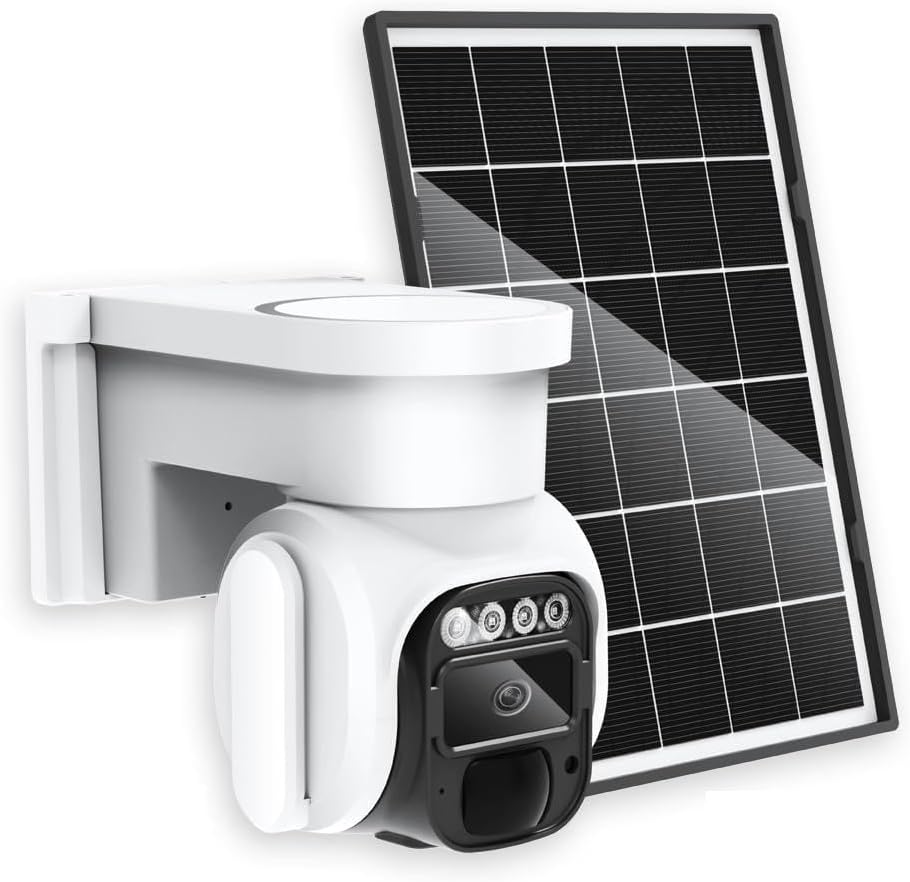

Photos from current listings. Actual item, color, and included accessories may vary.
Solar Outdoor Camera Buying Guide
Solar outdoor cameras pair a photovoltaic panel with an internal lithium battery to deliver untethered surveillance, so the core trade-off is panel wattage and battery capacity versus sustained recording and night-vision load. The decision rule is simple: buy an integrated panel rated for at least 3W with a battery of 5000mAh or more for daily motion events, and step up to 6W+ and 10000mAh for continuous or high-traffic coverage.
Key takeaways
- Integrated vs detached solar panels: all-in-one units simplify mounting but limit panel angle; detached panels allow optimal south-facing tilt and longer cable runs.
- Cellular (4G LTE) models need a nano-SIM and data plan, while Wi-Fi models require 2.4GHz coverage at the camera location; 5GHz is not supported on most budget units.
- 2K (2560x1440) sensors with color night vision use an IR-cut filter plus white LEDs, drawing more power than 1080p IR-only models and reducing battery runtime.
At a glance
- Category
- Smart Home Electronics
- Last updated
- Nov 28, 2026
Current offers
Highlights
- Integrated vs detached solar panels: all-in-one units simplify mounting but limit panel angle; detached panels allow optimal south-facing tilt and longer cable runs.
- Cellular (4G LTE) models need a nano-SIM and data plan, while Wi-Fi models require 2.4GHz coverage at the camera location; 5GHz is not supported on most budget units.
- 2K (2560x1440) sensors with color night vision use an IR-cut filter plus white LEDs, drawing more power than 1080p IR-only models and reducing battery runtime.
- PIR motion detection triggers recording; continuous recording is rare on solar models because panel output cannot sustain 24/7 write load without a large external panel.
Best use cases
- Best fit: rural or remote property with no Wi-Fi — choose a 4G LTE model with included SIM and SD card for standalone 2K coverage.
- Best fit: suburban yard with strong 2.4GHz Wi-Fi — choose a Wi-Fi pan/tilt solar camera with 360° coverage and 5000mAh+ battery for event-based recording.
- Wrong fit: continuous 24/7 recording — solar cameras rely on PIR-triggered clips; pick a wired PoE camera instead.
- Wrong fit: deep shade or north-facing wall — panel output drops below maintenance threshold; select a detached panel with a 3m cable or a wired model.
Buying tips
- Match panel wattage to use: 3W panel supports roughly 20-30 motion events per day at 2K; 6W+ needed for high-traffic driveways or 24/7 live-view habits.
- Battery capacity rule: 5000mAh gives 2-3 months typical event use; 10000mAh doubles that — check the mAh rating, not just 'long standby' claims.
- For cellular models, confirm LTE band support for your carrier (B2/B4/B5/B12/B13 for US AT&T/T-Mobile/Verizon) and that the SIM slot is nano-size.
- Choose IP65 or higher for outdoor mounting; IP66 adds dust protection for agricultural or dusty environments. Metal housings resist UV cracking better than ABS plastic.
Specs
| Connectivity | Wi-Fi 2.4GHz / 4G LTE |
|---|---|
| Resolution | 1080p / 2K / 4K |
| Panel + Battery | 3-6W panel / 5000-10000mAh |
| Weather Rating | IP65 / IP66 |
Related searches
What to check before buying
- Mounting surface: verify wall or eave can hold the camera plus panel weight (typically 0.5-1.5 kg) and that the panel faces south (northern hemisphere) with 4+ hours direct sun.
- Wi-Fi coverage: measure 2.4GHz signal strength at the mount point; below -70 dBm causes dropouts. Cellular models need LTE signal of -100 dBm or better.
- Power budget: confirm the panel cable length reaches from panel to camera (often 1-3m) and that the camera supports USB-C or DC barrel charging for top-ups.
- Companion parts: for cellular models, budget for a data SIM plan; for Wi-Fi models, ensure a microSD card (up to 128GB, Class 10) is included or purchased.
FAQ
Data sources: eBay / Amazon listings and product attribute feeds. Updated Nov 28, 2026.
Some links on this page are affiliate links. If you buy after clicking one, we may earn a commission at no extra cost to you. This does not change which products appear here or their order. Affiliate disclosure.