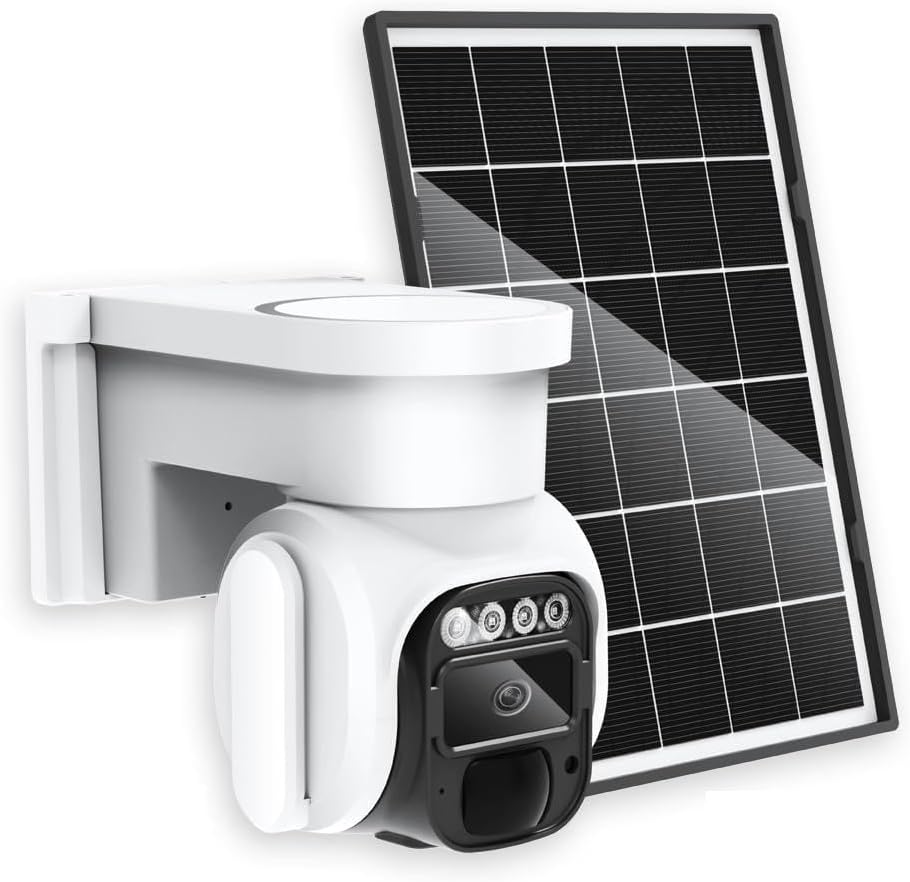

Photos from current listings. Actual item, color, and included accessories may vary.
Solar Camera Buying Guide
Solar cameras are outdoor security units pairing a solar panel with an internal battery and wireless radio (Wi‑Fi or 4G LTE) to deliver untethered surveillance. The core trade-off is panel wattage and battery capacity against camera feature load—pan/tilt motors and constant 2K streaming drain power that a small panel cannot replace. Buy a panel‑to‑battery ratio sized for continuous operation with margin; treat undersized panels and low‑grade plastics as the compromise tier.
Key takeaways
- Solar panel output of 5W–8W with a 10,000–20,000mAh battery sustains a fixed 2K camera through 3–5 overcast days; pan/tilt models need 8W–12W and 15,000mAh+ to avoid dormancy.
- 4G LTE models bypass Wi‑Fi range limits but require an active nano‑SIM data plan; Wi‑Fi models need 2.4GHz coverage at the mount (5GHz is not supported on most battery cameras).
- PIR (passive infrared) detection is the battery‑efficient standard; continuous recording or AI person/vehicle detection without PIR dramatically shortens runtime.
At a glance
- Category
- Smart Home Electronics
- Last updated
- Nov 28, 2026
Current offers
Highlights
- Solar panel output of 5W–8W with a 10,000–20,000mAh battery sustains a fixed 2K camera through 3–5 overcast days; pan/tilt models need 8W–12W and 15,000mAh+ to avoid dormancy.
- 4G LTE models bypass Wi‑Fi range limits but require an active nano‑SIM data plan; Wi‑Fi models need 2.4GHz coverage at the mount (5GHz is not supported on most battery cameras).
- PIR (passive infrared) detection is the battery‑efficient standard; continuous recording or AI person/vehicle detection without PIR dramatically shortens runtime.
- IP65 is the minimum weather rating for exposed mounting; IP66/IP67 adds resistance to driven rain and dust. Metal housings resist UV yellowing and heat better than ABS plastic.
Best use cases
- Best fit: remote gates, barns, or lots beyond Wi‑Fi range—choose a 4G LTE model with SIM slot and 8W+ panel; skip Wi‑Fi‑only units where signal cannot reach.
- Best fit: wide yard or driveway coverage—pick a pan/tilt 2K model with 355° pan and 90°+ tilt, but only with 10W panel and 15,000mAh+ battery to offset motor drain.
- Best fit: fixed entry or side‑gate watch—a fixed‑lens 2K camera with 5W panel and 10,000mAh battery is sufficient and less expensive; skip pan/tilt if coverage angle is already adequate.
- Wrong fit: shaded north‑facing walls or dense tree canopy—solar yield collapses; use a wired power over Ethernet (PoE) camera instead of a solar model.
Buying tips
- Sizing rule: match panel wattage to daily consumption—fixed 2K camera draws roughly 3–5Wh/day; a 5W panel yields 15–25Wh/day in 3–5 peak sun hours, leaving margin for cloudy days.
- Battery rule: capacity in mAh ÷ camera average draw (mA) = runtime hours without sun; choose 10,000mAh+ for fixed models and 15,000mAh+ for pan/tilt to cover 3+ overcast days.
- Connectivity rule: Wi‑Fi models require 2.4GHz band and −70dBm or better signal at the mount; 4G models need a nano‑SIM with a data plan and LTE band support for your carrier.
- Weather/material rule: specify IP65 minimum, IP66 preferred, and metal or UV‑stabilized housing; avoid unrated plastic domes that cloud and crack under UV within a season.
Specs
| Connectivity | Wi-Fi 2.4GHz vs 4G LTE (SIM) |
|---|---|
| Solar Panel & Battery | 5-12W panel / 10,000-20,000mAh |
| Resolution & Night | 1080p-2K; IR or color night vision |
| Weather & Housing | IP65-IP67; metal or UV plastic |
Related searches
What to check before buying
- Measure mounting height and panel cable run—most solar panels include 3m (10ft) cable; confirm the panel can face true south (northern hemisphere) with no shade from 9am–3pm.
- Check Wi‑Fi RSSI at the exact mount point on a phone (2.4GHz) or confirm LTE band coverage for your carrier before choosing the radio type.
- Confirm the camera accepts the storage you will use: microSD up to the stated class/capacity, or an NVR/cloud plan; 4G models often bundle a SIM and SD but verify data plan terms.
- Verify power‑up temperature range (often −20°C to 50°C) and that the mount surface (wall, eave, pole) and included hardware match your structure.
FAQ
Data sources: eBay / Amazon listings and product attribute feeds. Updated Nov 28, 2026.
Some links on this page are affiliate links. If you buy after clicking one, we may earn a commission at no extra cost to you. This does not change which products appear here or their order. Affiliate disclosure.