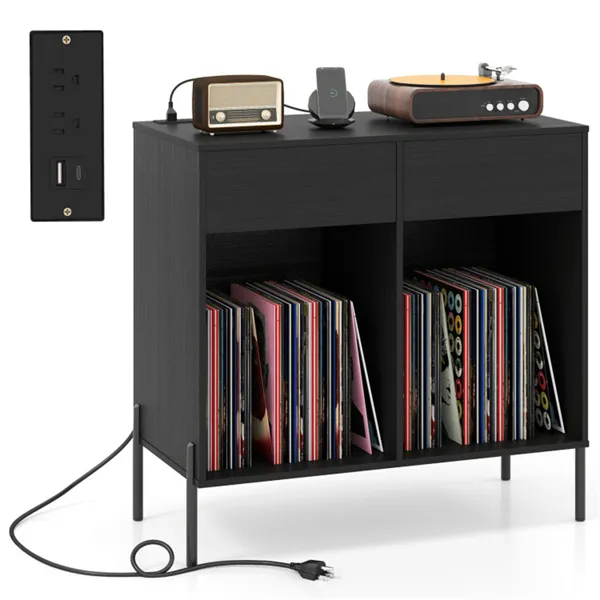

Photos from current listings. Actual item, color, and included accessories may vary.
Record Stand With Storage Buying Guide
A record stand with storage is a furniture piece that elevates a turntable to listening height while housing LPs, cleaning tools, and accessories. The primary trade-off is between open display (fast access, dust exposure) and enclosed cabinetry (protection, heavier build); cheap stands often use thin MDF and undersized legs that wobble at volume. The decision rule: buy a stand rated for at least the combined weight of your turntable plus 50–80 records, with a top surface at least 2 inches larger than the turntable footprint per side, or skip it.
Key takeaways
- Load-rated capacity is the key metric: a stand holding 250 LPs must support roughly 80–100 lb of records alone (each LP ~0.5–0.6 lb), so look for solid wood or 18mm+ MDF with metal cross-bracing.
- Turntable isolation matters: stands with adjustable floor-protecting pads or rubber feet reduce vibration transfer; flimsy 15mm particleboard shelves resonate audibly at moderate volume.
- Storage architecture options are open cube (fast flip-through, dust-prone), drawer (dust protection, slower access), and divided vertical slots (display-forward, low capacity).
At a glance
- Category
- Record Storage & Accessories
- Last updated
- Nov 28, 2026
Current offers
Highlights
- Load-rated capacity is the key metric: a stand holding 250 LPs must support roughly 80–100 lb of records alone (each LP ~0.5–0.6 lb), so look for solid wood or 18mm+ MDF with metal cross-bracing.
- Turntable isolation matters: stands with adjustable floor-protecting pads or rubber feet reduce vibration transfer; flimsy 15mm particleboard shelves resonate audibly at moderate volume.
- Storage architecture options are open cube (fast flip-through, dust-prone), drawer (dust protection, slower access), and divided vertical slots (display-forward, low capacity).
- Power integration (built-in outlets/USB) is a convenience tier—confirm the stand's outlet module is UL/ETL listed and positioned away from the platter to avoid hum.
Best use cases
- Best fit: a dedicated listening corner in a living room—pick a 250-LP-capacity stand with a top wide enough for a full-size turntable plus a receiver, and open cubes for quick flipping.
- Best fit: small apartments or bedrooms—choose a compact stand with vertical record slots and a drawer to hide cables and cleaning brushes, accepting lower capacity (~50–80 LPs).
- Wrong fit: heavy audiophile setups with a 30+ lb turntable and outboard phono stage—skip thin MDF stands and choose solid hardwood or steel-frame units rated well above the combined load.
Buying tips
- Measure your turntable's footprint including the dust cover when open, then add 4 inches of clearance on all sides; the stand top should be at least that size.
- Calculate record weight: 100 LPs ≈ 55 lb, so a 250-LP stand needs a shelf rating of 140 lb+ with mid-span support to avoid sag over time.
- Match storage style to climate: in humid rooms, enclosed drawers protect sleeves from warping; in dry climates, open cubes are fine and cheaper.
- Check leg and joint construction: metal legs with locking bolts or solid wood dowels outperform stapled particleboard joints, which loosen after repeated moves.
Specs
| Storage Capacity | 50–250 LPs open cube / drawer |
|---|---|
| Top Load Rating | 30–80 lb (turntable + gear) |
| Build Material | Solid wood / 18mm MDF / steel frame |
| Power Module | Optional UL/ETL-listed outlets + USB |
Related searches
What to check before buying
- Measure your turntable's width, depth, and open-lid height, plus the stand's top surface dimensions—allow at least 2 inches of overhang per side for stability.
- Confirm the stand's height puts the platter at elbow level when seated (typically 28–32 inches) to avoid skipping from heavy-handed cueing.
- Verify the stand's outlet module (if included) matches your country's plug standard and is ETL/UL listed; avoid unlisted power strips bolted to furniture.
- Check floor type: carpet needs wider floor-protecting pads or spikes; hardwood needs soft rubber pads to prevent scratching and vibration coupling.
FAQ
Data sources: eBay / Amazon listings and product attribute feeds. Updated Nov 28, 2026.
Some links on this page are affiliate links. If you buy after clicking one, we may earn a commission at no extra cost to you. This does not change which products appear here or their order. Affiliate disclosure.