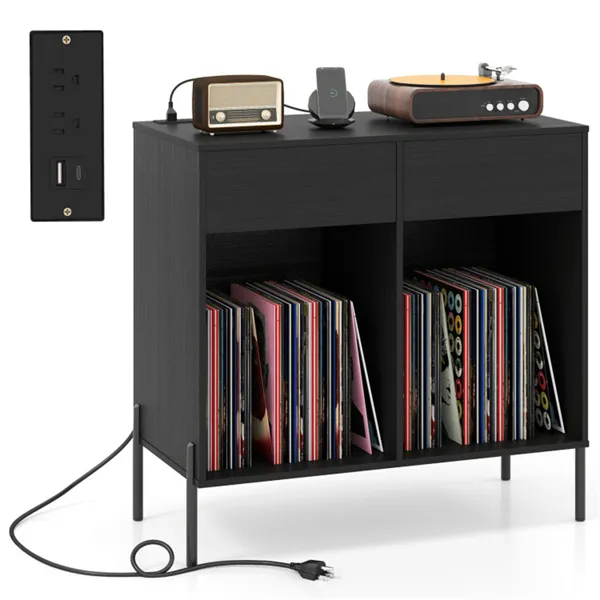

Photos from current listings. Actual item, color, and included accessories may vary.
Record Player Stand With Storage Buying Guide
A record player stand with storage is a furniture piece that elevates and isolates a turntable while integrating vinyl record shelving, drawers, or compartments. The core trade-off is between structural rigidity—critical for minimizing vibration and supporting heavy vinyl loads—and storage efficiency, where open cubbies maximize capacity but expose records to dust, while drawers and doors protect them at the cost of quick access. The clear decision rule: prioritize a stand with a solid, thick top and a weight-rated shelf system sized to your collection, and skip any unit that uses thin MDF or lacks a center support leg for spans over 30 inches.
Key takeaways
- Load capacity is governed by shelf span and material: particleboard or MDF shelves sag beyond 24–30 inches unsupported, while solid wood or metal frames with center supports handle 50+ lbs per shelf reliably.
- Vinyl storage density: a standard 12-inch LP occupies about 0.12–0.15 inches of shelf width, so a 30-inch-wide cubby holds roughly 200–250 albums when packed vertically.
- Turntable isolation depends on top mass and leg design: a 1-inch-thick top on four splayed legs with floor-protecting pads reduces footfall vibration better than a hollow-core top on a single pedestal.
At a glance
- Category
- Record Storage & Accessories
- Last updated
- Nov 28, 2026
Current offers
Highlights
- Load capacity is governed by shelf span and material: particleboard or MDF shelves sag beyond 24–30 inches unsupported, while solid wood or metal frames with center supports handle 50+ lbs per shelf reliably.
- Vinyl storage density: a standard 12-inch LP occupies about 0.12–0.15 inches of shelf width, so a 30-inch-wide cubby holds roughly 200–250 albums when packed vertically.
- Turntable isolation depends on top mass and leg design: a 1-inch-thick top on four splayed legs with floor-protecting pads reduces footfall vibration better than a hollow-core top on a single pedestal.
- Built-in charging stations and power outlets are convenience features that add wiring but do not affect structural performance—choose them only if cable management is a priority.
Best use cases
- Best fit: a dedicated listening room with 200+ records—pick a wide, low sideboard-style stand with adjustable or fixed vertical dividers and a center support leg, skipping open-back units that let records slide out.
- Wrong fit: a small apartment with a compact collection and frequent moving—skip heavy solid-wood consoles and choose a metal-legged, knock-down unit with a compact footprint under 36 inches wide.
- Best fit: a turntable with a dust cover and external phono stage—choose a stand with a top surface at least 18 inches deep and a rear cable cutout, skipping narrow nightstand-style units that force the cover to overhang.
- Wrong fit: a household with climbing pets or toddlers—skip open cubbies at floor level and pick a model with doors or drawers that latch, or wall-mount the unit above reach.
Buying tips
- Measure your turntable's footprint including the dust cover hinge—add at least 2 inches of clearance on all sides—and ensure the stand top depth is at least 16 inches for most belt-drive decks.
- Calculate record capacity: multiply shelf width in inches by 6.5 to estimate LP count for vertically stored albums, then derate by 15% for dividers and loose packing.
- For spans wider than 30 inches, require a center leg or a shelf thickness of at least 0.75 inches in plywood or 1 inch in MDF to prevent sag under vinyl weight.
- Check leg material and floor protection: metal legs should have adjustable leveling feet or rubber pads, and wood legs need felt glides to avoid scratching hardwood or tile.
Specs
| Storage Type | Open cubbies / Drawers / Doors |
|---|---|
| Record Capacity | 100–750 LPs (by width) |
| Top Material | MDF / Plywood / Solid wood |
| Leg & Support | Metal splayed / Wood / Center leg |
Related searches
What to check before buying
- Room fit: measure the intended wall space and door swing—allow 24 inches of clearance in front of drawers and 12 inches above the turntable for the dust cover to open fully.
- Floor and climate: solid wood stands expand in high humidity and may warp; sealed MDF or metal frames are more stable in humid rooms, and all legs should have non-marking pads for hardwood.
- Turntable weight and isolation: confirm the stand top is rated for your deck's weight plus 10 lbs, and place the stand on a rigid floor rather than carpet for stable playback.
- Power and cable access: if using a built-in outlet or charging station, verify the stand has a rear cutout and that its cord reaches your wall outlet without an extension cord.
FAQ
Data sources: eBay / Amazon listings and product attribute feeds. Updated Nov 28, 2026.
Some links on this page are affiliate links. If you buy after clicking one, we may earn a commission at no extra cost to you. This does not change which products appear here or their order. Affiliate disclosure.