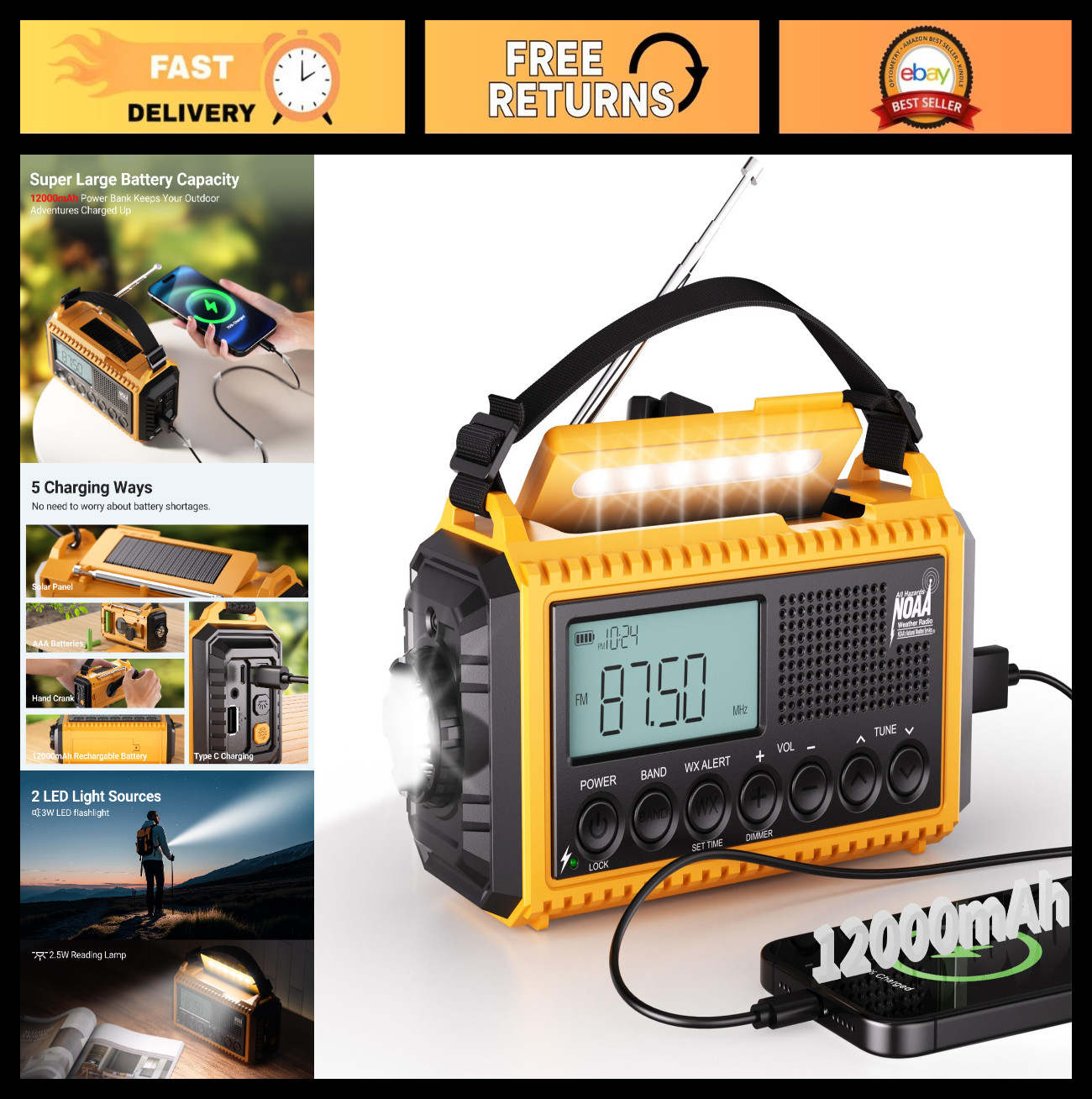

Photos from current listings. Actual item, color, and included accessories may vary.
Emergency Radio Buying Guide
Emergency radios combine NOAA weather alerts with off-grid power (hand crank, solar, battery) to keep you informed during blackouts and storms. The core trade-off is power capacity versus portability: sealed lead-acid or large Li-ion packs give multi-day runtime but add bulk, while compact crank-only models are lightweight but need constant winding. Choose a model with a real NOAA SAME decoder and a battery you can recharge by at least two methods; skip anything that lists 'solar' without a panel wattage or 'crank' without a dynamo rating.
Key takeaways
- NOAA reception requires a tuned VHF band (162.400–162.550 MHz) with SAME decoding for county-specific alerts; AM/FM-only radios cannot receive weather alerts.
- Hand-crank dynamos typically output 1–3 W at 3–6 V; a 12000 mAh Li-ion pack needs dozens of minutes of cranking for a partial charge, so crank is a backup, not primary.
- Solar panels on portable radios are 1–5 W and recharge slowly; a 5 W panel needs roughly 6–10 hours of direct sun to add meaningful runtime to a 2000–5000 mAh battery.
At a glance
- Category
- Walkie-Talkies & Two-Way Radios
- Last updated
- Nov 29, 2026
Current offers
Highlights
- NOAA reception requires a tuned VHF band (162.400–162.550 MHz) with SAME decoding for county-specific alerts; AM/FM-only radios cannot receive weather alerts.
- Hand-crank dynamos typically output 1–3 W at 3–6 V; a 12000 mAh Li-ion pack needs dozens of minutes of cranking for a partial charge, so crank is a backup, not primary.
- Solar panels on portable radios are 1–5 W and recharge slowly; a 5 W panel needs roughly 6–10 hours of direct sun to add meaningful runtime to a 2000–5000 mAh battery.
- Battery chemistry matters: Li-ion (18650/26650) offers higher energy density and lighter weight, while sealed lead-acid (4–6 V, 1–4 Ah) is heavier but tolerant of long storage and deep discharge.
Best use cases
- Home blackout kit: pick a desktop model with a 2000–5000 mAh Li-ion or 4 V lead-acid battery, NOAA SAME, and AC/USB charging; skip pocket crank-only radios that need constant winding.
- Backpacking or bug-out bag: choose a compact 100–200 g radio with 1000–2000 mAh battery, solar trickle, and crank backup; skip large 12000 mAh power-bank radios that add bulk.
- Severe-weather region: require NOAA SAME with county selection and an alert LED/vibration; skip AM/FM-only units that won't wake you for tornado or flash-flood warnings.
- Long-term storage: pick a radio with removable 18650 cells or lead-acid that holds charge for months; skip sealed Li-ion packs that self-discharge and are hard to replace.
Buying tips
- Match battery to use: 1000–2000 mAh for pocket/backpack (1–2 days), 3000–5000 mAh for home kits (3–7 days), and 8000–12000 mAh only if you also need to charge a phone.
- Require NOAA SAME decoding with a county code list; plain NOAA weather band without SAME alerts for all counties in range and can't be filtered.
- Check charging inputs: AC adapter, USB-C or micro-USB, and solar panel wattage (≥1 W). A radio that charges only by crank is impractical for daily readiness.
- Prefer removable 18650 cells (common, replaceable) or standard lead-acid (4 V/6 V); sealed proprietary Li-ion packs become e-waste when they age.
Specs
| Power Sources | Crank / Solar / AC / USB |
|---|---|
| Battery Capacity | 1000–12000 mAh Li-ion or 4V lead-acid |
| Weather Alert | NOAA SAME vs NOAA band only |
| Bands Received | AM / FM / SW / NOAA VHF |
Related searches
What to check before buying
- Measure your shelf or nightstand space: desktop units run 15–25 cm wide; confirm the footprint and antenna height before buying.
- Confirm your county's NOAA transmitter frequency and SAME code so you can program alerts; the radio must cover 162.400–162.550 MHz.
- Check your power sources: standard 120 V AC (US) or 230 V (EU) plug, plus USB output (5 V) for phone charging if needed.
- For backpacking, weigh the unit: sub-200 g with batteries is pocketable; 500 g+ models belong in a car or home kit.
FAQ
Data sources: eBay / Amazon listings and product attribute feeds. Updated Nov 29, 2026.
Some links on this page are affiliate links. If you buy after clicking one, we may earn a commission at no extra cost to you. This does not change which products appear here or their order. Affiliate disclosure.