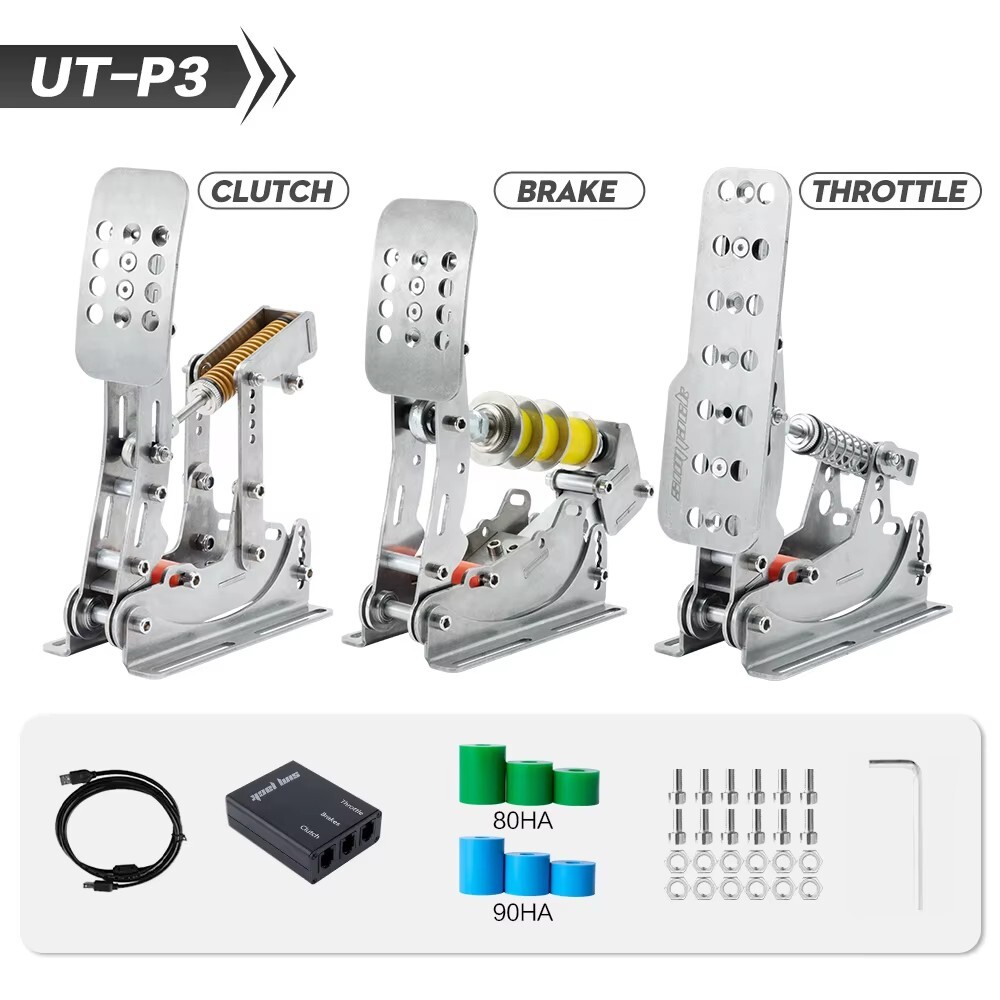

Photos from current listings. Actual item, color, and included accessories may vary.
Load Cell Pedal Buying Guide
Load cell pedals replace the potentiometer or Hall-effect brake with a strain-gauge sensor that measures pedal force, giving consistent, repeatable braking that separates clean laps from guesswork. The core trade-off is sensor resolution and pedal-frame rigidity versus price: entry units use a single load cell on a flexing plastic frame, while premium sets use machined steel or aluminum with adjustable preload and elastomer stacks. The decision rule is simple: any pedal with a rated load cell capacity of at least 50 kg, a metal brake arm, and adjustable pedal faces is a durable buy; anything with a plastic brake arm or an unrated sensor is a compromise.
Median $434.97
Key takeaways
- Brake force rating separates tiers: 50–75 kg load cells suit desk rigs, while 100–200 kg units are built for aluminum-profile cockpits that won't flex under hard braking.
- Pedal frame material matters as much as the sensor: stamped steel or CNC aluminum arms hold calibration, while plastic brake arms flex and cause inconsistent force readings.
- Adjustability tiers: premium sets offer tool-free preload, pedal-face angle, and elastomer or spring swaps; budget sets usually limit you to spacing and basic spring tension.
At a glance
- Category
- Sim Racing Pedals
- Last updated
- Nov 23, 2026
Current offers
Highlights
- Brake force rating separates tiers: 50–75 kg load cells suit desk rigs, while 100–200 kg units are built for aluminum-profile cockpits that won't flex under hard braking.
- Pedal frame material matters as much as the sensor: stamped steel or CNC aluminum arms hold calibration, while plastic brake arms flex and cause inconsistent force readings.
- Adjustability tiers: premium sets offer tool-free preload, pedal-face angle, and elastomer or spring swaps; budget sets usually limit you to spacing and basic spring tension.
- Clutch architecture varies: real load-cell clutch pedals use a second sensor or hall-effect travel, while cheaper sets use a simple spring with a microswitch that only reads on/off.
Best use cases
- Best fit: desk or wheel-stand sim racers should pick a 2-pedal load cell set rated 50–75 kg with a metal brake arm and USB connection — skip 3-pedal hydraulic sets that need a rigid cockpit.
- Best fit: aluminum-profile cockpit owners should buy a 3-pedal set with 100 kg+ brake capacity, adjustable preload, and a load-cell or hall-effect clutch for heel-and-toe and manual-gear driving.
- Wrong fit: console-only players should skip PC-first load cell sets unless the pedal explicitly lists console compatibility — most load cell brakes are calibrated through PC software and won't work on Xbox or PlayStation without a compatible wheelbase hub.
- Wrong fit: buyers wanting a quick bolt-on upgrade to a cheap plastic pedal set should skip standalone load cell pedals — the flex in the stock frame defeats the sensor's accuracy; buy a complete pedal set instead.
Buying tips
- Match load cell capacity to your rig: under 75 kg for wheel stands and desks, 100 kg or more only when the pedal deck is aluminum profile or a solid steel cockpit.
- Check the brake arm material: CNC aluminum or steel holds calibration; stamped or plastic arms flex and make the load cell read inconsistently under repeated hard braking.
- Verify the clutch type on 3-pedal sets: a load-cell or hall-effect clutch gives progressive travel, while a microswitch clutch is effectively an on/off button and limits manual-gear driving.
- Confirm connection and calibration: USB with PC software for deadzone and force curves is the standard; sets that only calibrate through a specific wheelbase hub lock you into that ecosystem.
Specs
| Brake Sensor | Load cell (strain gauge) vs Hall/potentiometer |
|---|---|
| Brake Force Rating | 50–75 kg desk/stand; 100 kg+ cockpit |
| Pedal Frame | CNC aluminum/steel vs stamped/plastic |
| Clutch Type | Load cell / hall-effect vs microswitch |
Related searches
What to check before buying
- Measure your pedal deck: load cell pedals are heavier and longer than stock sets, so confirm mounting-hole spacing and deck depth before buying.
- Check rig rigidity: a load cell brake transfers force into the frame, so a flexing wheel stand or desk will absorb travel and dull the sensor's benefit.
- Confirm PC software support and USB connection, plus console compatibility if you race on Xbox or PlayStation.
- Verify pedal-face spacing and angle adjustment fit your foot position and shoe size, especially for left-foot braking.
FAQ
Data sources: eBay / Amazon listings and product attribute feeds. Updated Nov 23, 2026.
Some links on this page are affiliate links. If you buy after clicking one, we may earn a commission at no extra cost to you. This does not change which products appear here or their order. Affiliate disclosure.