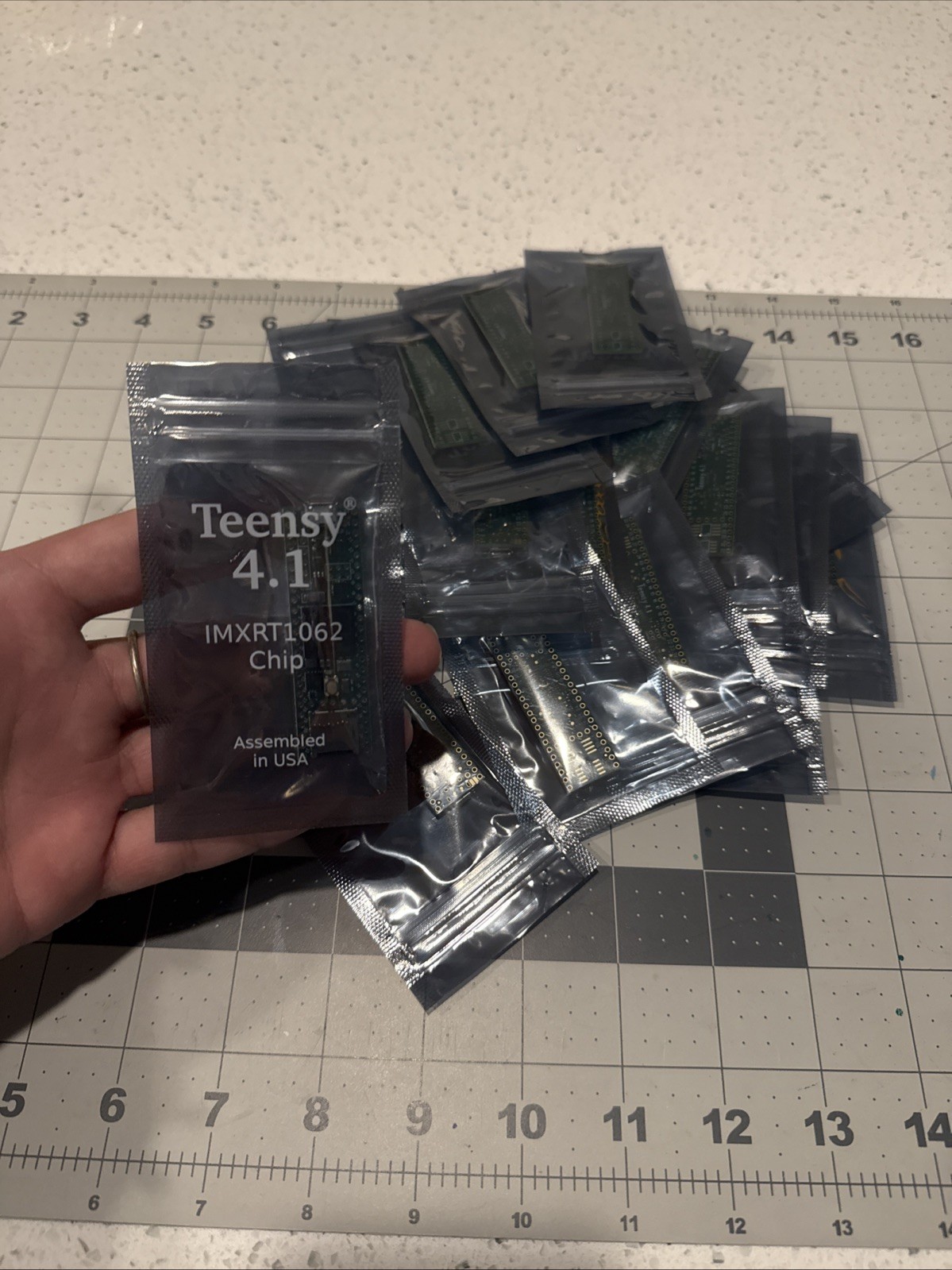

Photos from current listings. Actual item, color, and included accessories may vary.
Microcontroller Development Board Buying Guide
A microcontroller development board is the physical breakout that turns a bare MCU into a usable prototyping platform, and the core trade-off is bus width and clock speed versus I/O count, onboard peripherals, and ecosystem maturity. Choose a board whose native peripheral set (CAN, Ethernet, USB host, SDIO) matches your project's required buses and whose form factor fits your carrier or breadboard.
Key takeaways
- 32-bit ARM Cortex-M boards (Teensy 4.x, STM32 Nucleo, RP2040) run 100-600 MHz with FPU/DSP; 8-bit AVR boards sit at 16 MHz with 2-8 KB SRAM, which caps buffer-heavy work.
- The Teensy 4.1 uses an i.MX RT1062 at 600 MHz with native 10/100 Ethernet PHY pins, a microSD socket, and 8 serial ports, so networking and mass storage need no external shields.
- ESP32 boards integrate 2.4 GHz Wi-Fi and Bluetooth LE and dual-core 240 MHz Xtensa LX6, distinguishing them from MCUs that need an external radio module.
At a glance
- Category
- Microcontrollers & Dev Boards
- Last updated
- Nov 25, 2026
Current offers
Highlights
- 32-bit ARM Cortex-M boards (Teensy 4.x, STM32 Nucleo, RP2040) run 100-600 MHz with FPU/DSP; 8-bit AVR boards sit at 16 MHz with 2-8 KB SRAM, which caps buffer-heavy work.
- The Teensy 4.1 uses an i.MX RT1062 at 600 MHz with native 10/100 Ethernet PHY pins, a microSD socket, and 8 serial ports, so networking and mass storage need no external shields.
- ESP32 boards integrate 2.4 GHz Wi-Fi and Bluetooth LE and dual-core 240 MHz Xtensa LX6, distinguishing them from MCUs that need an external radio module.
- Onboard regulation and level shifting decide durability: 3.3 V-only MCU pins are not 5 V tolerant, so 5 V sensor use requires level shifters or a board with 5 V-tolerant I/O specified.
Best use cases
- Best fit for USB-MIDI, audio synthesis, and high-speed datalogging: 480-600 MHz Cortex-M7 boards with native USB and SDIO, not 16 MHz AVR boards with bit-banged USB.
- Best fit for battery-powered Wi-Fi sensors: ESP32 or RP2040 with 2.4 GHz radio and deep-sleep current in the microamp range; skip Ethernet-only boards for wireless-only deployments.
- Best fit for industrial CAN/RS-485: STM32 or Teensy 4.1 with native CAN-FD controllers; skip boards that expose only UART and leave CAN to software emulation.
- Wrong fit for breadboard-only learners: large-format 60+ pin boards that consume a full breadboard; pick a compact 24-pin DIP-footprint board instead.
Buying tips
- Count native buses first: each CAN, Ethernet, or USB-host port needs dedicated MCU pins, so a board with 3 UARTs and no CAN cannot serve multi-node vehicle projects.
- Match flash and RAM to firmware scale: 1 MB flash / 512 KB RAM handles RTOS and TLS; 32 KB flash / 2 KB RAM fits only bare-metal sensor loops.
- Check VIN and regulator headroom: boards fed from 5 V USB or 7-12 V VIN with onboard buck tolerate wider supply range than 3.3 V-only regulated input boards.
- Prefer castellated or 0.1-inch headers for shield compatibility; verify GPIO pitch is 2.54 mm and pinout matches the ecosystem (Arduino R3, Feather, Teensy) you plan to use.
Specs
| MCU Architecture | 8-bit AVR / 32-bit ARM / Xtensa |
|---|---|
| Clock Speed | 16 MHz to 600 MHz |
| Onboard Connectivity | Wi-Fi/BLE, Ethernet, USB, CAN |
| GPIO & Pitch | 2.54 mm headers / castellated pads |
Related searches
What to check before buying
- Verify the board's pin pitch and footprint (2.54 mm headers, breadboard width) against your existing shield, carrier, or enclosure cutouts.
- Confirm the supply input range and connector type (USB-C, micro-USB, VIN screw terminal) matches your power source and voltage.
- Check that required buses (CAN transceiver, Ethernet magnetics, USB host) are either onboard or available on standard headers.
- Confirm programming interface: native USB, external debugger (SWD/JTAG), or bootloader button, and that your toolchain supports the target core.
FAQ
Data sources: eBay / Amazon listings and product attribute feeds. Updated Nov 25, 2026.
Some links on this page are affiliate links. If you buy after clicking one, we may earn a commission at no extra cost to you. This does not change which products appear here or their order. Affiliate disclosure.