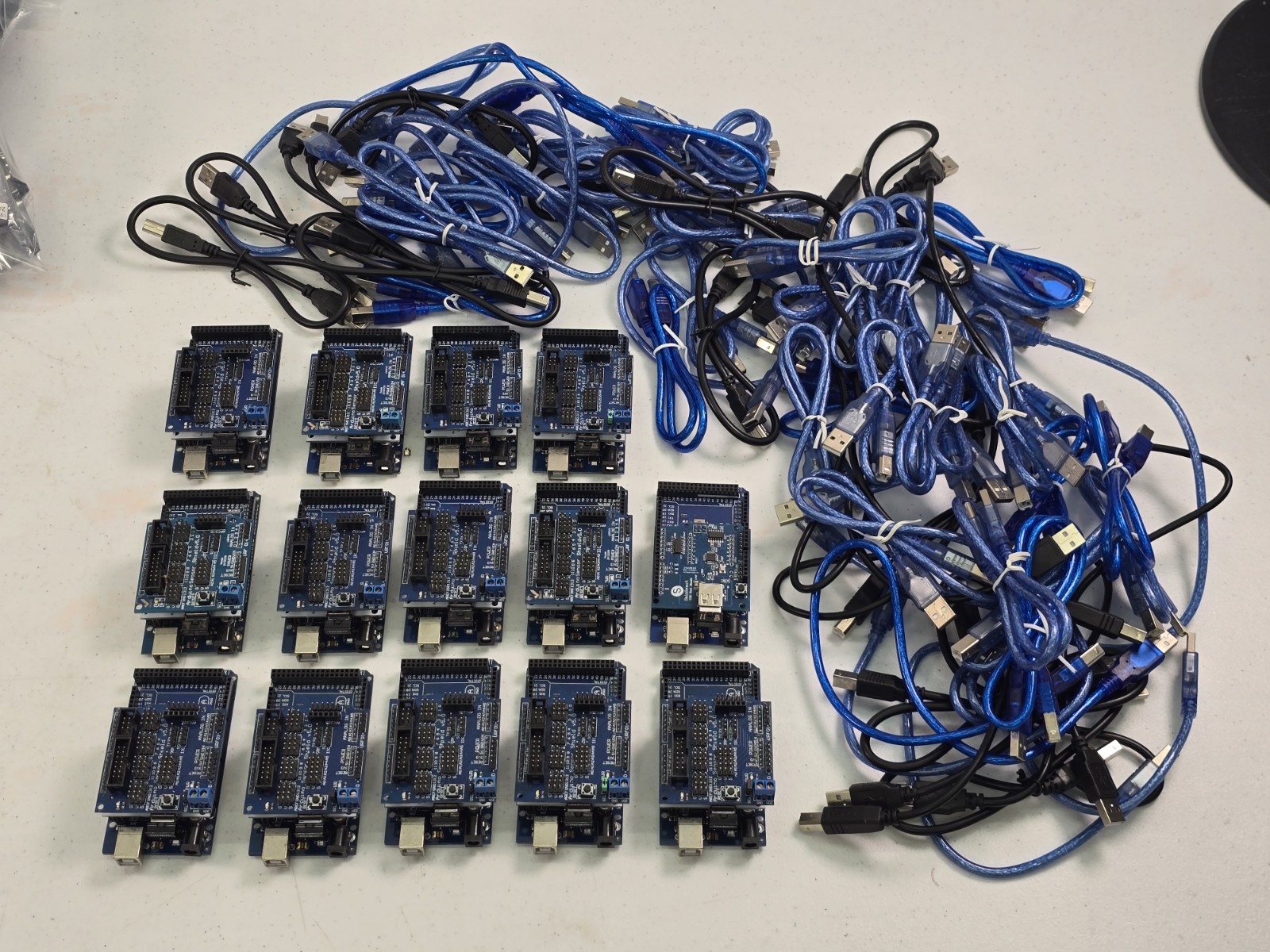

Photos from current listings. Actual item, color, and included accessories may vary.
Arduino Mega 2560 Buying Guide
The Arduino Mega 2560 is an 8-bit ATmega2560 development board with 54 digital I/O, 16 analog inputs, and 4 hardware serial ports—the go-to when Uno-style boards run out of pins. The core trade-off is buying an official 16 MHz/5 V board with the ATmega16U2 USB bridge versus a CH340 clone that saves cost but may need driver work and lacks the same build consistency. The decision rule: if you need more than 20 GPIO, multiple UARTs, or 256 KB flash, buy a genuine or well-reviewed Mega 2560 clone; if you only need a handful of pins, an Uno or ESP32 is cheaper and faster.
Key takeaways
- ATmega2560: 256 KB flash, 8 KB SRAM, 4 KB EEPROM, 16 MHz—SRAM is the real limit for large buffers and arrays.
- 54 digital pins (15 PWM) and 16 analog inputs at 10-bit resolution; 5 V logic tolerates classic shields but not 3.3 V sensors directly.
- Four hardware serial ports (Serial, Serial1–3) allow GPS, Bluetooth, and debug simultaneously—something the Uno cannot do.
At a glance
- Category
- Microcontrollers & Dev Boards
- Last updated
- Nov 25, 2026
Current offers
Highlights
- ATmega2560: 256 KB flash, 8 KB SRAM, 4 KB EEPROM, 16 MHz—SRAM is the real limit for large buffers and arrays.
- 54 digital pins (15 PWM) and 16 analog inputs at 10-bit resolution; 5 V logic tolerates classic shields but not 3.3 V sensors directly.
- Four hardware serial ports (Serial, Serial1–3) allow GPS, Bluetooth, and debug simultaneously—something the Uno cannot do.
- Official boards use ATmega16U2 for USB-serial; clones typically use CH340G/CH340C, which may require separate drivers on macOS and Windows.
Best use cases
- Best fit: 3D printers, CNC, and multi-sensor rigs that need 30+ I/O and multiple UARTs—pick a Mega 2560 with a proven USB bridge and 5 V-compatible shields.
- Best fit: legacy 5 V Arduino shield stacks (RAMPS, LCD keypads, relay banks)—choose the Mega 2560 over a 3.3 V ESP32 to avoid level-shifting every signal.
- Wrong fit: battery-powered IoT with Wi-Fi/BLE—skip the Mega and use an ESP32 or Nano 33 IoT; the Mega draws far more current and has no radio.
- Wrong fit: compact wearables or single-sensor projects—a Nano or Uno costs less and fits smaller enclosures; the Mega’s footprint is roughly 4×2 inches.
Buying tips
- Count I/O first: if your project uses more than 20 digital pins or more than one serial device, the Mega 2560 is the correct tier; otherwise step down to an Uno.
- Choose the USB bridge deliberately: ATmega16U2 official boards work driver-free; CH340 clones are fine but require installing the CH340 driver before upload.
- Confirm 5 V logic compatibility: the Mega 2560 is 5 V; use level shifters for 3.3 V sensors or pick a 3.3 V board instead of wiring directly.
- Check power path: the Mega can accept 7–12 V on VIN or the barrel jack, but USB alone limits current—plan a separate 5 V supply for motors and relays.
Specs
| Microcontroller | ATmega2560, 8-bit AVR, 16 MHz |
|---|---|
| Flash / SRAM / EEPROM | 256 KB / 8 KB / 4 KB |
| I/O Count | 54 digital (15 PWM), 16 analog |
| USB-Serial Bridge | ATmega16U2 (official) vs CH340 (clone) |
Related searches
What to check before buying
- Measure your enclosure: the Mega 2560 is about 101.6 × 53.3 mm with mounting holes; confirm clearance for shields and cable headers.
- Verify shield compatibility: classic Uno shields fit mechanically, but check that shield pins use the Mega’s extended header rows for the extra I/O.
- Plan your power: confirm a 7–12 V DC source or regulated 5 V rail is available for VIN, especially if driving relays, motors, or LED strips.
- Install drivers before first upload: for CH340 clones, download the CH340 driver; for official boards, the ATmega16U2 works with standard Arduino IDE drivers.
FAQ
Data sources: eBay / Amazon listings and product attribute feeds. Updated Nov 25, 2026.
Some links on this page are affiliate links. If you buy after clicking one, we may earn a commission at no extra cost to you. This does not change which products appear here or their order. Affiliate disclosure.