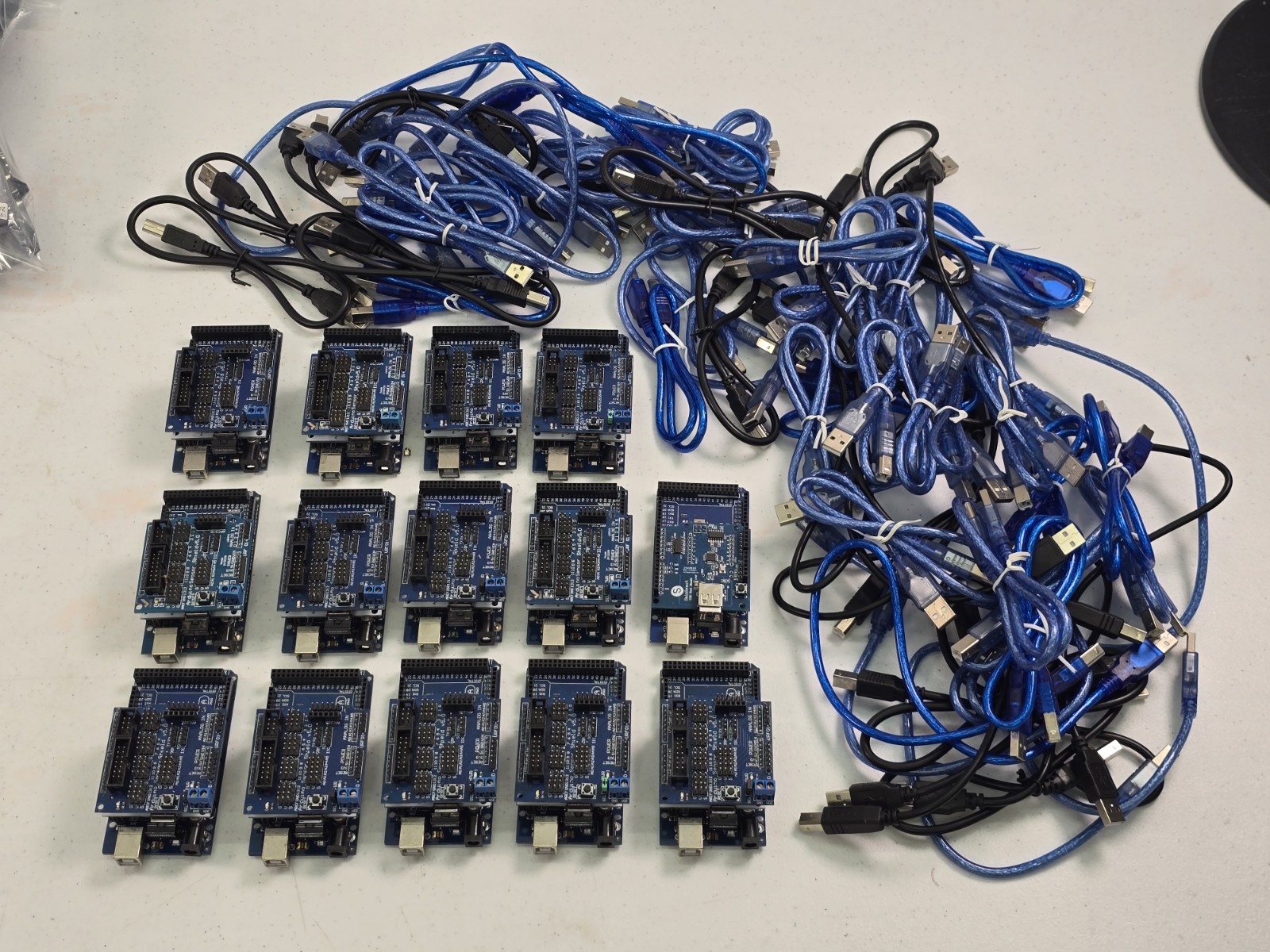

Photos from current listings. Actual item, color, and included accessories may vary.
Mega 2560 Buying Guide
The Mega 2560 is an 8-bit ATmega2560 development board defined by its large GPIO count (54 digital, 16 analog) and 256 KB flash, making it the go-to when Uno-class boards run out of pins or memory. The primary trade-off is between official/quality clones with genuine 16U2 USB-serial chips and cheap CH340 clones that may need driver work but cost less. Buy a board with the 16U2 or a known-good CH340 and proper voltage regulation if you need reliability; accept a CH340 clone only if you can install drivers and tolerate minor firmware quirks.
Key takeaways
- ATmega2560: 256 KB flash, 8 KB SRAM, 4 KB EEPROM, 16 MHz — about 8x the Uno's flash and 4x its SRAM for large sketches and buffers.
- 54 digital I/O (15 PWM) and 16 analog inputs vs Uno's 20 I/O — the defining pin-count advantage for multi-sensor and multi-relay builds.
- USB-serial bridge matters: genuine 16U2 (official/quality clones) vs CH340 (budget clones) — CH340 needs a driver on some OS versions but works fine once installed.
At a glance
- Category
- Microcontrollers & Dev Boards
- Last updated
- Nov 25, 2026
Current offers
Highlights
- ATmega2560: 256 KB flash, 8 KB SRAM, 4 KB EEPROM, 16 MHz — about 8x the Uno's flash and 4x its SRAM for large sketches and buffers.
- 54 digital I/O (15 PWM) and 16 analog inputs vs Uno's 20 I/O — the defining pin-count advantage for multi-sensor and multi-relay builds.
- USB-serial bridge matters: genuine 16U2 (official/quality clones) vs CH340 (budget clones) — CH340 needs a driver on some OS versions but works fine once installed.
- Board variants: full-size Mega 2560 (standard Arduino footprint) vs Mega 2560 Pro Mini (compact, no USB jack, often 5V/3.3V selectable) — Pro Mini saves space but requires an external USB-TTL adapter.
Best use cases
- Best fit: 3D printers, CNC, and multi-stepper projects needing 5+ axes plus endstops and thermistors — pick full-size Mega 2560 with 16U2 for stable USB and standard RAMPS shield compatibility.
- Best fit: large sensor networks (16+ analog sensors, many relays) where Uno runs out of pins — choose any Mega 2560; if space-constrained, Mega 2560 Pro Mini with an external USB-TTL adapter.
- Wrong fit: simple blink/LED/one-sensor projects — an Uno or Nano is cheaper and sufficient; skip Mega 2560 unless you specifically need >20 I/O or >32 KB flash.
- Wrong fit: 3.3V-only sensor systems without level shifting — standard Mega 2560 is 5V logic; use a 3.3V-native board or add level shifters rather than wiring 3.3V sensors directly.
Buying tips
- Count your required pins first: if you need more than 20 digital I/O or more than 6 analog inputs, Mega 2560 is justified; otherwise an Uno/Nano saves cost and size.
- Prefer boards with the ATmega16U2 USB-serial chip for plug-and-play driver support; CH340 clones are acceptable if you install the CH340 driver and verify the board is detected before soldering.
- For shield-based builds (RAMPS, LCD, sensor shields), buy the full-size Mega 2560 with the standard Arduino header layout — Pro Mini lacks the shield footprint.
- Check voltage regulation: quality clones use an AMS1117 or better regulator rated for 7-12V input; avoid boards with undersized regulators if you plan to power from Vin with servos or relays attached.
Specs
| MCU / Flash | ATmega2560 / 256 KB |
|---|---|
| I/O Count | 54 digital (15 PWM), 16 analog |
| USB-Serial Chip | ATmega16U2 vs CH340 |
| Board Variant | Full-size vs Pro Mini |
Related searches
What to check before buying
- Measure your enclosure or shield stack: full-size Mega 2560 is about 101.5 x 53.3 mm with headers; Mega 2560 Pro Mini is roughly 55 x 40 mm — confirm clearance before ordering.
- Confirm your power source: 7-12V DC on Vin or USB 5V; if using a 12V supply with many servos, verify the regulator can handle the current or power servos separately.
- Verify logic level: Mega 2560 is 5V logic — list any 3.3V-only sensors and plan level shifters or a 3.3V board instead.
- If choosing Mega 2560 Pro Mini, budget for a USB-TTL adapter (FTDI or CH340) and confirm the pinout matches your wiring plan; it has no USB jack.
FAQ
Data sources: eBay / Amazon listings and product attribute feeds. Updated Nov 25, 2026.
Some links on this page are affiliate links. If you buy after clicking one, we may earn a commission at no extra cost to you. This does not change which products appear here or their order. Affiliate disclosure.