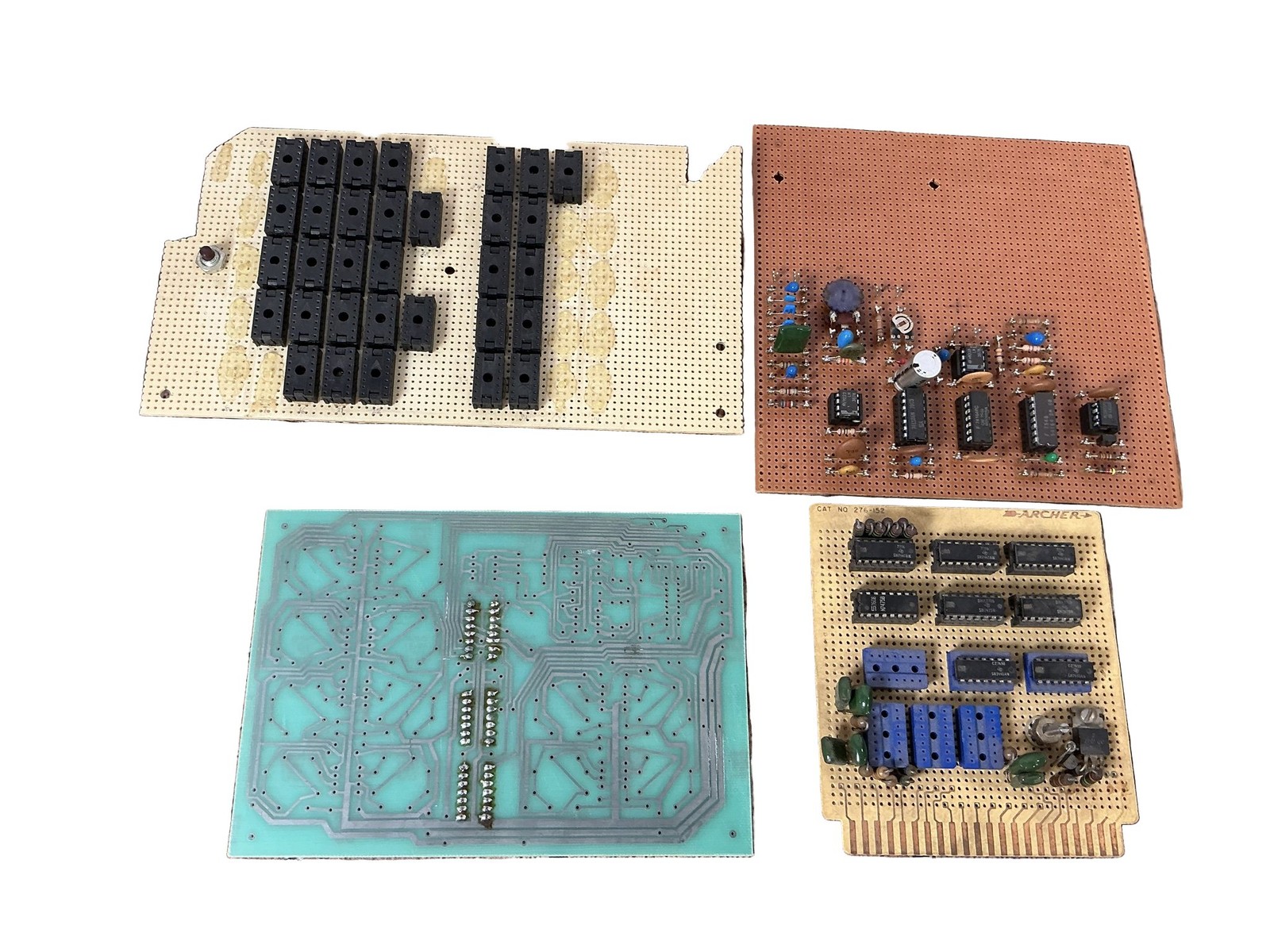

Photos from current listings. Actual item, color, and included accessories may vary.
Circuit Board Buying Guide
Circuit boards are the physical substrates that connect and host electronic components, ranging from bare prototyping boards to assembled modules. The primary trade-off is between conductor quality and substrate durability: bare boards with thin copper and loose tolerances fail under repeated soldering, while properly plated FR-4 with 1oz copper survives rework and thermal cycling. The decision rule: buy boards rated for at least 1oz copper and FR-4 Tg 130°C+ for any project you intend to keep, and avoid paper-phenolic or unspecified alloy boards for anything beyond one-off breadboarding.
Key takeaways
- FR-4 glass-epoxy (Tg 130-180°C) is the durable standard; paper-phenolic (FR-2) is cheap but brittle, moisture-sensitive, and unsuitable for repeated soldering.
- Copper weight determines current capacity and solderability: 1oz (35µm) is the practical minimum for hand assembly; 2oz handles higher current and repeated rework.
- Surface finish matters: HASL is cost-effective and solderable; ENIG offers flat pads for fine-pitch SMD and better shelf life but costs more.
At a glance
- Category
- Microcontrollers & Dev Boards
- Last updated
- Nov 25, 2026
Current offers
Highlights
- FR-4 glass-epoxy (Tg 130-180°C) is the durable standard; paper-phenolic (FR-2) is cheap but brittle, moisture-sensitive, and unsuitable for repeated soldering.
- Copper weight determines current capacity and solderability: 1oz (35µm) is the practical minimum for hand assembly; 2oz handles higher current and repeated rework.
- Surface finish matters: HASL is cost-effective and solderable; ENIG offers flat pads for fine-pitch SMD and better shelf life but costs more.
- Prototyping architectures differ: wire-wrap boards use long pin headers for point-to-point wiring; perma-proto and stripboard use pre-tinned copper strips for soldered buses.
Best use cases
- Best fit: Arduino/ESP32 sensor breakouts and one-off logic — choose FR-4 perma-proto or stripboard with 1oz copper and HASL finish; skip paper-phenolic boards.
- Best fit: permanent installation in enclosures or high-vibration environments — specify FR-4 Tg 150°C+ with plated through-holes and locking headers; skip unplated single-sided boards.
- Best fit: wire-wrap prototyping for DIP ICs and quick rewiring — use dedicated wire-wrap boards with gold-plated square pins; skip them for SMD or high-frequency designs where stray inductance matters.
- Wrong fit: high-current power switching or motor drivers on generic 1oz prototyping board — use 2oz copper or dedicated power boards with thermal relief; generic boards overheat at sustained 3A+ traces.
Buying tips
- Match copper weight to current: 1oz copper supports roughly 1A per 1mm trace width for 10°C rise; double width or go 2oz for 2-3A loads.
- Check hole plating: plated through-holes (PTH) are mandatory for double-sided boards and reliable solder joints; unplated holes wick solder and crack under thermal cycling.
- Verify grid and pitch: standard 0.1in (2.54mm) pitch fits DIP, headers, and most through-hole parts; confirm pad diameter >=1.7mm for easy hand soldering.
- For SMD work, choose boards with ENIG finish and 0.05in or finer pitch breakout; HASL is too uneven for fine-pitch QFP and BGA hand alignment.
Specs
| Substrate Material | FR-4 glass-epoxy vs paper-phenolic |
|---|---|
| Copper Weight | 1oz (35µm) standard / 2oz heavy |
| Surface Finish | HASL vs ENIG (flat pads) |
| Board Architecture | Wire-wrap / perma-proto / stripboard |
Related searches
What to check before buying
- Measure your enclosure and mounting hole pattern before selecting board dimensions; standard prototyping boards range from 3x7cm to 10x15cm, and mounting holes are often M3.
- Confirm your soldering iron and tip can reach the board's thermal mass: 1oz copper on FR-4 needs a 30-40W iron or better; 2oz copper demands 50W+ or preheating.
- Check compatibility with your headers and connectors: 0.1in pitch board accepts standard male/female headers; wire-wrap boards require square gold-plated posts for reliable wrap connections.
- For RF or high-speed signals, avoid generic prototyping boards entirely; use grounded copper-pour boards or custom PCBs with controlled impedance.
FAQ
Data sources: eBay / Amazon listings and product attribute feeds. Updated Nov 25, 2026.
Some links on this page are affiliate links. If you buy after clicking one, we may earn a commission at no extra cost to you. This does not change which products appear here or their order. Affiliate disclosure.