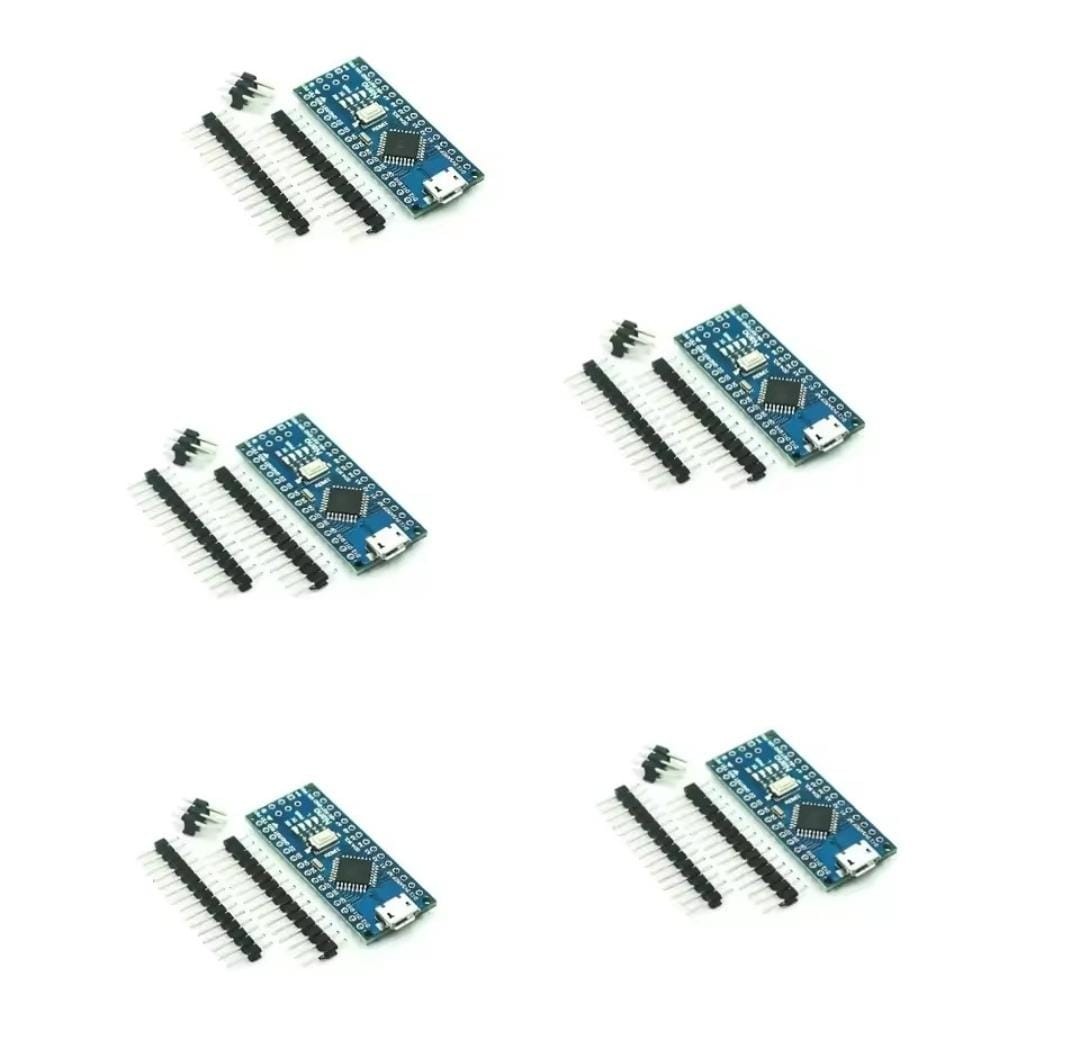

Photos from current listings. Actual item, color, and included accessories may vary.
Arduino Nano Atmega328p Buying Guide
The Arduino Nano ATmega328P is a breadboard-friendly microcontroller board built around an 8-bit AVR core, offering 14 digital I/O, 8 analog inputs, and USB programming in a 45×18 mm form factor. The critical decision is not the ATmega328P itself but the USB-to-serial bridge and regulator quality: genuine FTDI or high-grade CH340C/CP2102 chips and an AMS1117-class LDO separate reliable boards from dropout-prone clones. Buy boards with a documented bridge chip and a 5V/500mA regulator if you need stable 5V rail under load; accept the cheapest CH340 clones only for bench tinkering where USB power is stable.
Key takeaways
- ATmega328P runs at 16 MHz with 32 KB flash, 2 KB SRAM, 1 KB EEPROM — 14 digital I/O (6 PWM) and 8 analog inputs on 0.1" (2.54 mm) header pitch.
- USB bridge chip determines driver stability: FT232RL (genuine Arduino Nano) vs CH340G/CH340C vs CP2102 — CH340C avoids the external crystal and is the most reliable clone option.
- Board voltage regulator: AMS1117-5.0 delivers 5V from 6.5–12V VIN but derates sharply above 500 mA — high-current peripherals need external 5V supply, not VIN.
At a glance
- Category
- Microcontrollers & Dev Boards
- Last updated
- Nov 25, 2026
Current offers
Highlights
- ATmega328P runs at 16 MHz with 32 KB flash, 2 KB SRAM, 1 KB EEPROM — 14 digital I/O (6 PWM) and 8 analog inputs on 0.1" (2.54 mm) header pitch.
- USB bridge chip determines driver stability: FT232RL (genuine Arduino Nano) vs CH340G/CH340C vs CP2102 — CH340C avoids the external crystal and is the most reliable clone option.
- Board voltage regulator: AMS1117-5.0 delivers 5V from 6.5–12V VIN but derates sharply above 500 mA — high-current peripherals need external 5V supply, not VIN.
- Nano V3.0 pinout matches Arduino Nano every/classic footprint; some clones ship with 5V-only logic and no 3.3V output or reversed A4/A5 SDA/SCL labels — verify silkscreen revision.
Best use cases
- Best fit: breadboard prototyping, sensor logging, and small robotics — pick a CH340C or CP2102 board with AMS1117 regulator and 5V/3.3V dual output.
- Best fit: permanent installations with 7–12V VIN — choose boards with a genuine AMS1117 and reverse-polarity protection; skip the cheapest no-name clones for 24/7 duty.
- Wrong fit: projects needing Wi-Fi, BLE, or 3.3V-native logic at speed — the ATmega328P lacks radio and its 3.3V output is limited to ~50 mA from the FTDI/CH340, so use an ESP32 or add a module.
- Wrong fit: motor drivers or LED arrays drawing over 500 mA from the 5V pin — the onboard regulator will overheat; power the load separately and share only ground.
Buying tips
- Match USB bridge to your OS: CH340 needs a driver on macOS/Windows; CP2102 and FT232RL are driver-free on modern OS — choose CP2102/FT232RL for plug-and-play.
- Check header pitch and layout: 0.1" (2.54 mm) pitch with 15 pins per side on 0.6" (15.24 mm) row spacing; boards with 0.05" pitch or non-standard spacing won't fit Nano shields.
- Confirm regulator and VIN range: AMS1117-5.0 accepts up to 12V VIN but efficiency drops; for 9V battery use, prefer a board with a 5V/3.3V dual LDO and reverse-polarity diode.
- Buy multi-packs for soldering: 5-packs of CH340 clones are cost-effective for permanent solder-down projects, but keep one FT232RL or CP2102 board as a known-good reference for driver debugging.
Specs
| MCU Core | ATmega328P 8-bit AVR @ 16 MHz |
|---|---|
| USB Bridge Chip | FT232RL / CH340C / CP2102 |
| Logic & VIN | 5V logic, 7–12V VIN (AMS1117) |
| I/O & Memory | 14 DIO (6 PWM), 8 AI, 32KB flash |
Related searches
What to check before buying
- Measure your breadboard or shield: the Nano is 45×18 mm with 0.6" row spacing — verify your carrier or PCB footprint matches before ordering a 5-pack.
- Verify USB port type: most Nano V3.0 boards use Mini-USB or USB-C; confirm your cable stock matches the board's connector to avoid adapter costs.
- Check logic-level needs: ATmega328P is 5V logic — if your sensors are 3.3V-only, confirm the board exposes a 3.3V pin (max ~50 mA) or plan a level shifter.
- Plan power budget: onboard AMS1117 supplies ~500 mA at 5V; add up sensor and display current and use external 5V if the total exceeds 400 mA continuous.
FAQ
Data sources: eBay / Amazon listings and product attribute feeds. Updated Nov 25, 2026.
Some links on this page are affiliate links. If you buy after clicking one, we may earn a commission at no extra cost to you. This does not change which products appear here or their order. Affiliate disclosure.