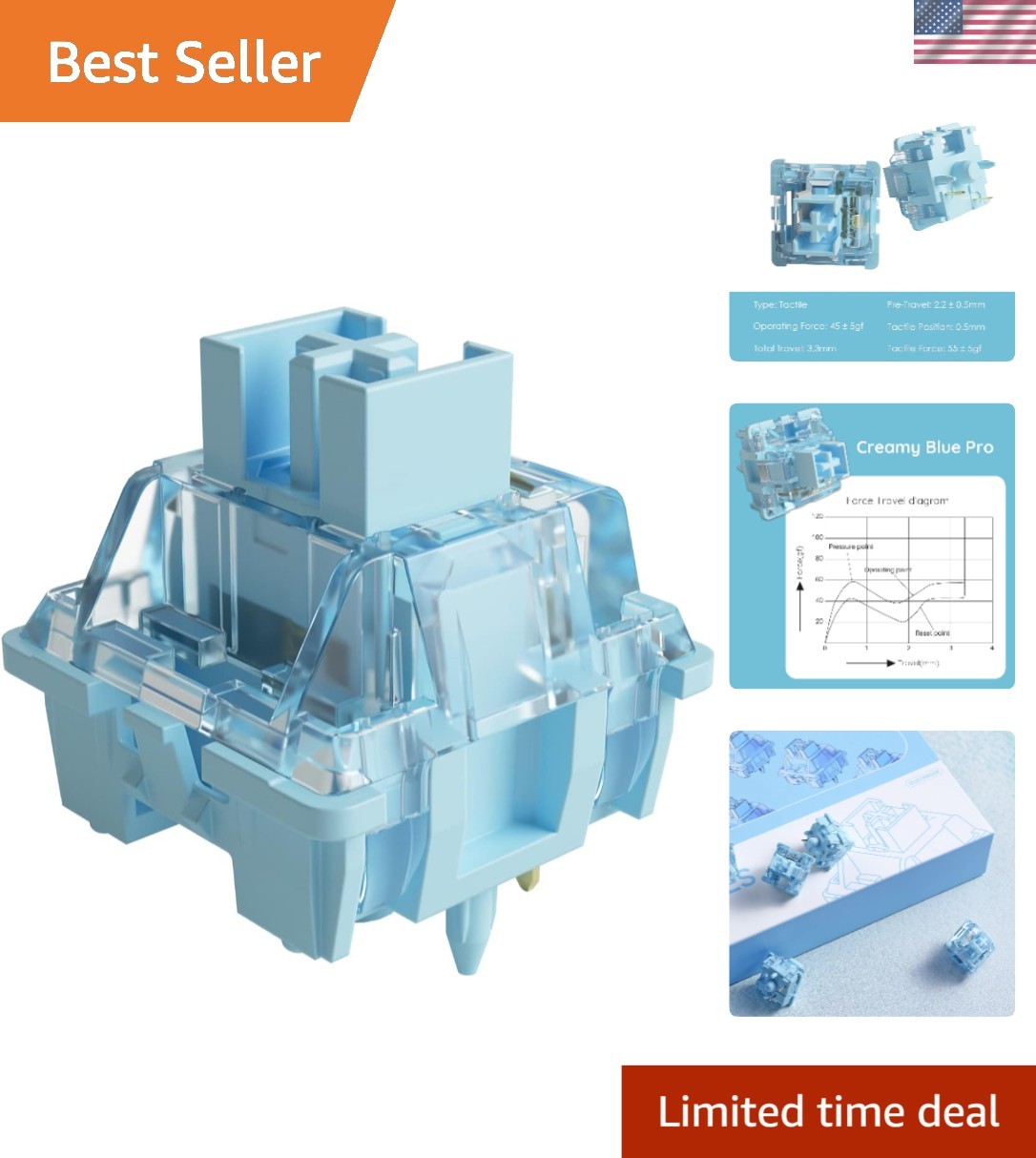

Photos from current listings. Actual item, color, and included accessories may vary.
Creamy Keyboard Switch Buying Guide
Creamy keyboard switches are a subjective sound profile sought by enthusiasts—typically linear or light-tactile switches with factory lubrication and tight tolerances that produce a deep, muted, 'thocky' keystroke rather than a sharp, high-pitched click. The primary trade-off is between pre-lubed, tight-tolerance switches that sound creamy out of the box and dry, loose switches that require hand-lubing and filming to reduce rattle. The decision rule: buy switches explicitly described as factory-lubed linear with polycarbonate or nylon housings and a long-pole or POM stem for a deep sound; skip any switch labeled 'clicky' or with loose stem wobble, which will sound sharp and hollow, not creamy.
Key takeaways
- Sound profile is dominated by housing material: polycarbonate tops give a higher-pitched clack, while full nylon or POM housings produce the deeper, muted tone associated with 'creamy'.
- Factory lubrication grade matters more than spring weight: switches sold as 'pre-lubed' with visible grease on the stem rails and spring ends sound creamy immediately; dry switches need manual Krytox 205g0 application.
- Stem wobble kills the creamy effect—tight-tolerance switches (often advertised with ±0.05 mm or lower wobble) reduce plastic rattle that makes keystrokes sound thin and sharp.
At a glance
- Category
- Keyboard Switches
- Last updated
- Nov 23, 2026
Current offers
Highlights
- Sound profile is dominated by housing material: polycarbonate tops give a higher-pitched clack, while full nylon or POM housings produce the deeper, muted tone associated with 'creamy'.
- Factory lubrication grade matters more than spring weight: switches sold as 'pre-lubed' with visible grease on the stem rails and spring ends sound creamy immediately; dry switches need manual Krytox 205g0 application.
- Stem wobble kills the creamy effect—tight-tolerance switches (often advertised with ±0.05 mm or lower wobble) reduce plastic rattle that makes keystrokes sound thin and sharp.
- Long-pole stems (3.5 mm or longer) bottom out on the housing for a deeper, more muted clack; standard 3.0 mm stems produce a sharper, higher-pitched bottom-out.
Best use cases
- Best fit: office or shared-space typists who want a quiet, deep-sounding board—choose factory-lubed linear switches with nylon housings and 45–55 g actuation; skip clicky or tactile switches with sharp bumps.
- Best fit: first-time modders building a budget creamy board—pick pre-lubed linear switches in the 40–50 g range and pair with a PBT keycap set; skip hand-lubing kits until you know your preferred weight.
- Wrong fit: competitive gamers needing the fastest actuation—creamy switches prioritize sound over speed; choose optical or low-actuation-force linear switches instead.
- Wrong fit: buyers wanting a loud, sharp 'clacky' sound—creamy switches are deliberately muted; choose clicky or high-pitched polycarbonate-topped switches instead.
Buying tips
- Match spring weight to finger strength: 35–45 g for light typists, 45–55 g for general use, 60 g+ for heavy-handed typists; too light feels mushy, too heavy feels fatiguing.
- Prioritize full-nylon or POM housings over polycarbonate tops if creamy sound is the goal; polycarbonate produces a sharper, higher-pitched clack.
- Buy factory-lubed switches only if the listing specifies the lubricant type and application points (rails and spring); vague 'pre-lubed' claims often mean inconsistent grease.
- Check plate compatibility: 5-pin switches need a PCB with extra holes or a plate with cutouts; 3-pin switches drop into any MX-style hot-swap socket without modification.
Specs
| Switch Type | Linear / Light Tactile |
|---|---|
| Housing Material | Nylon / POM / PC blend |
| Actuation Force | 35–55 g typical |
| Lubrication | Factory-lubed vs dry |
Related searches
What to check before buying
- Confirm your keyboard or PCB uses MX-style hot-swap sockets or solder pads—cream switches are almost exclusively MX-compatible, not Alps or optical.
- Measure your plate thickness and cutout: 5-pin switches require 1.5 mm plates with extra pin holes; 3-pin switches fit standard 1.5 mm plates without modification.
- Check your board's stabilizer clearance: long-pole switches may contact stabilizer housings on some layouts—test one switch in a stabilized position before installing a full set.
FAQ
Data sources: eBay / Amazon listings and product attribute feeds. Updated Nov 23, 2026.
Some links on this page are affiliate links. If you buy after clicking one, we may earn a commission at no extra cost to you. This does not change which products appear here or their order. Affiliate disclosure.