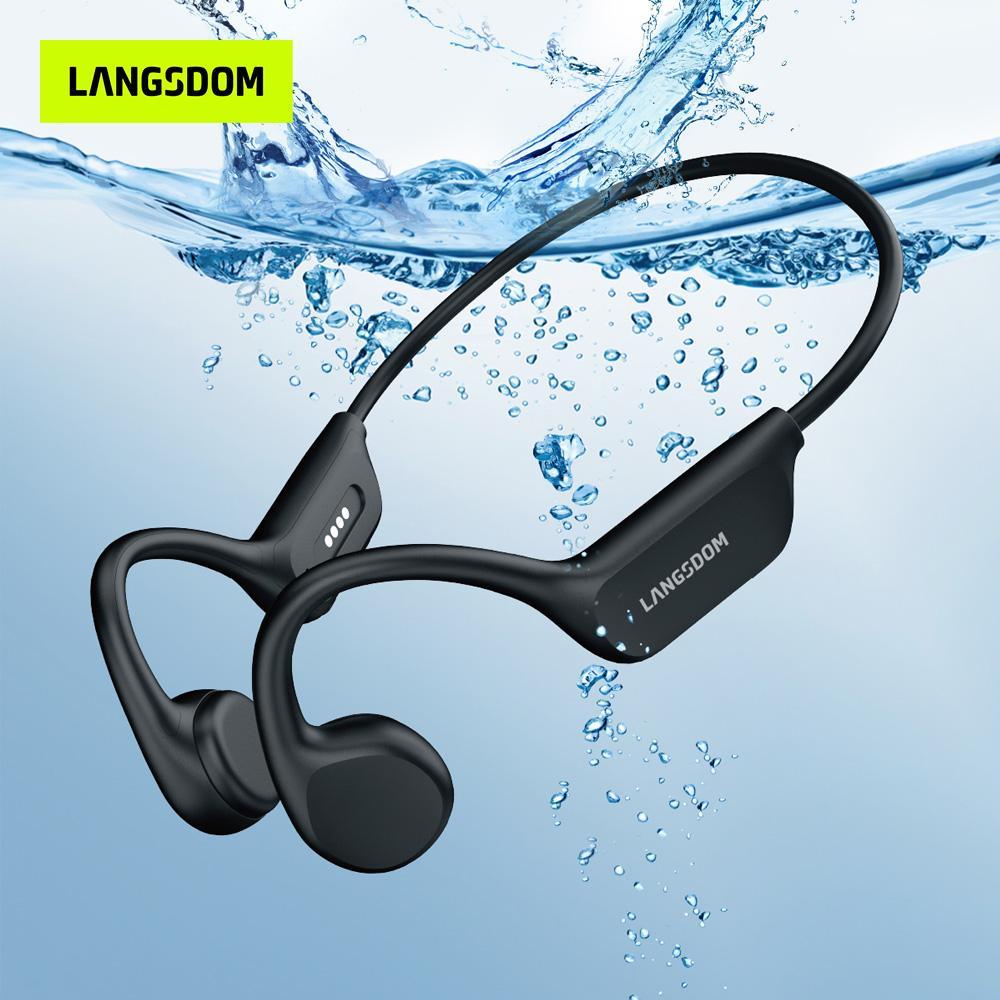

Photos from current listings. Actual item, color, and included accessories may vary.
Swimming Earphone Buying Guide
Swimming earphones are waterproof in-ear headphones built for lap swimming, open-water training, and shower use, and the defining trade-off is on-board MP3 memory versus Bluetooth—since Bluetooth signals cannot transmit through water. The durable rule: choose a sealed IPX8 or IP68 unit with 2-4 GB internal storage and a dedicated swim eartip system; any Bluetooth-only model is a land-only compromise.
Key takeaways
- Bluetooth does not propagate through water; swim-mode units must store 2-4 GB of MP3 files and run in local playback mode.
- IPX8 means continuous immersion beyond 1 m; IP68 adds dust ingress protection—both are required grades for lap swimming.
- Bone-conduction units avoid ear-canal occlusion but transmit through cheekbones; sealed in-ear designs deliver stronger bass and better noise isolation.
At a glance
- Category
- In-Ear Earphones
- Last updated
- Nov 28, 2026
Current offers
Highlights
- Bluetooth does not propagate through water; swim-mode units must store 2-4 GB of MP3 files and run in local playback mode.
- IPX8 means continuous immersion beyond 1 m; IP68 adds dust ingress protection—both are required grades for lap swimming.
- Bone-conduction units avoid ear-canal occlusion but transmit through cheekbones; sealed in-ear designs deliver stronger bass and better noise isolation.
- Swim eartips use multi-flange or memory-foam silicone that seals the canal against water; standard eartips leak and degrade rapidly in chlorinated water.
Best use cases
- Lap pool training: pick an IPX8 in-ear model with 2-4 GB MP3 memory and multi-flange eartips; skip Bluetooth-only models since signal drops the moment your head submerges.
- Open-water and triathlon training: choose bone-conduction IP68 units that leave the ear canal open for ambient safety and stay put under a swim cap.
- Casual shower and splash use: a standard IPX7 Bluetooth pair is adequate; skip the MP3-storage premium and the swim eartip kit.
- Competitive squad training with long sessions: prioritize 8+ hour battery in local-playback mode and a secure over-ear hook; skip short-battery clip-on designs.
Buying tips
- Confirm IPX8 or IP68 on the rating label itself—IPX7 handles splashes and brief immersion but not sustained lap swimming.
- Check MP3 storage capacity: 2 GB holds roughly 500 tracks at 128 kbps; 4 GB doubles that for long-course sets.
- Match eartip flange count to canal size: triple-flange seals narrow canals; memory-foam or double-flange suits wider canals.
- Verify local-playback battery life (target 6-10 hours) rather than Bluetooth runtime, which is irrelevant underwater.
Specs
| Waterproof Rating | IPX8 minimum / IP68 for open water |
|---|---|
| Playback Mode | On-board MP3 storage (Bluetooth fails underwater) |
| Storage Capacity | 2-4 GB (≈500-1000 tracks at 128 kbps) |
| Eartip Type | Multi-flange or memory-foam silicone swim tips |
Related searches
What to check before buying
- Measure your swim cap fit and goggle strap width—hook-style earphones must sit flat under the cap without pressure points.
- Confirm pool water chemistry: chlorinated and saltwater pools both require rinse-after-use care; IPX8 is the minimum for both.
- Check the charging connector type: magnetic pogo-pin charging avoids the micro-USB port corrosion that kills pool earphones.
- Verify the plug/voltage standard of the charger (USB 5 V) and that a charging case or cable is included, since magnetic cables are often proprietary.
FAQ
Data sources: eBay / Amazon listings and product attribute feeds. Updated Nov 28, 2026.
Some links on this page are affiliate links. If you buy after clicking one, we may earn a commission at no extra cost to you. This does not change which products appear here or their order. Affiliate disclosure.