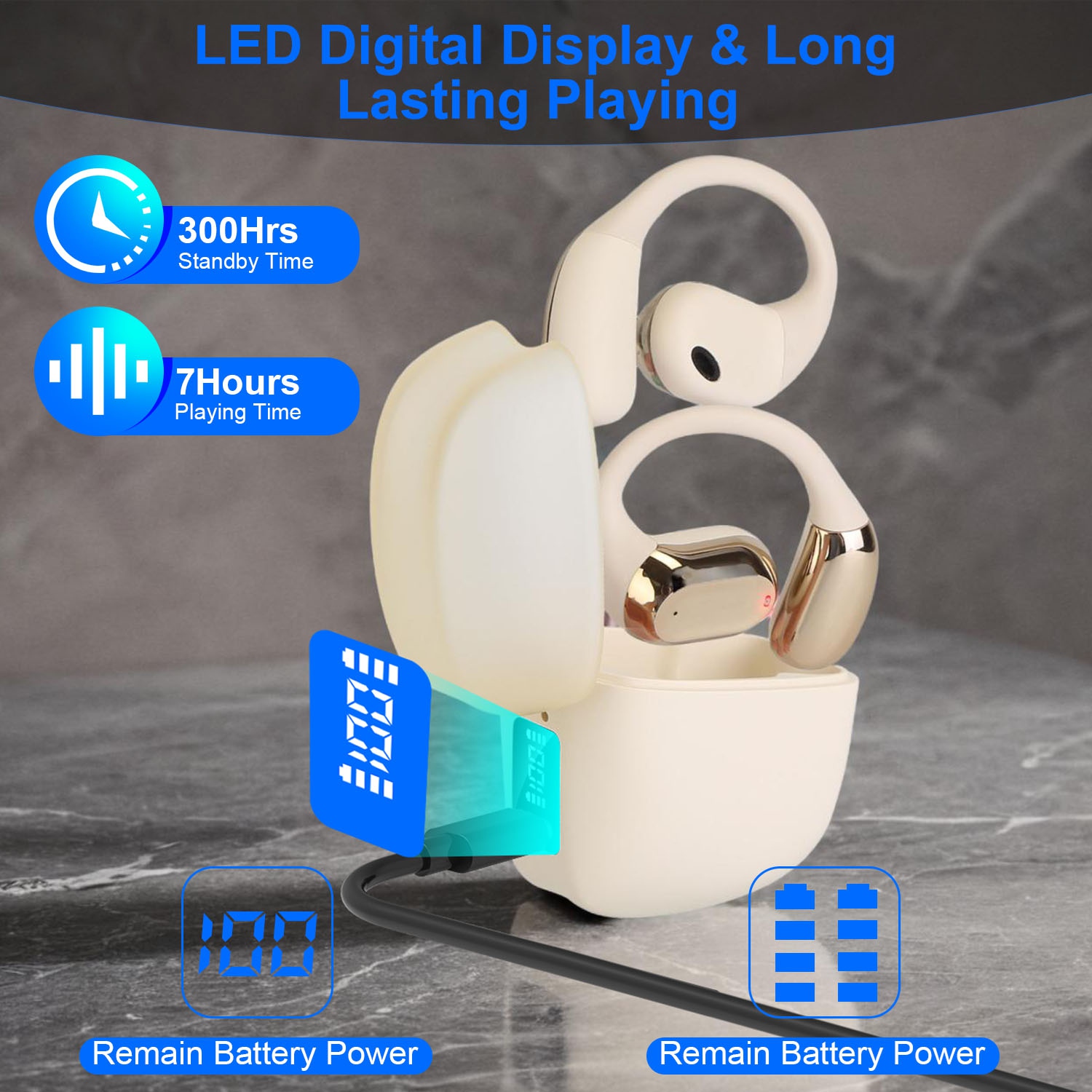

Photos from current listings. Actual item, color, and included accessories may vary.
Open Ear Wireless Earbud Buying Guide
Open-ear wireless earbuds use air-conduction drivers that sit outside the ear canal, trading passive isolation and bass depth for situational awareness and long-wear comfort. The core trade-off is acoustic coupling versus secure fit: ear-hook and ear-cuff designs stay put during motion but leak sound, while clip-on styles minimize leakage but demand precise placement. Choose ear-hook air-conduction for workouts and cycling, bone-conduction only when canal hygiene or total occlusion is the priority, and skip open-ear entirely if you need deep bass or commute-grade noise isolation.
Key takeaways
- Air-conduction open-ear drivers fire toward the concha without sealing the canal, so bass rolls off below roughly 100 Hz and output leaks at high volume.
- Bluetooth 5.3/5.4 with multipoint is the current baseline; older 5.0/5.1 chips increase latency and drop connections in crowded 2.4 GHz environments.
- IPX5 handles sweat and rain spray but not submersion; IPX7/IP68 is required for swimming or heavy downpour exposure.
At a glance
- Category
- In-Ear Earphones
- Last updated
- Nov 28, 2026
Current offers
Highlights
- Air-conduction open-ear drivers fire toward the concha without sealing the canal, so bass rolls off below roughly 100 Hz and output leaks at high volume.
- Bluetooth 5.3/5.4 with multipoint is the current baseline; older 5.0/5.1 chips increase latency and drop connections in crowded 2.4 GHz environments.
- IPX5 handles sweat and rain spray but not submersion; IPX7/IP68 is required for swimming or heavy downpour exposure.
- Ear-hook models anchor behind the auricle with a flexible titanium or TPU arm; clip-on models grip the helix and suit glasses wearers better.
Best use cases
- Running and cycling: pick ear-hook air-conduction with IPX5+ and 8+ hours per charge; skip bone-conduction if you want fuller music and wind-noise resistance.
- Office and open-plan work: choose a low-leakage clip-on or ear-cuff model with multipoint pairing; skip open-ear entirely if you need to block HVAC or conversation noise.
- Glasses wearers: a clip-on or ear-cuff design avoids the behind-ear collision of ear-hooks; skip thick-arm ear-hooks that press against spectacle temples.
- Swimming and water sports: only IPX8-rated bone-conduction with onboard memory qualifies; standard open-ear air-conduction earbuds are not pool-safe.
Buying tips
- Match the fit type to your ear: ear-hook arms need roughly 1.5–2 cm of clearance behind the auricle, while clip-on grips suit helix thickness under about 8 mm.
- Treat battery claims skeptically: a 300-hour standby figure reflects the charging case, not playtime; expect 6–12 hours per bud and 24–48 hours total with the case.
- Verify Bluetooth version and codec: 5.3/5.4 with AAC or LDAC gives lower latency and stabler multipoint than 5.0 with SBC only.
- Check the charging case connector: USB-C is now standard, while micro-USB indicates older stock and slower top-ups.
Specs
| Fit Style | Ear-hook / clip-on / ear-cuff |
|---|---|
| Bluetooth Version | 5.3–5.4 (5.0/5.1 older) |
| Waterproof Rating | IPX5 sweat / IPX7–IPX8 swim |
| Battery Playtime | 6–12 hr bud, 24–48 hr case |
Related searches
What to check before buying
- Measure behind-ear clearance for ear-hook arms and confirm your glasses temples won't collide with the hook.
- Confirm your phone supports the bud's Bluetooth version and preferred codec before expecting multipoint or low-latency modes.
- Check the IP rating against your sweat level and weather: IPX5 for gym use, IPX7/IP68 for rain or pool.
- Verify the case fits your pocket or bag and that USB-C charging matches your existing cables and adapters.
FAQ
Data sources: eBay / Amazon listings and product attribute feeds. Updated Nov 28, 2026.
Some links on this page are affiliate links. If you buy after clicking one, we may earn a commission at no extra cost to you. This does not change which products appear here or their order. Affiliate disclosure.