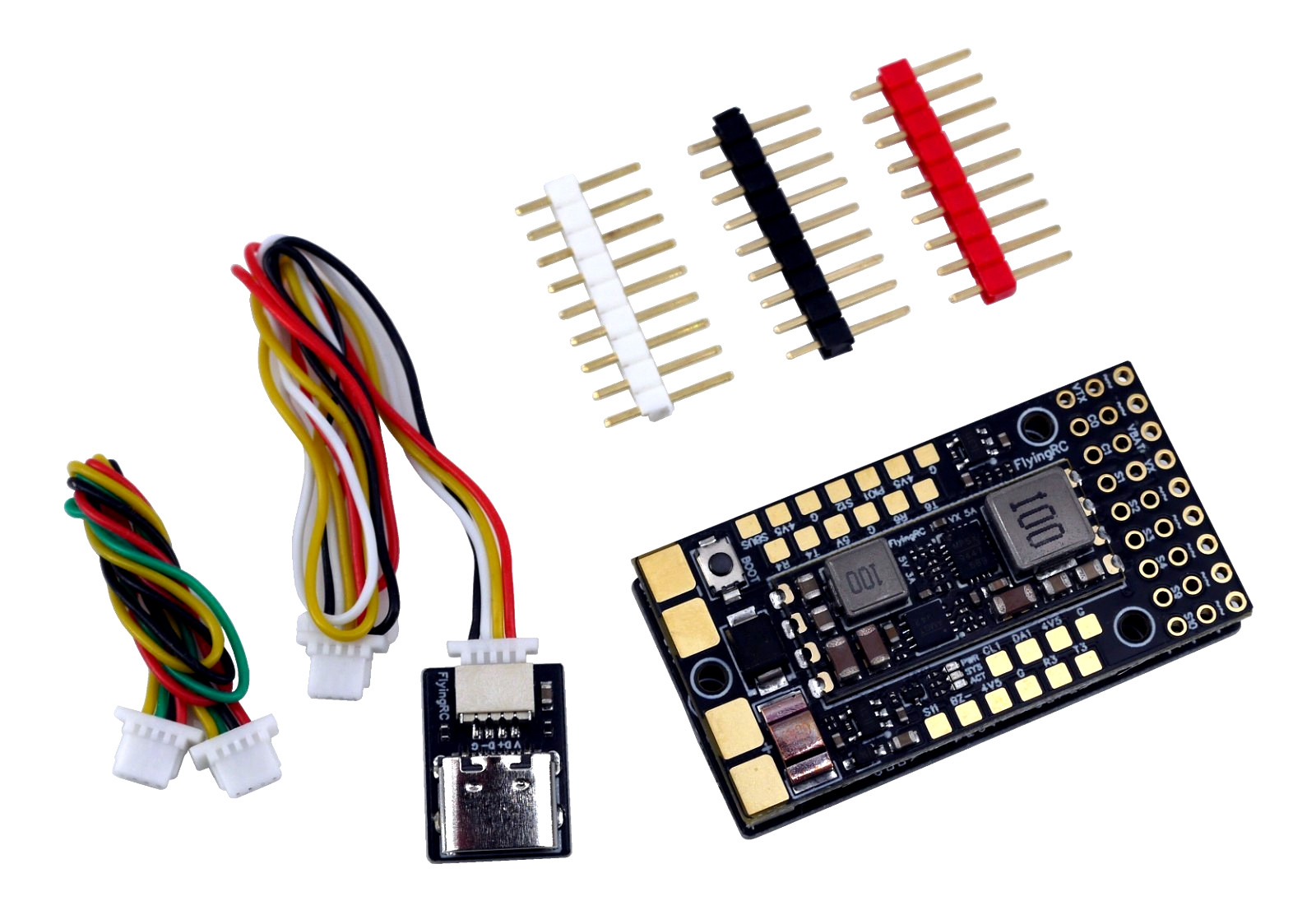

Photos from current listings. Actual item, color, and included accessories may vary.
RC Flight Controller Buying Guide
An RC flight controller is the stabilization and control brain of an FPV or fixed-wing model, translating pilot input and sensor data into motor and servo commands. The core trade-off is processor headroom and firmware ecosystem versus I/O layout and build quality: F4 boards are the minimum for modern Betaflight/INAV features, while F7 and H7 boards add faster loop times, more UARTs, and headroom for GPS rescue and HD video. Buy for your airframe's required outputs first, then match the processor generation and firmware target.
Key takeaways
- STM32 F4 (168 MHz) runs Betaflight/INAV adequately but limits loop rate and peripheral count; F7 (216 MHz) and H7 (480 MHz) unlock faster gyro sampling and more serial ports for GPS, HD VTX, and telemetry.
- Fixed-wing builds need at least 4-6 PWM servo outputs plus a dedicated UART for GPS and another for receiver; multirotor builds need 4 motor outputs with DShot capability and a current-sense pad.
- Integrated gyro matters: MPU6000 is proven and vibration-tolerant; ICM42688 and BMI270 offer SPI speed but can be more sensitive to frame resonance, requiring soft-mounting.
At a glance
- Category
- FPV Flight Controllers
- Last updated
- Nov 23, 2026
Current offers
Highlights
- STM32 F4 (168 MHz) runs Betaflight/INAV adequately but limits loop rate and peripheral count; F7 (216 MHz) and H7 (480 MHz) unlock faster gyro sampling and more serial ports for GPS, HD VTX, and telemetry.
- Fixed-wing builds need at least 4-6 PWM servo outputs plus a dedicated UART for GPS and another for receiver; multirotor builds need 4 motor outputs with DShot capability and a current-sense pad.
- Integrated gyro matters: MPU6000 is proven and vibration-tolerant; ICM42688 and BMI270 offer SPI speed but can be more sensitive to frame resonance, requiring soft-mounting.
- Onboard voltage regulation (5V BEC, 9V VTX pad) and a barometer determine whether you can power a receiver and GPS without an external BEC, and whether altitude hold works.
Best use cases
- Choose an F4 or F7 board with 6+ PWM outputs and a barometer for fixed-wing FPV planes; skip multirotor-only boards with 4 motor outputs and no servo rail.
- Choose an F7 or H7 board with dual gyro and 8 motor outputs for 5-inch freestyle quads running Betaflight with GPS rescue; skip F4 boards if you need 8 kHz+ loop times and HD OSD.
- Choose a board with onboard 9V/12V VTX regulation and a plug-in DJI/Caddx harness for digital HD builds; skip boards that only offer 5V VTX pads if your air unit needs 9V.
- Choose a wing board with a built-in current sensor and 4-6S input range for long-range fixed-wing; skip 2-4S-only boards if you plan to run 6S packs.
Buying tips
- Count outputs before anything else: a fixed-wing with aileron, elevator, rudder, throttle, and flaps needs 5-6 servo outputs, while a quad needs exactly 4 motor outputs plus a current-sense input.
- Match processor to firmware: F4 supports Betaflight 4.x and INAV but with reduced features; F7/H7 are required for the latest GPS rescue, HD OSD, and high-rate gyro features.
- Verify input voltage range: 3-6S (11.1-25.2V) boards suit most 5-inch and wing builds, while 2-4S boards are limited to small quads and lightweight fixed-wing setups.
- Check gyro mounting: soft-mounted gyros reduce propwash oscillation on quads; hard-mounted boards are fine for fixed-wing but need vibration isolation from the airframe.
Specs
| Processor | STM32 F4 / F7 / H7 |
|---|---|
| PWM Outputs | 4-8 (motor or servo) |
| Input Voltage | 2-6S LiPo (7.4-25.2V) |
| Mounting Pattern | 20x20 / 30.5x30.5 mm |
Related searches
What to check before buying
- Measure your frame's mounting pattern: 30.5x30.5 mm is standard for 5-inch quads, while 20x20 mm suits sub-250 g builds and many fixed-wing stacks.
- Confirm your receiver protocol: SBUS, CRSF, and ELRS require specific UART pads; ensure the board has at least one free full UART after GPS and VTX are assigned.
- Check your VTX voltage: analog 5V VTXs run from the 5V pad, but DJI/Caddx air units need 9V or 12V, so verify the board's BEC output matches.
- Verify physical clearance: a 30.5 mm board with side-mounted USB and pads needs frame space for the plug and wire routing, especially in tight wings.
FAQ
Data sources: eBay / Amazon listings and product attribute feeds. Updated Nov 23, 2026.
Some links on this page are affiliate links. If you buy after clicking one, we may earn a commission at no extra cost to you. This does not change which products appear here or their order. Affiliate disclosure.