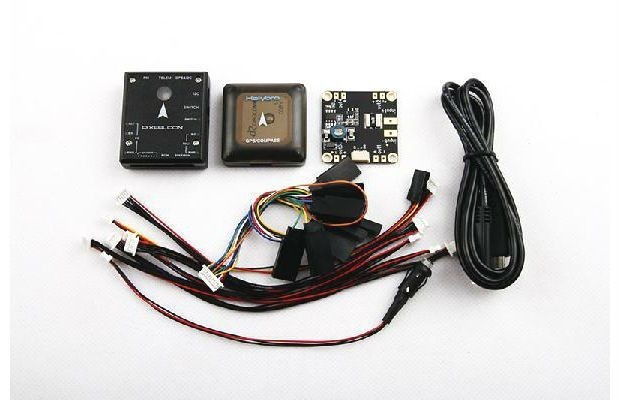

Photos from current listings. Actual item, color, and included accessories may vary.
Px4 Flight Controller Buying Guide
A PX4 flight controller is an autopilot board running the open-source PX4 stack, used for GPS-guided missions, position hold, and autonomous flight rather than pure manual FPV. The core trade-off is onboard sensor fusion and processor headroom versus cost: genuine PX4-optimized hardware pairs a fast MCU with redundant IMUs, barometer, and magnetometer support, while stripped boards force you to add external sensors and rely on weaker fusion. Pick a board with a dedicated PX4 target and exposed GPS/telemetry/I2C ports if you need waypoint missions; choose a basic F4/F7 board only for manual freestyle where GPS is irrelevant.
Key takeaways
- PX4-optimized boards carry a dedicated PX4 board target and run the full stack with EKF2 sensor fusion, requiring at least one GPS/mag and often a second IMU or barometer for reliable position hold.
- Processor tier separates capability: F4-class MCUs handle basic PX4 builds, F7/H7-class boards provide the headroom for dual-IMU fusion, onboard logging, and faster loop rates needed for autonomous missions.
- Sensor redundancy is the durability and reliability metric: boards with two IMUs and a barometer tolerate vibration and single-sensor failure, while single-IMU boards are manual-flight only.
At a glance
- Category
- FPV Flight Controllers
- Last updated
- Nov 23, 2026
Current offers
Highlights
- PX4-optimized boards carry a dedicated PX4 board target and run the full stack with EKF2 sensor fusion, requiring at least one GPS/mag and often a second IMU or barometer for reliable position hold.
- Processor tier separates capability: F4-class MCUs handle basic PX4 builds, F7/H7-class boards provide the headroom for dual-IMU fusion, onboard logging, and faster loop rates needed for autonomous missions.
- Sensor redundancy is the durability and reliability metric: boards with two IMUs and a barometer tolerate vibration and single-sensor failure, while single-IMU boards are manual-flight only.
- A genuine M8N GPS/mag module uses concurrent GPS+GLONASS reception and a compass with a defined orientation; mismatched or low-quality modules cause toilet-bowling and failed arming more than the controller itself.
Best use cases
- Best fit: autonomous waypoint, survey, or return-to-home builds — pick an F7/H7-class PX4-target board with dual IMUs, barometer, and a clear GPS/telemetry port map.
- Best fit: GPS-assisted position hold for cinematic or beginner stabilization — a mid-tier F4/F7 PX4 board plus an M8N GPS/mag is the minimum reliable configuration.
- Wrong fit: pure manual freestyle or racing where latency and weight dominate — a PX4 stack adds sensor and GPS overhead; choose a lightweight Betaflight/INAV-focused F4/F7 board instead.
- Wrong fit: micro whoops or sub-2-inch builds — full PX4 autopilot boards and GPS modules exceed the weight and space budget; use a minimalist all-in-one flight controller.
Buying tips
- Match the board's firmware target to PX4 before purchase: a board with an official PX4 target and documented pinout saves hours versus unsupported clones.
- Choose an F7 or H7 MCU if you plan dual-IMU fusion, onboard blackbox logging, or fast autonomous loops; F4 is adequate only for basic GPS-assisted flight.
- Budget a GPS/mag module with concurrent GPS+GLONASS and a known compass orientation (e.g., M8N-class), and mount it on a mast away from power wiring.
- Confirm voltage and port standards: 5V input from a BEC, separate telemetry UART, I2C for external compass, and a buzzer/safety-switch header — missing ports force workarounds.
Specs
| Firmware Stack | PX4 with dedicated board target |
|---|---|
| MCU Tier | F4 basic / F7-H7 advanced |
| IMU Redundancy | Single vs dual IMU fusion |
| GPS/Mag Support | M8N-class GPS+GLONASS, I2C compass |
Related searches
What to check before buying
- Measure your frame's mounting pattern (30.5×30.5mm or 20×20mm) and confirm the board's hole spacing and overall footprint fit without stacking conflicts.
- Verify your power system delivers a clean 5V rail at sufficient current for the controller plus GPS and receiver, and that your ESC telemetry protocol matches the board's inputs.
- Check that you have a GPS mounting location with sky view and clearance from VTX and power leads, plus a mast or standoff to isolate the compass.
- Confirm your radio receiver protocol (SBUS, CRSF, or serial) and telemetry radio compatibility with the board's available UARTs before finalizing the build.
FAQ
Data sources: eBay / Amazon listings and product attribute feeds. Updated Nov 23, 2026.
Some links on this page are affiliate links. If you buy after clicking one, we may earn a commission at no extra cost to you. This does not change which products appear here or their order. Affiliate disclosure.