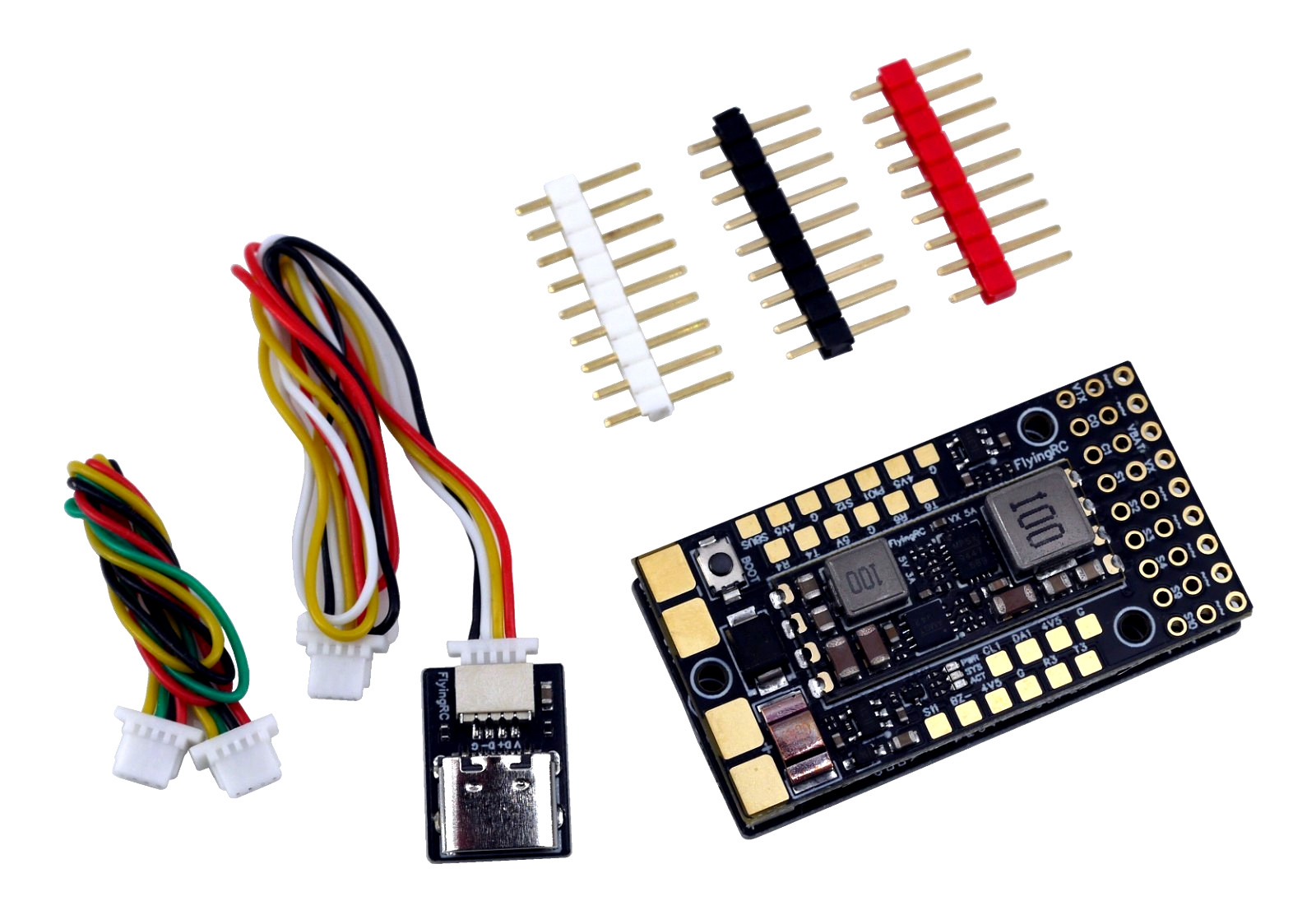

Photos from current listings. Actual item, color, and included accessories may vary.
Fixed Wing Flight Controller Buying Guide
Fixed-wing flight controllers are the autopilot brains that stabilize planes, gliders, and wings, differing from quad controllers mainly in firmware support for fixed-wing mixing, servo outputs, and airspeed handling. The core trade-off is processing headroom and sensor quality versus price: F4 boards are adequate for basic stabilization and GPS return-to-home, while F7/H7 boards unlock faster loop rates, more UARTs, and robust ArduPlane/INAV features. Choose by firmware ecosystem and I/O count first, not by flashy labels; a well-cooled F405 with proper power modules beats an undersized H7 with no BEC or airspeed port.
Key takeaways
- F4 (STM32F405) runs INAV/ArduPlane at 1–8 kHz loop rates with 1MB flash; F7 (STM32F722/F745) doubles RAM and adds 2–4x UARTs for GPS, telemetry, and airspeed simultaneously.
- Fixed-wing firmware requires at least 4–6 PWM servo outputs plus a dedicated airspeed (I2C/analog) input for ArduPlane; INAV uses a single pitot via I2C and supports up to 8 motor/servo outputs on F405.
- Onboard BEC current matters: planes with 4+ digital servos need a 5V/3A BEC or a separate UBEC; most 30.5x30.5mm boards supply only 1.5–2A and will brown out under stall-load servo current.
At a glance
- Category
- FPV Flight Controllers
- Last updated
- Nov 23, 2026
Current offers
Highlights
- F4 (STM32F405) runs INAV/ArduPlane at 1–8 kHz loop rates with 1MB flash; F7 (STM32F722/F745) doubles RAM and adds 2–4x UARTs for GPS, telemetry, and airspeed simultaneously.
- Fixed-wing firmware requires at least 4–6 PWM servo outputs plus a dedicated airspeed (I2C/analog) input for ArduPlane; INAV uses a single pitot via I2C and supports up to 8 motor/servo outputs on F405.
- Onboard BEC current matters: planes with 4+ digital servos need a 5V/3A BEC or a separate UBEC; most 30.5x30.5mm boards supply only 1.5–2A and will brown out under stall-load servo current.
- Barometer and IMU quality varies: BMP280 vs DPS310 (altitude hold) and MPU6000 vs ICM42688 (vibration rejection); fixed-wing GPS return-to-home depends on a stable baro and low-noise IMU, not just GPS.
Best use cases
- Best fit: 3–5 channel park flyers and 1–1.5m wings with INAV — pick an F405 board with 6 PWM outputs, 5V/2A BEC, and I2C pads for compass/airspeed; skip H7 unless you need 10+ UARTs.
- Best fit: long-range FPV planes with ArduPlane — choose F765/H743 with dual IMUs, 7+ UARTs, and onboard OSD; skip F411 boards that lack flash for terrain data and full ArduPlane builds.
- Wrong fit: 3D aerobatic or turbine models needing 12+ high-current servo outputs — a 30.5mm fixed-wing FC is inadequate; use a dedicated power distribution board with a separate stabilizer or a large-format autopilot.
- Wrong fit: micro sub-250g planes where every gram counts — a full-size F405 with headers adds 8–12g; use a 20x20mm or AIO board with integrated receiver and VTX instead.
Buying tips
- Count servo outputs before buying: 4-channel plane needs 4 PWM plus 1 for throttle; add 1 per aileron/flap and 1 for airspeed/arming — F405 boards typically expose 6–8, F7 boards 8–12.
- Match BEC to servo count: analog 9g servos draw ~0.3A each, digital metal-gear servos 0.8–1.5A each; 4 digital servos demand a 5V/3A BEC, so add a UBEC if the board lists 2A or less.
- Firmware target decides chip: INAV 7.x supports F405/F411/F7/H7; ArduPlane 4.5+ needs 1MB flash (F405 minimum) and recommends F7/H7 for GPS blending and dual IMU; avoid F411 for ArduPlane.
- Check voltage sensing and current input pads: fixed-wing return-to-home and battery failsafe require a current sensor pad and a power module rated for your pack (2–6S); boards without a current pad need an external sensor.
Specs
| MCU Class | F405 / F722 / H743 (flash 1MB+) |
|---|---|
| PWM Outputs | 6–12 servo/motor pads |
| Firmware Target | INAV / ArduPlane / Betaflight |
| Mount Pattern | 30.5x30.5mm / 20x20mm |
Related searches
What to check before buying
- Measure your airframe's servo bay and mounting pattern: 30.5x30.5mm stacks need 30.5mm spacing; 20x20mm boards suit micro planes; verify frame standoff height clears the barometer foam.
- Confirm your radio receiver protocol: SBUS/CRSF/ELRS input pads must be present and uninverted; F4 boards often have a dedicated SBUS pad while F7 uses any UART with softserial.
- Plan GPS and airspeed placement: GPS needs a UART, compass needs I2C, and airspeed needs I2C or analog — count free ports after receiver, VTX control, and telemetry.
- Check power module compatibility: match XT30/XT60 connector and voltage range (2–6S) to your ESC and battery; verify the board's VBAT pad accepts the module's divider ratio (usually 10:1 or 11:1).
FAQ
Data sources: eBay / Amazon listings and product attribute feeds. Updated Nov 23, 2026.
Some links on this page are affiliate links. If you buy after clicking one, we may earn a commission at no extra cost to you. This does not change which products appear here or their order. Affiliate disclosure.