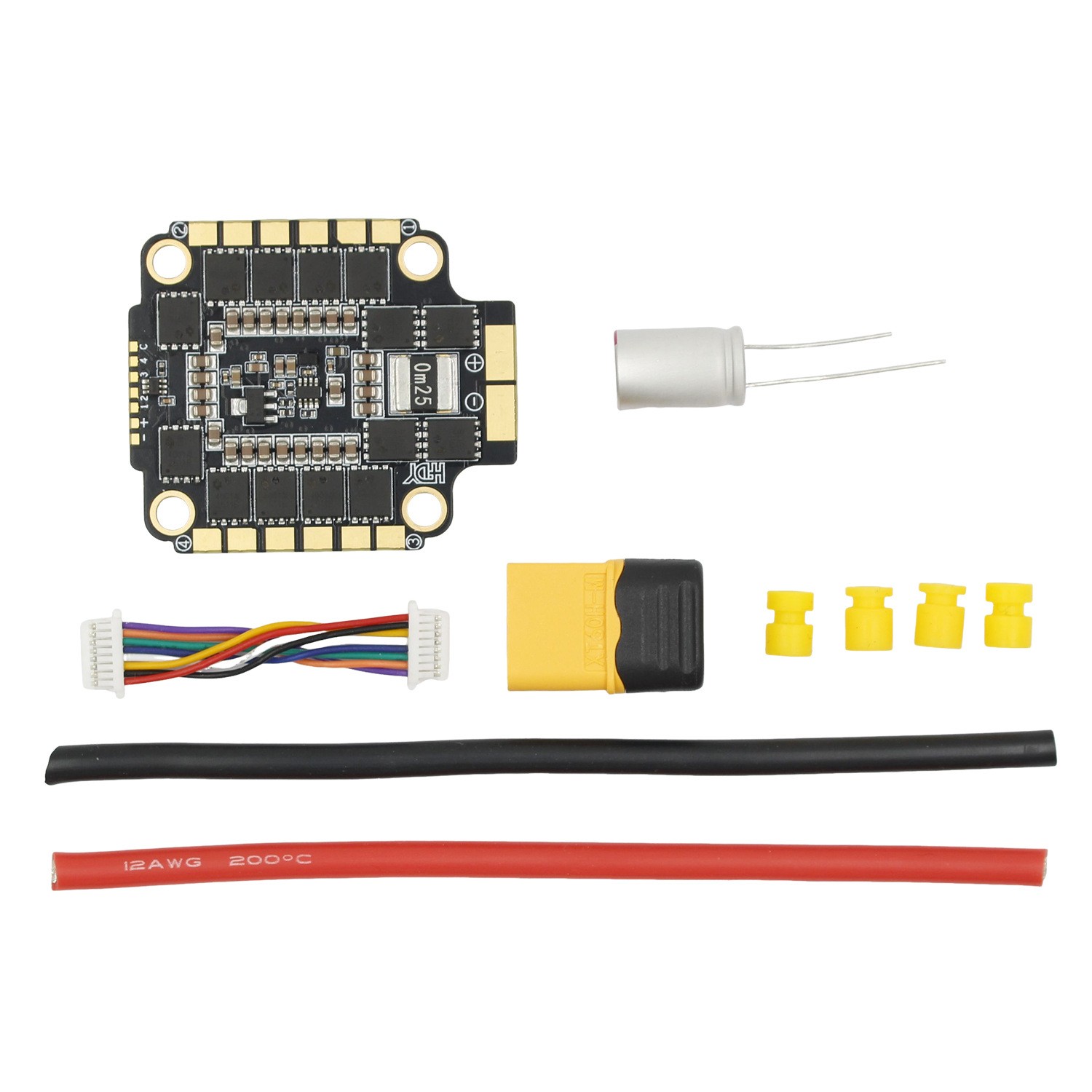

Photos from current listings. Actual item, color, and included accessories may vary.
Drone Flight Controller Board Buying Guide
A drone flight controller board is the central processing and stabilization unit that translates pilot input and sensor data into motor commands. The primary trade-off is between MCU headroom (F4 vs F7/H7) and firmware ecosystem support, with build durability determined by pad quality, gyro isolation, and voltage regulation. Choose an F7/H7 board with dual gyros and 5V/9V BEC if you fly modern digital HD or aggressive freestyle; choose an F4 board only for lightweight analog freestyle or budget builds where firmware simplicity matters.
Median $76.13
Key takeaways
- MCU generation dictates firmware ceiling: F4 (STM32F405) runs Betaflight with limited features; F7 (STM32F745) and H7 (STM32H743) unlock 8kHz+ PID loops, dual gyro support, and full GPS/rescue modes.
- Gyro choice and isolation determine vibration resilience: BMI270 offers low noise and is well-supported; ICM42688P provides higher resolution but needs soft-mounting; dual-gyro boards let firmware switch to the cleaner sensor mid-flight.
- Integrated BEC ratings decide peripheral compatibility: 5V/3A handles analog VTX and receiver; 9V/2A or 10V/2A is required for DJI/Caddx digital air units; boards with only 5V/1.5A brown out under digital load.
At a glance
- Category
- FPV Flight Controllers
- Last updated
- Nov 23, 2026
Current offers
Highlights
- MCU generation dictates firmware ceiling: F4 (STM32F405) runs Betaflight with limited features; F7 (STM32F745) and H7 (STM32H743) unlock 8kHz+ PID loops, dual gyro support, and full GPS/rescue modes.
- Gyro choice and isolation determine vibration resilience: BMI270 offers low noise and is well-supported; ICM42688P provides higher resolution but needs soft-mounting; dual-gyro boards let firmware switch to the cleaner sensor mid-flight.
- Integrated BEC ratings decide peripheral compatibility: 5V/3A handles analog VTX and receiver; 9V/2A or 10V/2A is required for DJI/Caddx digital air units; boards with only 5V/1.5A brown out under digital load.
- Pad and connector quality separates durable boards from compromises: 4-layer PCBs with 2oz copper and through-hole motor pads resist delamination; JST-SH 1.0 connectors and USB-C with strain relief prevent field failures.
Best use cases
- Best fit: 5-inch freestyle or cinematic builds with digital HD — pick an F7/H7 board with 9V/2A BEC, dual gyros, and 30.5x30.5mm mounting; skip F4 boards with single 5V BEC.
- Best fit: sub-250g toothpick or 3-inch analog builds — choose a 20x20mm F4 or F7 AIO with integrated 4-in-1 ESC and 5V/2A BEC; avoid full-size 30.5mm stacks that add weight.
- Best fit: long-range or GPS-rescue quads — require an H7 board with barometer, full UART set (6+), and 9V BEC for HD VTX; skip boards with only 4 UARTs and no barometer.
- Wrong fit: cinematic heavy-lift or 7-inch builds — do not use a 20x20 AIO with 40A ESC; select a 30.5x30.5 board with external 4-in-1 ESC rated 60A+ and dual gyros for prop vibration isolation.
Buying tips
- Match mounting pattern to frame: 30.5x30.5mm for 5-inch and larger; 25.5x25.5mm or 20x20mm for 3-4 inch; 16x16mm for sub-250g. Verify hole spacing and soft-mount grommet diameter before ordering.
- Check BEC output against VTX draw: analog VTX needs 5V/1.5A minimum; DJI O3/Caddx Vista requires 9V/2A or 10V/2A. A board with only 5V/2A will not reliably power digital air units.
- Count UARTs for peripherals: receiver (1), GPS (1-2), VTX control (1), camera control (1), ESC telemetry (1). Six UARTs is the practical minimum for modern builds; eight is future-proof.
- Prefer boards with exposed motor pads and through-hole solder points over micro-connectors for motor wiring; JST-SH 1.0 connectors are standard for GPS and VTX but fragile — inspect for reinforced solder tabs.
Specs
| MCU Tier | F4 / F7 / H7 (STM32) |
|---|---|
| Mounting Pattern | 30.5 / 25.5 / 20 / 16 mm |
| BEC Output | 5V/2A-3A; 9V/2A for HD VTX |
| Gyro Config | Single or dual (BMI270 / ICM42688P) |
Related searches
What to check before buying
- Measure frame stack height and mounting hole spacing (30.5, 25.5, 20, or 16mm) and confirm soft-mount grommet compatibility with the board's hole diameter.
- Verify input voltage range (2-6S LiPo typical) against your battery plan; 6S builds need boards rated for 25V+ input and ESCs rated for 6S.
- Confirm your radio receiver protocol (ELRS, Crossfire, SBUS) and available UART; ELRS requires a full UART with TX/RX, not a half-duplex pad.
- Check physical clearance for USB-C port and SD card slot inside the frame; right-angle adapters may be needed for low-profile builds.
FAQ
Data sources: eBay / Amazon listings and product attribute feeds. Updated Nov 23, 2026.
Some links on this page are affiliate links. If you buy after clicking one, we may earn a commission at no extra cost to you. This does not change which products appear here or their order. Affiliate disclosure.