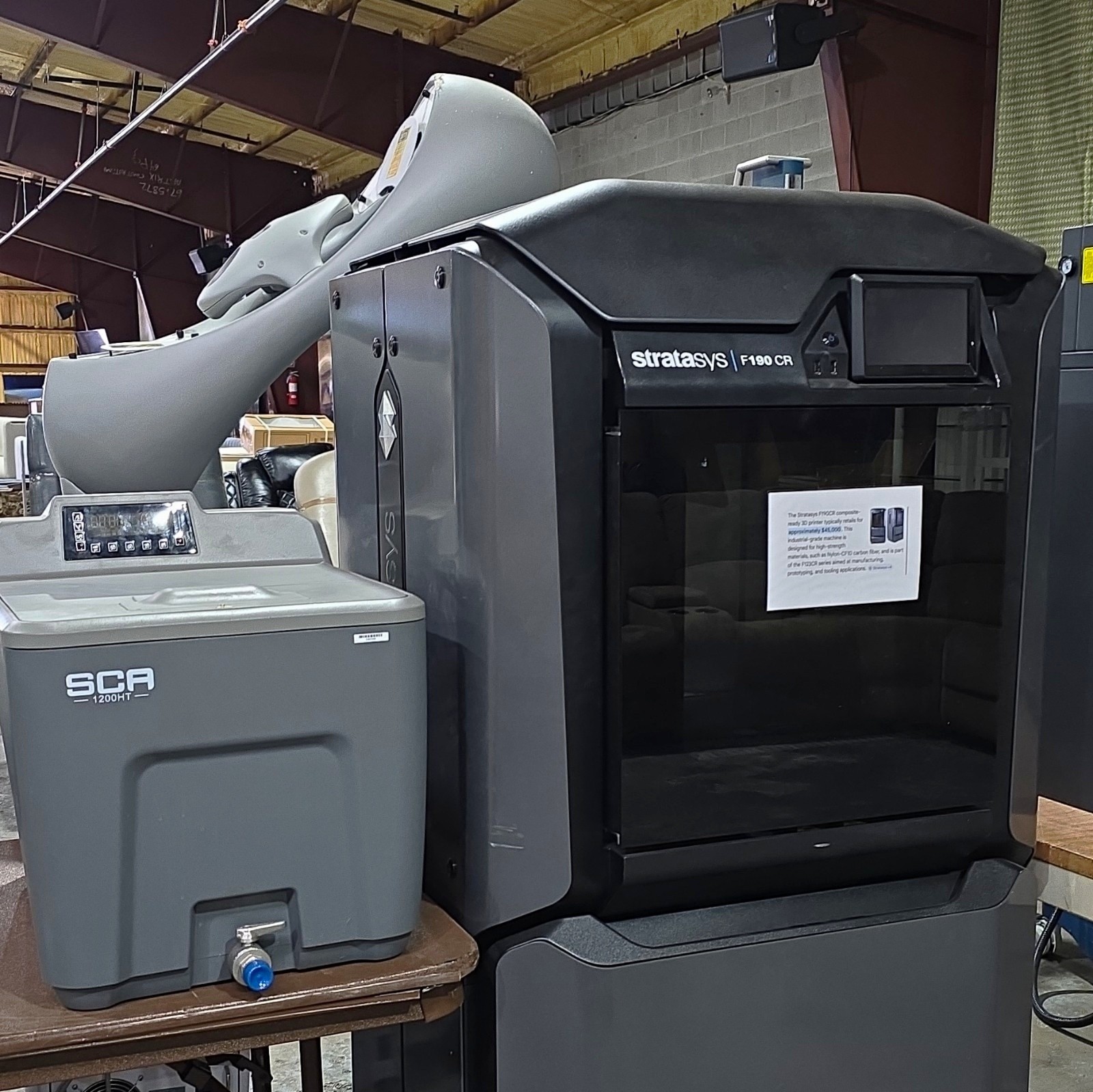

Photos from current listings. Actual item, color, and included accessories may vary.
Stratasy FDM Printer Buying Guide
Stratasys FDM printers are industrial-grade fused deposition modeling systems that prioritize repeatable engineering-grade output, soluble support, and chamber-controlled thermal stability over low upfront cost. The core trade-off is between an open-material, hobby-class machine and a closed, validated ecosystem where firmware, slicer profiles, and heated build chambers are locked to certified thermoplastics. The decision rule: if you need unattended production of functional end-use parts in ABS, PC, or ULTEM, a Stratasys-class closed FDM is mandatory; for visual prototypes or low-volume PLA work, an open-source desktop FDM delivers the same geometry at a fraction of the lifecycle cost.
Key takeaways
- Stratasys FDM lines split into office-grade (F123 Series: PLA/ABS/ASA with soluble support) and industrial-grade (F370/F450/F900: PC-ABS, Nylon12, ULTEM 9085 with heated chambers up to 200°C).
- Soluble support material (SR-30/SR-35) enables complex internal geometry and dissolvable interfaces — a capability open desktop FDM cannot match without dual extrusion and caustic bath handling.
- Closed heated build chambers (70–200°C) and sealed filament bays prevent warping in high-shrinkamorphous polymers like ABS and PC, delivering ±0.127 mm or better repeatability across the build volume.
At a glance
- Category
- FDM 3D Printers
- Last updated
- Nov 28, 2026
Current offers
Highlights
- Stratasys FDM lines split into office-grade (F123 Series: PLA/ABS/ASA with soluble support) and industrial-grade (F370/F450/F900: PC-ABS, Nylon12, ULTEM 9085 with heated chambers up to 200°C).
- Soluble support material (SR-30/SR-35) enables complex internal geometry and dissolvable interfaces — a capability open desktop FDM cannot match without dual extrusion and caustic bath handling.
- Closed heated build chambers (70–200°C) and sealed filament bays prevent warping in high-shrinkamorphous polymers like ABS and PC, delivering ±0.127 mm or better repeatability across the build volume.
- Proprietary filament spools with RFID chips lock material profiles to the machine — this guarantees print parameters but eliminates third-party material sourcing and raises per-part cost.
Best use cases
- Best fit: production-floor jigs, fixtures, and end-use parts in ULTEM or PC — choose the F900 or F450 with heated chamber and soluble support; skip desktop open-frame printers that warp on engineering resins.
- Best fit: regulated industries (aerospace, medical) needing traceable material certificates and validated processes — pick Stratasys with RFID-locked spools; avoid third-party 'Stratasys-compatible' filaments that void process validation.
- Wrong fit: hobbyist, classroom, or low-volume (<50 parts/year) visual modeling — a Stratasys lease or purchase cannot be justified; use a Creality/Prusa-class open FDM and accept manual support removal.
- Wrong fit: multi-color or full-color cosmetic parts — Stratasys FDM is single/two-material functional; for color, use PolyJet or desktop multi-color FDM instead.
Buying tips
- Match chamber temperature to polymer: ABS/ASA require ≥70°C chamber; PC/PC-ABS need ≥135°C; ULTEM 9085 demands ≥190°C — an open printer cannot hold these, so do not attempt high-temp resins on F123-class machines.
- Size the build volume to your largest single part plus support: F123 series offers ~250×200×200 mm; F370 ~355×254×355 mm; F450 ~406×355×406 mm; F900 up to 914×610×914 mm — undersizing forces part splitting and bonded assemblies.
- Budget for proprietary material: Stratasys spools cost 5–10× generic equivalents; calculate annual filament mass (kg) × spool price before committing, and factor soluble support consumption at roughly 30–50% of model material.
- Confirm slicer and firmware licensing: GrabCAD Print or Insight is bundled per machine seat; older Fortus systems may require Insight on a licensed workstation — verify the software seat transfers with any used unit.
Specs
| Chamber Temp | 70°C office / 135–200°C industrial |
|---|---|
| Build Volume | 200–914 mm per axis by model tier |
| Materials | PLA/ABS/ASA to PC/ULTEM 9085 |
| Support Type | Soluble SR-30/SR-35 or breakaway |
Related searches
What to check before buying
- Measure the largest part envelope (X×Y×Z in mm) including support; compare against the machine's published build volume with at least 10% margin.
- Verify facility power: industrial FDM units draw 2–6 kW at 208–240 V single-phase; confirm dedicated circuit and HVAC capacity for chamber heat rejection.
- Check floor space and clearance: F450/F900 need rear service access (~1 m) and a stable floor; office-class F123 fits a benchtop with 0.5 m clearance.
- Confirm material availability and shelf life: sealed Stratasys spools expire in 12–24 months; ensure your usage rate justifies full spool purchases and that soluble support tanks (if used) have drainage.
FAQ
Data sources: eBay / Amazon listings and product attribute feeds. Updated Nov 28, 2026.
Some links on this page are affiliate links. If you buy after clicking one, we may earn a commission at no extra cost to you. This does not change which products appear here or their order. Affiliate disclosure.