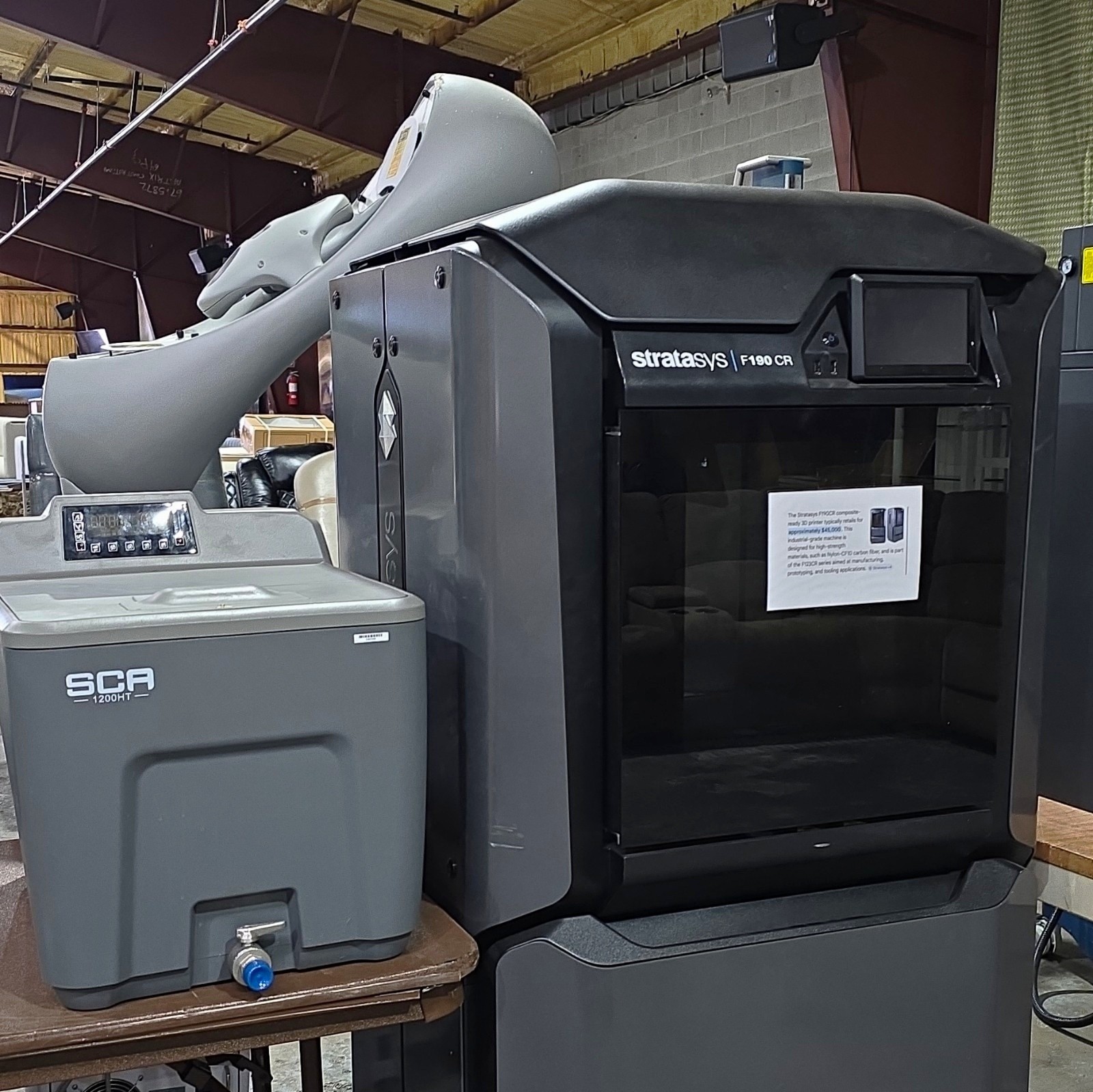

Photos from current listings. Actual item, color, and included accessories may vary.
Stratasy FDM 3D Printer Buying Guide
Stratasys FDM 3D printers are industrial-grade fused deposition modeling systems built for repeatable, engineering-grade thermoplastics—not hobbyist PLA tinkering. The core trade-off is closed-material, heated-chamber architecture with vendor-locked consumables versus open-market machines that can print cheaper but cannot match Stratasys dimensional repeatability or soluble-support workflows. Choose Stratasys when you need validated ULTEM, PPSF, or ABS-M30 parts with traceable mechanical properties; skip it if your parts are visual prototypes or low-stress fixtures where a hobby FDM at a fraction of the cost suffices.
Key takeaways
- Stratasys FDM systems use heated build chambers (typically 80–145°C) and high-temperature extruders (up to 450°C+) required for engineering thermoplastics like ULTEM 9085, PPSF, and ABS-M30—commodity open-frame printers cannot reach these ranges.
- Soluble support (SR-30, SR-100, SUP705) enables complex overhangs and internal channels; the support material is dissolved in a heated ultrasonic bath, eliminating manual breakaway damage on intricate geometries.
- Material ecosystems are vendor-locked: Stratasys machines require Stratasys-branded cartridges/chips, and third-party filament is not supported—budget for consumable cost per part, not just machine acquisition.
At a glance
- Category
- FDM 3D Printers
- Last updated
- Nov 28, 2026
Current offers
Highlights
- Stratasys FDM systems use heated build chambers (typically 80–145°C) and high-temperature extruders (up to 450°C+) required for engineering thermoplastics like ULTEM 9085, PPSF, and ABS-M30—commodity open-frame printers cannot reach these ranges.
- Soluble support (SR-30, SR-100, SUP705) enables complex overhangs and internal channels; the support material is dissolved in a heated ultrasonic bath, eliminating manual breakaway damage on intricate geometries.
- Material ecosystems are vendor-locked: Stratasys machines require Stratasys-branded cartridges/chips, and third-party filament is not supported—budget for consumable cost per part, not just machine acquisition.
- Model tiers differ by chamber size and material capability: F123 Series (F170/F270/F370) uses ABS/ASA/PLA and soluble supports; F400/F900 and Fortus lines add high-temp engineering resins, larger build envelopes, and industrial repeatability.
Best use cases
- Best fit: aerospace, automotive, and medical R&D needing validated ULTEM 9085 or PPSF parts with documented mechanical properties—select the Fortus 450mc or F900 tier for high-temp materials and large envelopes.
- Best fit: production jigs, fixtures, and end-use tooling needing repeatable ABS-M30 or ASA parts with soluble supports—choose F370 or F400 for the build volume and material set that matches part size.
- Wrong fit: hobbyists, classrooms, or visual prototypes where PLA/PETG suffice—an open-frame FDM at a fraction of the cost delivers adequate geometry without vendor-locked consumables or heated-chamber overhead.
- Wrong fit: buyers needing multi-color or high-detail resin parts—Stratasys FDM is single/two-material thermoplastic extrusion; SLA/DLP or polyjet systems are the correct category for fine detail and smooth surfaces.
Buying tips
- Size the build envelope to your largest part plus support: F170 is 10×10×10 in, F270 12×12×12 in, F370 14×10×14 in—measure the part diagonal, not just XYZ, and add 0.5 in clearance for soluble support.
- Match extruder and chamber temperature to your material: ABS/ASA need ~250–270°C extruder and 80–90°C chamber; ULTEM 9085 requires ~400°C+ and 145°C+ chamber, which only F400/F900/Fortus tiers provide.
- Budget for the consumable lock-in: Stratasys cartridges are chipped and priced per cubic inch of model and support—calculate material cost per part before committing to a platform.
- Verify facility requirements: industrial FDM systems need 208–240V power, compressed air for some models, and a ventilated space for ABS/ULTEM fumes; soluble support requires a heated ultrasonic tank and rinse station.
Specs
| Chamber Temp | 80–90°C (F123) vs 145°C+ (F400/Fortus) |
|---|---|
| Extruder Temp | Up to 250–270°C vs 400°C+ high-temp |
| Build Envelope | 10³ to 14×10×14 in (tier-dependent) |
| Material System | Vendor-locked chipped cartridges |
Related searches
What to check before buying
- Measure your largest part in all three axes and confirm it fits the build envelope with support clearance—undersizing forces part splitting or outsourcing.
- Confirm your material list against the machine's validated material portfolio; ULTEM/PPSF/PEKK require high-temp tiers, not F123 base models.
- Check facility power (208–240V single/three-phase), floor space for the cabinet plus support-cleaning station, and ventilation for styrene/ULTEM emissions.
- Plan the soluble-support workflow: heated ultrasonic bath, rinse tank, and drying—without it, complex geometries lose the main advantage of Stratasys FDM.
FAQ
Data sources: eBay / Amazon listings and product attribute feeds. Updated Nov 28, 2026.
Some links on this page are affiliate links. If you buy after clicking one, we may earn a commission at no extra cost to you. This does not change which products appear here or their order. Affiliate disclosure.