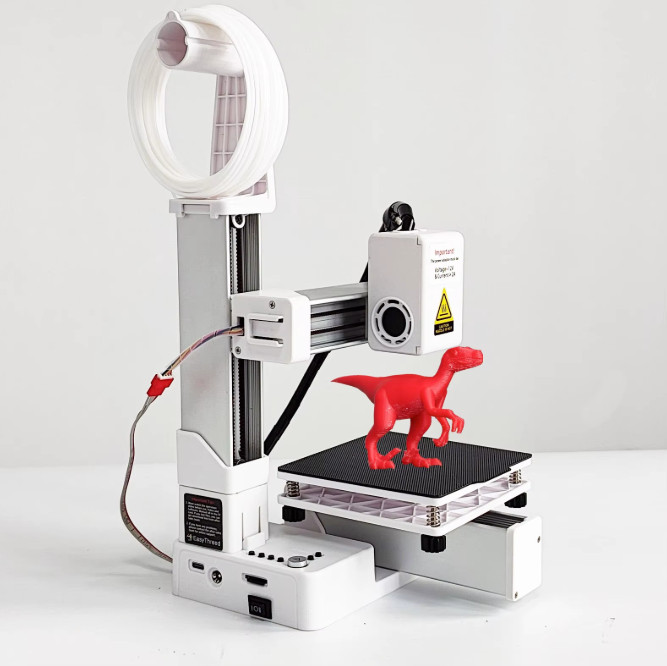

Photos from current listings. Actual item, color, and included accessories may vary.
PLA 3D Printer Buying Guide
PLA 3D printers are open-frame or enclosed FDM machines optimized for polylactic acid, the most forgiving filament thanks to low warp and low nozzle-temperature requirements. The core trade-off is frame rigidity and motion architecture versus price: a cantilever or acrylic frame with a single lead screw holds dimensional accuracy for small PLA parts but flexes under faster, taller prints, while a full aluminum extrusion cube with dual Z screws and linear rails holds tolerance across the whole build volume. Buy a rigid all-metal frame with a heated bed and a part-cooling fan if you want repeatable PLA prints; skip acrylic flat-pack kits with unheated beds only if you accept frequent re-leveling and small-part limits.
Key takeaways
- Aluminum extrusion frames with dual Z lead screws resist gantry sag and hold layer alignment far better than acrylic cantilever arms on tall PLA prints.
- A heated bed reaching at least 60°C is standard for PLA first-layer adhesion; unheated beds demand glue stick and limit bed size and speed.
- Direct-drive extruders handle flexible and abrasive filaments but add mass; Bowden setups print PLA faster on light gantries but retract poorly with TPU.
At a glance
- Category
- FDM 3D Printers
- Last updated
- Nov 28, 2026
Current offers
Highlights
- Aluminum extrusion frames with dual Z lead screws resist gantry sag and hold layer alignment far better than acrylic cantilever arms on tall PLA prints.
- A heated bed reaching at least 60°C is standard for PLA first-layer adhesion; unheated beds demand glue stick and limit bed size and speed.
- Direct-drive extruders handle flexible and abrasive filaments but add mass; Bowden setups print PLA faster on light gantries but retract poorly with TPU.
- Part-cooling blowers moving 5-10 CFM per duct are the deciding factor for PLA bridging and overhang quality, not just nozzle temperature.
Best use cases
- Best fit: miniature and tabletop hobby parts — pick a 180-220 mm build cube with a heated bed and a single 4010 or 5015 part-cooling fan; skip large-format kits that waste space and rigidity.
- Best fit: functional prototypes and jigs — choose a full aluminum extrusion frame with dual Z screws and a spring-steel PEI sheet for repeatable PLA flatness; skip acrylic flat-pack frames that flex at 150 mm/s.
- Best fit: classroom or shared use — select an auto-bed-leveling probe and a removable magnetic build plate to survive novice handling; skip bare glass beds with manual paper-leveling only.
- Wrong fit: engineering-grade or high-temp materials — PLA-focused open frames without an enclosure cannot hold ABS or ASA; buy an enclosed coreXY instead of forcing PLA hardware.
Buying tips
- Match build volume to your largest part plus 10 mm margin per axis; a 220×220×250 mm cube covers most PLA hobby and prototype work without wasted frame flex.
- Verify the bed reaches 60-70°C in under 5 minutes and that the part-cooling fan is a blower (5015) rather than a 4010 axial fan for PLA overhangs.
- Prefer a 0.4 mm brass nozzle with a proven hotend (V6 or MK8 pattern) over proprietary hotends; nozzle and heater cartridge availability determines long-term serviceability.
- Choose 32-bit mainboards with TMC2208/2209 stepper drivers over 8-bit A4988 boards for quieter PLA printing and smoother cornering at 100 mm/s.
Specs
| Frame Type | Aluminum extrusion / acrylic |
|---|---|
| Build Volume | 180-300 mm cube typical |
| Bed Temp | 60-70°C heated / unheated |
| Extruder Drive | Bowden vs direct drive |
Related searches
What to check before buying
- Measure your desk or shelf footprint: open-frame PLA printers typically need 40×40 cm of clearance plus 15 cm behind for the bed to travel.
- Confirm a standard 100-240 V input and regional plug type; heated beds draw 200-300 W and need a grounded outlet near the printer.
- Check that the slicer profile exists for the exact model — a supported Cura or PrusaSlicer profile saves hours of retraction and cooling tuning for PLA.
- Plan for a filament dry box or sealed storage: PLA absorbs moisture and strings badly after a few weeks in humid rooms above 50% RH.
FAQ
Data sources: eBay / Amazon listings and product attribute feeds. Updated Nov 28, 2026.
Some links on this page are affiliate links. If you buy after clicking one, we may earn a commission at no extra cost to you. This does not change which products appear here or their order. Affiliate disclosure.