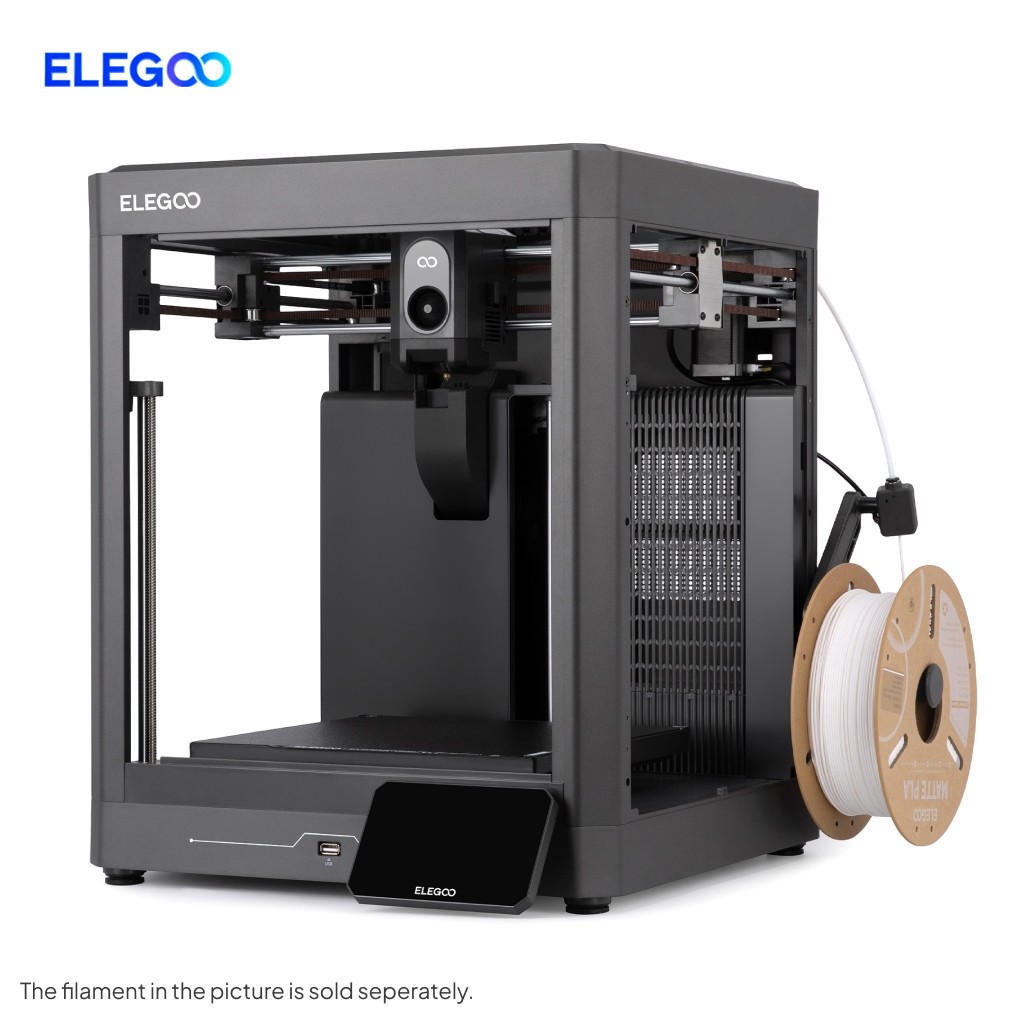

Photos from current listings. Actual item, color, and included accessories may vary.
Elegoo FDM Printer Buying Guide
Elegoo FDM printers are open-frame and enclosed CoreXY/ bedslinger machines built for hobbyists and makers, spanning entry-level Neptune bedslingers to high-speed Centauri CoreXY models. The primary trade-off is bed-slinger simplicity and lower cost versus CoreXY speed, enclosure, and multi-material readiness. The decision rule: buy a bedslinger only for PLA/PETG prototypes on a tight footprint; buy a CoreXY Elegoo (Centauri or Centauri Carbon) when you need 300+ mm/s print speeds, ABS/ASA, or future multi-color upgrades.
Key takeaways
- Elegoo splits its FDM line into Neptune bedslingers (Neptune 4/4 Pro, 235x235x265 mm) and Centauri CoreXY printers (Centauri 2, Centauri Carbon) with Klipper-based firmware for input shaping and pressure advance.
- Centauri Carbon adds a fully enclosed chamber with active filtration and a 350°C hotend, enabling ABS, ASA, and PC prints that open-frame Neptune models cannot handle reliably.
- Neptune 4 Pro uses a 300°C hotend and PEI magnetic bed with 121-point auto-bed leveling; Centauri models step up to 500 mm/s max travel and 20,000 mm/s² acceleration on CoreXY gantries.
At a glance
- Category
- FDM 3D Printers
- Last updated
- Nov 28, 2026
Current offers
Highlights
- Elegoo splits its FDM line into Neptune bedslingers (Neptune 4/4 Pro, 235x235x265 mm) and Centauri CoreXY printers (Centauri 2, Centauri Carbon) with Klipper-based firmware for input shaping and pressure advance.
- Centauri Carbon adds a fully enclosed chamber with active filtration and a 350°C hotend, enabling ABS, ASA, and PC prints that open-frame Neptune models cannot handle reliably.
- Neptune 4 Pro uses a 300°C hotend and PEI magnetic bed with 121-point auto-bed leveling; Centauri models step up to 500 mm/s max travel and 20,000 mm/s² acceleration on CoreXY gantries.
- All current Elegoo FDM printers run 24V DC heated beds and Marlin or Klipper firmware, with Wi-Fi/Elegoo Slicer support on Neptune 4 series and Centauri 2.
Best use cases
- Best fit: buyers printing PLA/PETG figurines, jigs, and prototypes in a small room should pick the Neptune 4 Pro bedslinger—235 mm cube build, PEI sheet, and 121-point leveling cover most hobby work without enclosure overhead.
- Best fit: buyers running ABS/ASA functional parts or printing in a garage/workshop should choose the Centauri Carbon—the enclosed CoreXY chamber holds heat and filters VOCs, which open bedslingers cannot match.
- Wrong fit: shoppers wanting plug-and-play multi-color out of the box should skip Elegoo FDM entirely—no current Elegoo FDM ships with an AMS-style multi-filament unit; that requires a Bambu Lab or Prusa upgrade path.
- Best fit: budget-limited makers who still want 300°C hotend capability and Klipper speed tuning should target the Centauri 2 open-frame CoreXY rather than paying the enclosure premium of the Carbon.
Buying tips
- Match build volume to your largest part: Neptune 4/4 Pro gives 235x235x265 mm; Centauri 2 and Centauri Carbon give 256x256x256 mm—measure your part diagonal before choosing the smaller Neptune.
- Pick the hotend tier by material: 300°C (Neptune 4 Pro, Centauri 2) covers PLA/PETG/TPU/PLA-CF; 350°C enclosed (Centauri Carbon) is required for ABS/ASA/PC and high-temp engineering filaments.
- Choose CoreXY (Centauri) over bedslinger (Neptune) when you need consistent 250-300 mm/s printing—the moving-bed inertia of bedslingers limits real-world acceleration regardless of firmware tuning.
- Confirm firmware ecosystem: Neptune 4 series uses Marlin with Elegoo Slicer/Orca profiles; Centauri models use Klipper with web interface—pick the one matching your comfort with config-file tuning.
Specs
| Motion Architecture | Bedslinger (Neptune) vs CoreXY (Centauri) |
|---|---|
| Build Volume | 235³ mm (Neptune) / 256³ mm (Centauri) |
| Hotend Max Temp | 300°C open / 350°C enclosed |
| Firmware | Marlin (Neptune 4) / Klipper (Centauri) |
Related searches
What to check before buying
- Measure your desk or shelf footprint: Neptune 4 Pro needs roughly 475x455 mm; Centauri Carbon enclosure needs roughly 500x500 mm plus clearance for filament spool and rear cable chain.
- Confirm room ventilation: open-frame Neptune models release ultrafine particles and VOCs with PLA; ABS/ASA on any Elegoo FDM requires an enclosed, filtered space or a dedicated workshop.
- Check power: all Elegoo FDM printers ship with 24V DC external power bricks rated for 100-240V input—verify your outlet and use a surge protector for the heated bed's peak draw.
- Plan companion parts: a filament dryer for PETG/TPU, a hardened nozzle for CF-filled filaments, and a spare PEI sheet are near-mandatory add-ons before your first abrasive-material print.
FAQ
Data sources: eBay / Amazon listings and product attribute feeds. Updated Nov 28, 2026.
Some links on this page are affiliate links. If you buy after clicking one, we may earn a commission at no extra cost to you. This does not change which products appear here or their order. Affiliate disclosure.