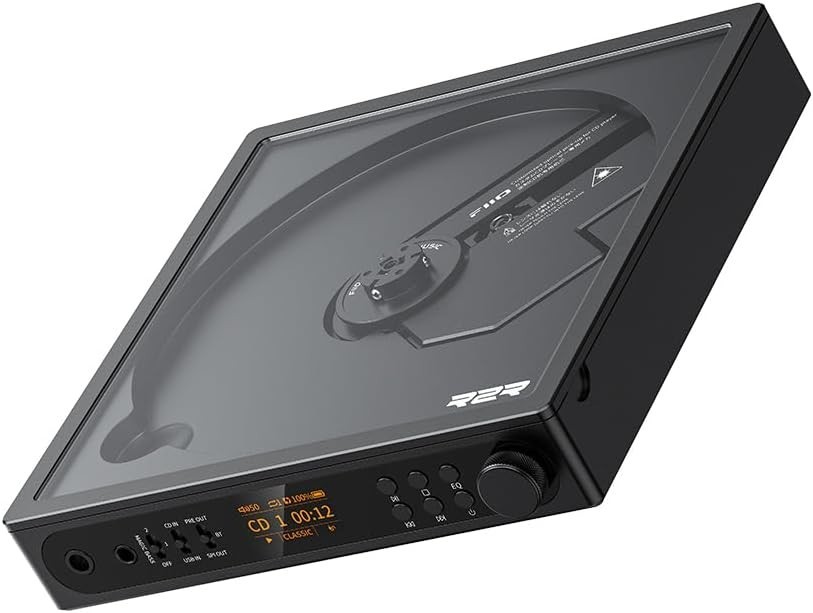

Photos from current listings. Actual item, color, and included accessories may vary.
Portable DAC Player Buying Guide
A portable DAC player is a battery-powered digital-to-analog converter with an integrated headphone amplifier, built to bypass a phone or laptop's weaker internal audio stage for cleaner, louder, and higher-resolution output. The core trade-off is between clean decoding/amplification headroom (DAC chip tier, amp output power, balanced outputs, Bluetooth codec support) and portability/battery life. The decision rule: if it cannot deliver at least 2 Vrms single-ended or 4 Vrms balanced into 32 ohms with a measured noise floor below 3 µV, it is a dongle-class compromise rather than a true portable DAC player.
Key takeaways
- DAC chip architecture determines resolution ceiling: flagship ESS ES9038/ES9281 or AKM AK4493/AK4499 chips decode 32-bit/768kHz PCM and DSD512, while entry Cirrus Logic or older ESS chips cap at 24-bit/192kHz and DSD128.
- Amplifier output power is the decisive headroom metric: a true portable DAC player delivers 150–300 mW into 32 ohms single-ended and 400–800 mW balanced, compared to 30–60 mW from phone dongles; this directly determines whether it can drive 300-ohm dynamic headphones.
- Output architecture separates tiers: models with both 3.5mm single-ended and 4.4mm/2.5mm balanced sockets deliver full power on balanced, while single-port devices are limited to half the amplifier's potential output.
At a glance
- Category
- Digital Audio Players
- Last updated
- Nov 29, 2026
Current offers
Highlights
- DAC chip architecture determines resolution ceiling: flagship ESS ES9038/ES9281 or AKM AK4493/AK4499 chips decode 32-bit/768kHz PCM and DSD512, while entry Cirrus Logic or older ESS chips cap at 24-bit/192kHz and DSD128.
- Amplifier output power is the decisive headroom metric: a true portable DAC player delivers 150–300 mW into 32 ohms single-ended and 400–800 mW balanced, compared to 30–60 mW from phone dongles; this directly determines whether it can drive 300-ohm dynamic headphones.
- Output architecture separates tiers: models with both 3.5mm single-ended and 4.4mm/2.5mm balanced sockets deliver full power on balanced, while single-port devices are limited to half the amplifier's potential output.
- Bluetooth codec support varies by generation: LDAC and aptX Adaptive generally require Qualcomm/CSR or dedicated receiver chips; models without them fall back to SBC/AAC and are wirelessly lossy even with a high-end DAC.
Best use cases
- Best fit: pair a balanced-output portable DAC player (4.4mm) with 250–600 ohm dynamic or planar headphones for desktop-grade listening on the go; skip single-ended dongles that cannot drive high-impedance loads with authority.
- Best fit: choose a USB-C DAC player with LDAC/aptX Adaptive if you stream from a phone or DAP wirelessly; wrong fit: buying a wired-only model if your primary source is a Bluetooth transmitter or you need cable-free mobility.
- Best fit: pick a standalone battery-powered player with its own volume control and gain switch if you commute or travel; wrong fit: a dongle that plugs directly into the phone's USB-C port and drains the phone, which is better for desk use.
- Best fit: select a model with both 3.5mm and 4.4mm/2.5mm outputs plus line-out if you switch between IEMs and full-size headphones; skip single-port DACs if you own multiple headphones with different plugs and impedance.
Buying tips
- Match amplifier power to headphone sensitivity: for 300-ohm, 97dB/mW headphones, target at least 250 mW into 32 ohms balanced (roughly 4 Vrms) to reach 110dB peaks; for IEMs at 110dB/mW, 50 mW into 32 ohms is ample and lower gain reduces noise.
- Choose the DAC chip tier by file library: if you only stream 16/44.1 or 24/96, an AK4493 or ES9219 class chip is sufficient; only pay for ES9038PRO/AK4499EX if you own 32/384 or DSD256+ files and a balanced amp to match.
- Confirm output connectors match your headphone cables before buying: 4.4mm Pentaconn balanced is the current standard for portable players; 2.5mm balanced is older and requires adapter cables, while 3.5mm single-ended is universal but delivers half the power.
- Verify Bluetooth codec support against your source device: LDAC requires Android 8.0+ or a Sony source; aptX Adaptive requires a Qualcomm transmitter; iPhone tops out at AAC over Bluetooth, so a wired USB-C connection is the only way to get full-resolution audio from an iPhone.
Specs
| DAC Chip Tier | Flagship vs Mid vs Entry |
|---|---|
| Amp Output Power | 150-800 mW into 32 ohms |
| Output Connectors | 3.5mm SE / 4.4mm BAL / 2.5mm BAL |
| Bluetooth Codecs | LDAC / aptX Adaptive / AAC / SBC |
Related searches
What to check before buying
- Measure your headphones' impedance and sensitivity from their spec sheet: below 32 ohms and above 105dB/mW is IEM-friendly (low gain), while 150–600 ohms and below 100dB/mW demands a balanced output with at least 4 Vrms swing.
- Confirm your source device's output: USB-C audio support on Android 10+ and iOS 14+ is standard for wired DACs, but LDAC/aptX Adaptive Bluetooth requires a compatible transmitter chip in the phone or player.
- Verify the plug standard used by your headphone cables: 4.4mm balanced, 2.5mm balanced, and 3.5mm single-ended are not interchangeable; budget for adapter cables if the DAC player lacks your connector type.
- Check the unit's physical dimensions and weight against your carry method: battery-powered DAC players with metal chassis typically weigh 150–300 g and are pocketable only if under 120 × 60 × 15 mm; larger desktop-class DACs need a bag.
FAQ
Data sources: eBay / Amazon listings and product attribute feeds. Updated Nov 29, 2026.
Some links on this page are affiliate links. If you buy after clicking one, we may earn a commission at no extra cost to you. This does not change which products appear here or their order. Affiliate disclosure.