
Photos from current listings. Actual item, color, and included accessories may vary.
CD Player With Bluetooth And USB Buying Guide
A CD player with Bluetooth and USB combines a physical disc transport with wireless streaming to headphones or speakers and USB playback/recording, all in one chassis. The core trade-off is between a full-size home deck with a robust tray mechanism and optical/digital outputs versus a compact portable unit that sacrifices drive stability and output flexibility. Buyers should prioritize a slot- or tray-loading transport with shock buffering, Bluetooth 5.0 or higher for stable range, and USB-A for direct MP3/WAV playback or USB-B for computer audio; skip any model that lists Bluetooth but omits a digital output or USB host mode.
Median $221.50 · New & pre-owned listings
Key takeaways
- Transport type determines longevity: slot-loading drives resist dust and misalignment better than tray mechanisms, while top-loading decks offer the most stable platter for scratched discs.
- Bluetooth version and codec support matter: Bluetooth 5.0+ delivers lower latency and longer range than 4.2; codecs like aptX or AAC improve streaming quality over SBC.
- USB functionality splits into two distinct tiers: USB-A host ports play MP3/WMA/WAV files from flash drives, while USB-B ports turn the player into a computer DAC for recording or playback.
At a glance
- Category
- Digital Audio Players
- Last updated
- Nov 29, 2026
Current offers
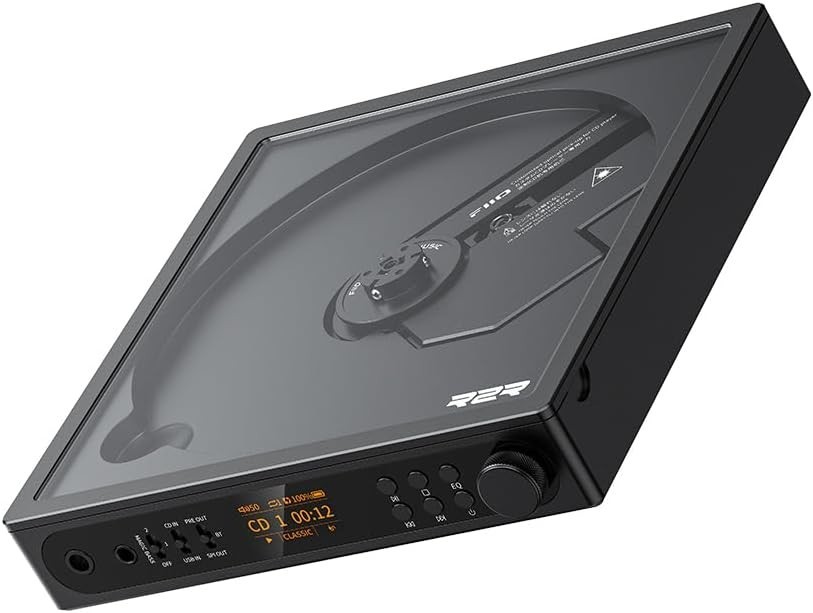
Highlights
- Transport type determines longevity: slot-loading drives resist dust and misalignment better than tray mechanisms, while top-loading decks offer the most stable platter for scratched discs.
- Bluetooth version and codec support matter: Bluetooth 5.0+ delivers lower latency and longer range than 4.2; codecs like aptX or AAC improve streaming quality over SBC.
- USB functionality splits into two distinct tiers: USB-A host ports play MP3/WMA/WAV files from flash drives, while USB-B ports turn the player into a computer DAC for recording or playback.
- Built-in 2-way speakers with separate woofers and tweeters outperform single full-range drivers for room-filling sound, but add bulk and require AC power.
Best use cases
- Best fit for wireless headphones or a Bluetooth speaker: choose a compact player with Bluetooth 5.0, USB-A playback, and a rechargeable battery for living-room or bedroom use.
- Best fit for a hi-fi stereo system: select a full-size deck with RCA and optical/coaxial digital outputs, a metal tray, and USB-B for computer audio; skip portable units lacking digital outs.
- Wrong fit for critical listening with external DAC: avoid players that only offer analog RCA outputs and no digital output or USB-B, as you cannot bypass the internal DAC.
Buying tips
- Match Bluetooth version to range needs: Bluetooth 5.0 or higher provides up to 10 m (33 ft) line-of-sight; Bluetooth 4.2 cuts range and increases dropout risk through walls.
- Check USB port type precisely: USB-A host plays files from flash drives (FAT32, up to 32 GB typically); USB-B device port enables computer connectivity and recording—many budget units omit USB-B entirely.
- Verify disc compatibility: most players handle CD, CD-R, CD-RW, and MP3-CDs; for scratched or archival discs, prefer a top-loading transport with a stable clamp.
- Confirm power and output specs: built-in speakers need at least 2 x 5 W RMS for a small room; headphone output impedance under 50 ohms suits most earbuds and low-impedance headphones.
Specs
| Bluetooth Version | 5.0+ preferred vs 4.2 legacy |
|---|---|
| USB Port Type | USB-A host + USB-B device |
| Disc Transport | Slot-load vs tray vs top-load |
| Power Source | AC mains vs rechargeable battery |
Related searches
What to check before buying
- Measure your shelf or cabinet depth: full-size decks are typically 17 in (43 cm) wide and 12 in (30 cm) deep, while compact units run 10–14 in (25–36 cm) wide.
- Check your speaker or headphone input: Bluetooth works with any BT receiver, but wired setups need matching RCA, 3.5 mm, or optical inputs on your amp or powered speakers.
- Confirm power standard: most home decks are 100–240 V AC with a detachable IEC cable; portable units use USB-C or a DC barrel jack—match your region's plug type.
- Verify USB drive format: most players require FAT32 formatting for USB-A playback, and some cap drive capacity at 32 GB; exFAT and NTFS are rarely supported.
FAQ
Data sources: eBay / Amazon listings and product attribute feeds. Updated Nov 29, 2026.
Some links on this page are affiliate links. If you buy after clicking one, we may earn a commission at no extra cost to you. This does not change which products appear here or their order. Affiliate disclosure.