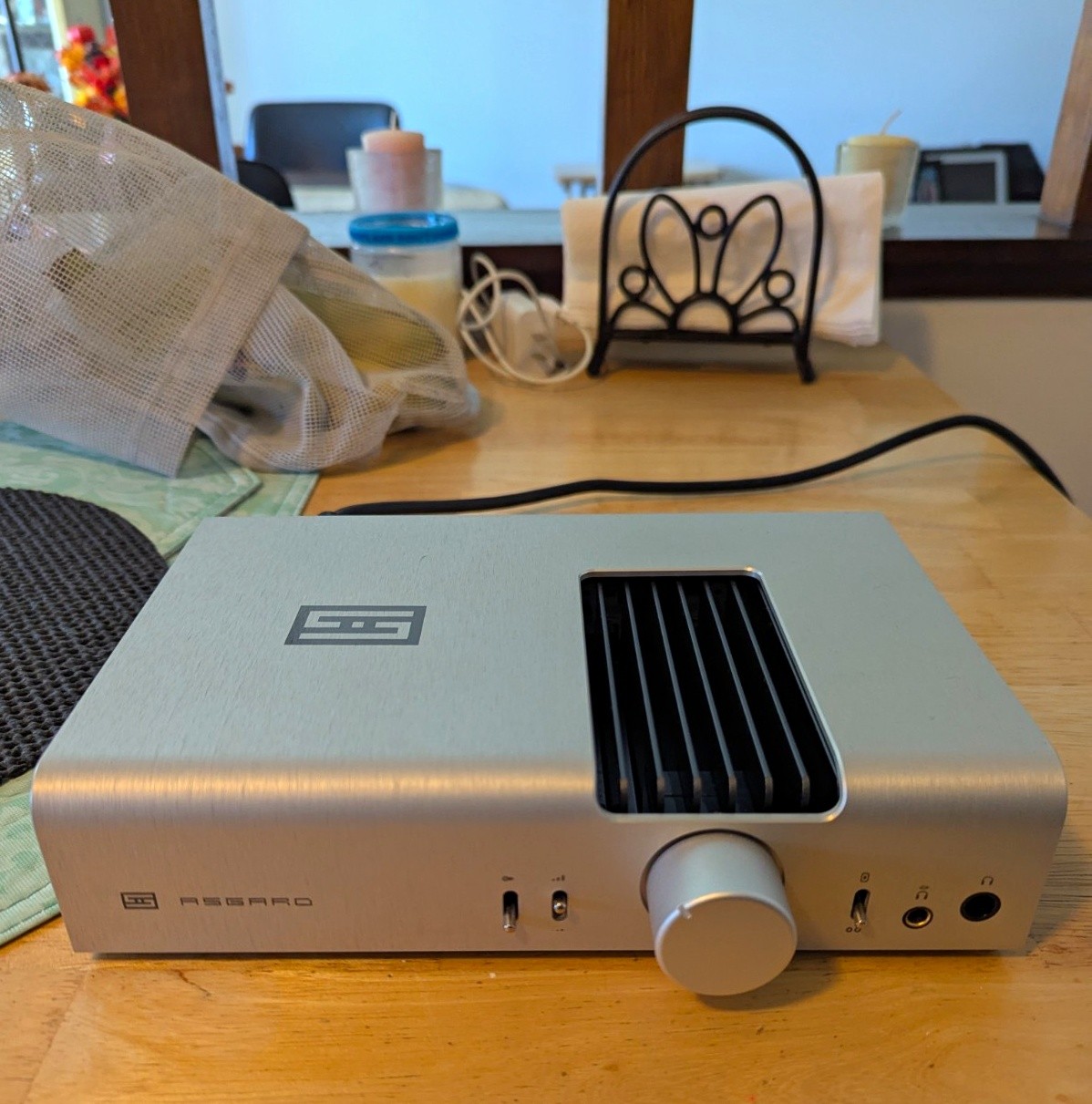

Photos from current listings. Actual item, color, and included accessories may vary.
Schiit Headphone Amp Buying Guide
Schiit headphone amps are a family of discrete, US-assembled desktop amplifiers spanning budget single-ended units to balanced and tube-hybrid designs. The primary trade-off is topology and power delivery versus connectivity and control: class-AB discrete output stages define the house sound, while balanced and tube variants add output power and tonal options at higher cost. The decision rule is simple: match amp topology and output power to headphone impedance/sensitivity, and only pay for balanced or tube features if your headphones or source actually benefit.
Key takeaways
- Discrete class-AB output stages (no op-amps in the gain path on most models) drive the characteristic Schiit sound and high current delivery.
- Single-ended models like Magni deliver roughly 2–3 W into 32 ohms; balanced models like Jotunheim 2 roughly double that via 4-pin XLR and dual 3-pin XLR outputs.
- Tube-hybrid designs (Vali, Lyr) use a tube voltage gain stage with solid-state current buffers, offering tube rolling without the instability of OTL designs.
At a glance
- Category
- DACs & Headphone Amplifiers
- Last updated
- Nov 25, 2026
Current offers
Highlights
- Discrete class-AB output stages (no op-amps in the gain path on most models) drive the characteristic Schiit sound and high current delivery.
- Single-ended models like Magni deliver roughly 2–3 W into 32 ohms; balanced models like Jotunheim 2 roughly double that via 4-pin XLR and dual 3-pin XLR outputs.
- Tube-hybrid designs (Vali, Lyr) use a tube voltage gain stage with solid-state current buffers, offering tube rolling without the instability of OTL designs.
- The Nexus and Continuity topologies reduce distortion and improve linearity in balanced and higher-tier models; entry models use simpler discrete stages.
Best use cases
- Best fit: Magni for a desktop single-ended setup with dynamic headphones up to 300 ohms—skip if you need balanced input/output or IEM-level noise floor.
- Best fit: Jotunheim 2 for planars and hard-to-drive dynamics needing balanced power and preamp outputs—skip only if your headphones are all high-sensitivity IEMs.
- Best fit: Vali or Lyr for tube-hybrid tone and modest tube rolling—wrong fit if you expect OTL tube-amp behavior or need absolute transparency.
- Best fit: Asgard for a higher-power single-ended amp with a stepped attenuator feel—wrong fit if you want compact footprint or balanced connectivity.
Buying tips
- Match power to load: aim for at least 1 W into 32 ohms for planars and 300-ohm dynamics; entry single-ended amps are marginal for low-sensitivity planars.
- Balanced outputs require balanced cables and a balanced DAC source to realize the full power benefit—single-ended input to balanced output does not double power.
- Tube hybrids accept 6BZ7/6922-family tubes; check heater current and pinout compatibility before rolling, as not all 6922 variants are safe.
- Choose the modular chassis (Jotunheim, Lyr) only if you plan to use the optional DAC or phono modules; otherwise the fixed-input models deliver the same amp section for less.
Specs
| Amp Topology | Discrete Class-AB vs Tube Hybrid |
|---|---|
| Output Power Tier | 1-3 W (SE) / 4-6 W (Balanced) @32Ω |
| Headphone Outputs | 6.35mm SE / 4-pin XLR Balanced |
| Input Connectivity | RCA Single-Ended / XLR Balanced |
Related searches
What to check before buying
- Measure available desktop depth and height under a monitor riser; Schiit chassis are compact but rear cable clearance adds roughly 2–3 inches.
- Confirm your headphones' impedance and sensitivity: above 300 ohms or below 90 dB/mW demands the higher-power tiers.
- Verify source outputs: single-ended RCA vs balanced XLR determines whether a balanced amp is worth the premium.
- Check tube ventilation if choosing Vali or Lyr—allow at least 2 inches above the chassis for heat dissipation.
FAQ
Data sources: eBay / Amazon listings and product attribute feeds. Updated Nov 25, 2026.
Some links on this page are affiliate links. If you buy after clicking one, we may earn a commission at no extra cost to you. This does not change which products appear here or their order. Affiliate disclosure.