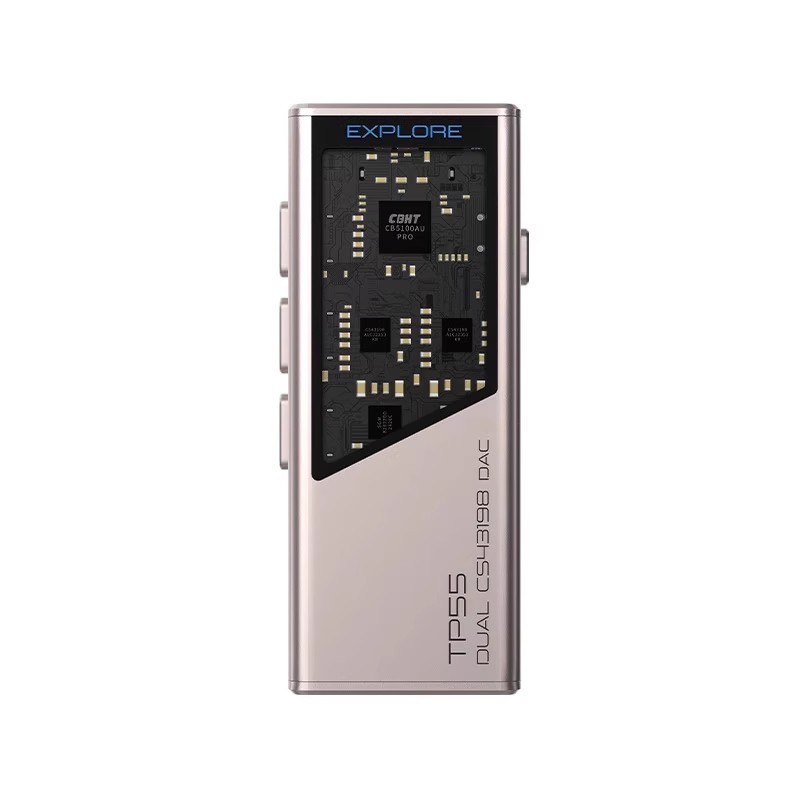

Photos from current listings. Actual item, color, and included accessories may vary.
Dongle DAC Buying Guide
A dongle DAC is a bus-powered USB-C or Lightning adapter that bypasses a phone or laptop's internal audio codec to deliver cleaner decoding and more current to wired headphones. The core trade-off is chipset quality and amplification headroom versus connector strain and heat under continuous load. Buy a dongle with a dedicated DAC chip and a real amp stage if you use low-impedance IEMs or planars; skip bare cable adapters that only pass analog audio.
Key takeaways
- Dual DAC architectures (e.g., two CS43198 chips) decode each channel independently, improving channel separation and lowering crosstalk versus single-DAC designs.
- Integrated amp stages such as dual SGM8262 op-amps supply the current needed for low-sensitivity planars; phones alone rarely exceed ~1 Vrms.
- Balanced 4.4mm outputs deliver roughly double the voltage swing of single-ended 3.5mm, giving cleaner headroom on high-impedance loads.
At a glance
- Category
- DACs & Headphone Amplifiers
- Last updated
- Nov 25, 2026
Current offers
Highlights
- Dual DAC architectures (e.g., two CS43198 chips) decode each channel independently, improving channel separation and lowering crosstalk versus single-DAC designs.
- Integrated amp stages such as dual SGM8262 op-amps supply the current needed for low-sensitivity planars; phones alone rarely exceed ~1 Vrms.
- Balanced 4.4mm outputs deliver roughly double the voltage swing of single-ended 3.5mm, giving cleaner headroom on high-impedance loads.
- Bus-powered USB-C dongles draw 50-150mW; models with hardware volume or gain switches avoid digital attenuation and preserve dynamic range.
Best use cases
- Pick a dual-DAC, balanced-output dongle for planar magnetic or high-impedance (60Ω+) headphones where phone headphone jacks clip and lose bass control.
- Choose a compact single-DAC dongle for IEMs and commuting when you want lower heat and battery draw over maximum output power.
- Skip dongles entirely for low-impedance, high-sensitivity IEMs if your phone's native jack already plays them loudly and cleanly.
- Avoid 4.4mm balanced models unless your cable terminates balanced; a single-ended 3.5mm dongle is smaller and cheaper for that use.
Buying tips
- Match output power to headphone sensitivity: planars and 300Ω dynamics need a dongle rated near 2 Vrms or higher; 16-32Ω IEMs need only ~0.5 Vrms.
- Prefer USB-C dongles with detachable or reinforced strain-relieved cables; the connector-to-cable joint is the most common failure point.
- A 4.4mm balanced jack only helps if your headphone cable is wired balanced; converting a single-ended cable via adapter negates the benefit.
- Check chipset generation: dual CS43198 or ES9219-class DACs outperform older single ES9018K2M designs in noise floor and power efficiency.
Specs
| DAC Architecture | Dual-chip vs single-chip |
|---|---|
| Output Jacks | 3.5mm SE / 4.4mm balanced |
| Amp Output Power | ~0.5-4 Vrms depending on tier |
| Host Connection | USB-C or MFi Lightning |
Related searches
What to check before buying
- Confirm your phone or laptop port: USB-C dongles need a USB-C host, while Lightning models require an MFi-certified adapter for stable power.
- Measure your headphone impedance and sensitivity; below 32Ω and above 105dB/mW, a basic dongle is sufficient and a high-power amp is overkill.
- Verify your cable termination: 3.5mm single-ended versus 4.4mm balanced, since mismatched plugs require a new cable, not an adapter.
- Account for case thickness and port clearance; stacked USB-C connectors and thick phone cases can prevent full insertion and cause dropouts.
FAQ
Data sources: eBay / Amazon listings and product attribute feeds. Updated Nov 25, 2026.
Some links on this page are affiliate links. If you buy after clicking one, we may earn a commission at no extra cost to you. This does not change which products appear here or their order. Affiliate disclosure.