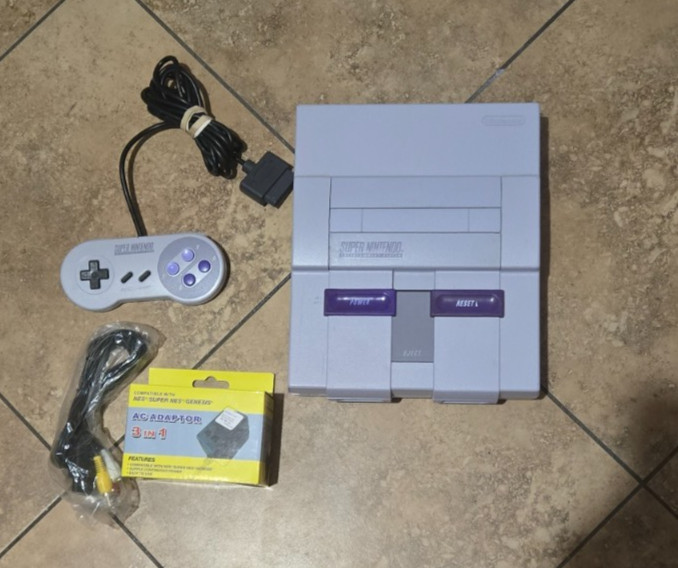

Photos from current listings. Actual item, color, and included accessories may vary.
Nintendo SNES Buying Guide
The Super Nintendo Entertainment System (SNES) is a 16-bit home console with a 3.58 MHz Ricoh 5A22 CPU, 128 KB work RAM, and a PPU supporting 256–4096 colors. Buyers today face a three-way trade-off: original hardware (recapped or not), the plug-and-play SNES Classic Mini with HDMI, or FPGA/emulation clones. The decision rule is simple: original shells with fresh capacitors and a region-matched power supply are durable; untested gray-market consoles and no-name clones are compromises.
Key takeaways
- Original SNES uses a 5V DC center-negative barrel jack; the PAL Super Nintendo uses a 9V/1.3A supply, so a region-correct PSU is mandatory.
- The 5A22 CPU runs at 3.58 MHz (NTSC) or 3.55 MHz (PAL); PAL consoles output 50 Hz and run many games slower and letterboxed.
- Recapping replaces aged electrolytic capacitors on the mainboard and power board; leaked caps are the top cause of audio hum and boot failures in 30-year-old units.
At a glance
- Category
- Console & Handheld Hardware
- Status
- Listings available
- Last updated
- Nov 29, 2026
Current offers
Highlights
- Original SNES uses a 5V DC center-negative barrel jack; the PAL Super Nintendo uses a 9V/1.3A supply, so a region-correct PSU is mandatory.
- The 5A22 CPU runs at 3.58 MHz (NTSC) or 3.55 MHz (PAL); PAL consoles output 50 Hz and run many games slower and letterboxed.
- Recapping replaces aged electrolytic capacitors on the mainboard and power board; leaked caps are the top cause of audio hum and boot failures in 30-year-old units.
- SNES Classic Mini (2017) outputs 720p over HDMI, includes 21 built-in games, and uses USB power — no cartridge slot or original controller ports.
Best use cases
- Best fit: playing original cartridges on a CRT or scaler — buy a recapped NTSC-U SNES with OEM controller and a 5V 1A center-negative PSU.
- Best fit: casual HDMI play with no cartridge collection — buy the SNES Classic Mini and skip original hardware, cartridges, and upscalers.
- Wrong fit: expecting 1080p or 4K native output from an original SNES — its 256×224 signal needs a line doubler or scaler; skip unless you budget for one.
- Wrong fit: buying a PAL console for a North American CRT or capture setup — 50 Hz timing and SCART wiring conflict; buy NTSC-U instead.
Buying tips
- Prioritize a unit with documented recapping and a clean cartridge slot; unrecapped consoles can work today but fail within months as caps drift.
- Match the power supply to the region: NTSC-U/J uses 5V DC center-negative; PAL uses 9V DC. A mismatched PSU can kill the voltage regulator.
- For original hardware on modern TVs, budget for a lag-free scaler (e.g., RetroTINK-class) plus an S-Video or RGB SCART cable; composite is the weakest signal.
- Skip 'restored' bundles without photos of the mainboard recap work; recapping without flux cleanup and correct cap grades is a common shortcut.
Specs
| CPU Architecture | Ricoh 5A22, 16-bit, 3.58 MHz |
|---|---|
| Native Output | Composite / S-Video / RGB (no HDMI) |
| Power Input | 5V DC NTSC / 9V DC PAL |
| Media Format | Cartridge slot vs 21 built-in (Mini) |
Alternatives to compare
Related searches
What to check before buying
- Confirm your TV has composite, S-Video, or SCART input — or plan for an HDMI scaler, since the SNES has no native digital output.
- Measure shelf or entertainment-center depth: the original SNES is roughly 20 cm deep and needs clearance for the cartridge slot.
- Check the power outlet voltage and plug type in your region; buy a console whose bundled or recommended PSU matches 120V/60Hz or 230V/50Hz.
- For the SNES Classic Mini, confirm an open USB-A port on your TV or a 5V USB adapter, plus an HDMI cable and port.
FAQ
Data sources: eBay / Amazon listings and product attribute feeds. Updated Nov 29, 2026.
Some links on this page are affiliate links. If you buy after clicking one, we may earn a commission at no extra cost to you. This does not change which products appear here or their order. Affiliate disclosure.