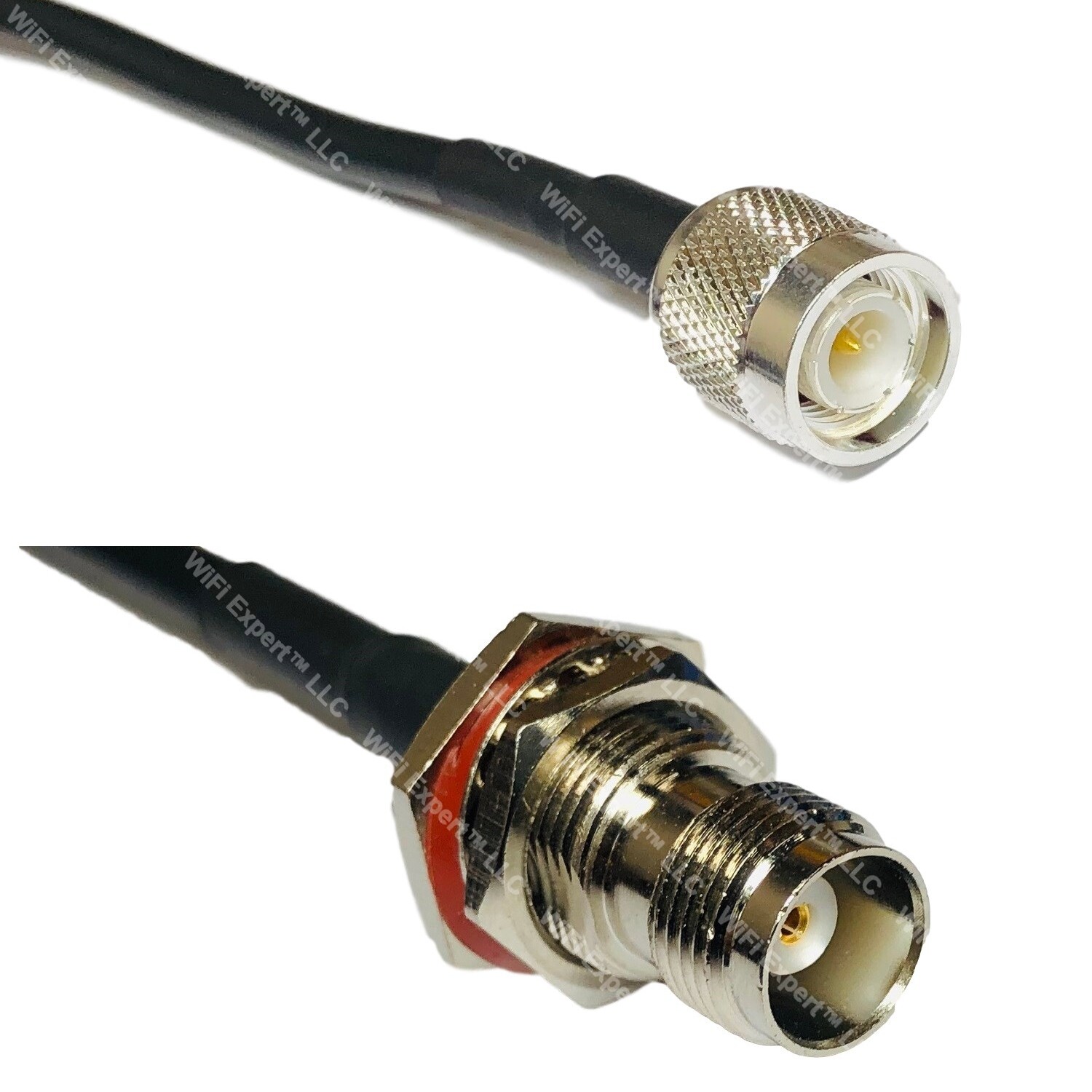

Photos from current listings. Actual item, color, and included accessories may vary.
Rf Cable Male Female Buying Guide
RF cable male-to-female assemblies are pre-terminated coaxial jumpers used to extend, adapt, or route RF signals between a male connector on one end and a female connector on the other. The primary trade-off is cable grade versus connector precision: low-loss LMR-style foam-dielectric cable with properly crimped or soldered connectors sustains signal integrity, while thin RG-58/RG-174 with molded ends is only for short, low-frequency runs. The decision rule: match connector series, impedance, and cable diameter to your frequency and bend radius, and never substitute a 75-ohm video cable for a 50-ohm RF path.
Key takeaways
- LMR-240 is 50-ohm, 0.240-inch OD low-loss coax with a foam dielectric and foil-plus-braid shield; its attenuation is roughly 30% lower than RG-58 at UHF, making it the practical minimum for runs over a few meters.
- TNC connectors are threaded 7/16-28 UNEF with a 50-ohm interface; a bulkhead female variant mounts through a panel and requires a lockwasher and nut, distinct from a cable-end female that simply mates inline.
- Connector attachment quality separates tiers: crimp-on connectors need the matching hex die and cable strip dimensions, while solder-center-pin plus crimp-ferrule builds tolerate higher vibration and repeated mating.
At a glance
- Category
- Coax, Connectors & Portable Cases
- Last updated
- Nov 23, 2026
Current offers
Highlights
- LMR-240 is 50-ohm, 0.240-inch OD low-loss coax with a foam dielectric and foil-plus-braid shield; its attenuation is roughly 30% lower than RG-58 at UHF, making it the practical minimum for runs over a few meters.
- TNC connectors are threaded 7/16-28 UNEF with a 50-ohm interface; a bulkhead female variant mounts through a panel and requires a lockwasher and nut, distinct from a cable-end female that simply mates inline.
- Connector attachment quality separates tiers: crimp-on connectors need the matching hex die and cable strip dimensions, while solder-center-pin plus crimp-ferrule builds tolerate higher vibration and repeated mating.
- Male-to-female assemblies are adapter jumpers, not extension cables for arbitrary loss budgets; every added connector pair contributes insertion loss and a potential impedance mismatch, so keep the count to what the run requires.
Best use cases
- Best fit: extending an antenna feed from a bulkhead-panel radio or SDR to a remotely mounted antenna when you need a male connector at the radio end and a female bulkhead at the enclosure — pick LMR-240 for UHF/VHF runs and keep length to the minimum that reaches.
- Best fit: lab and bench patching between instruments with different genders, where a short LMR-100 or RG-316 jumper with solder-crimp connectors gives repeatable, low-loss connections — choose 50-ohm rated cable only.
- Wrong fit: outdoor permanent runs over tens of meters — skip pre-made male-female jumpers and use a single continuous LMR-400 or hardline feed with a bulkhead surge arrestor, because every extra mated pair adds loss and a water-ingress point.
- Wrong fit: 75-ohm TV, satellite, or CCTV distribution — RF male-female assemblies here are 50-ohm; using them on 75-ohm video lines causes impedance mismatch and reflections, so select F-type or BNC 75-ohm parts instead.
Buying tips
- Match impedance first: 50-ohm for two-way radio, SDR, Wi-Fi, and test gear; 75-ohm for broadcast, satellite, and CCTV. A 50-ohm male-female jumper on a 75-ohm line reflects signal and degrades return loss.
- Size cable by frequency and run length: RG-174/LMR-100 for short patch runs under ~1 m, LMR-240 for 1-10 m at UHF, LMR-400 for longer or higher-loss runs. Thicker cable means larger bend radius and heavier connector strain relief.
- Confirm connector series and gender polarity: TNC, SMA, BNC, N, and UHF (PL-259/SO-239) do not intermate. TNC male has threads on the inside of the coupling nut; SMA male has a 1/4-36 thread and a center pin, so verify the mating half before ordering.
- For bulkhead female ends, check panel thickness and hole diameter: the connector needs a panel hole matched to its threaded barrel and enough behind-panel clearance for the nut and cable bend; a bulkhead TNC typically needs a 3/8-inch hole.
Specs
| Impedance | 50 ohm RF / 75 ohm video |
|---|---|
| Cable Grade | RG-174 / LMR-100 / LMR-240 / LMR-400 |
| Connector Series | TNC / SMA / BNC / N / UHF |
| Connector Mount | Inline cable-end / Bulkhead panel |
Related searches
What to check before buying
- Measure the actual run path including service loops and bend radius: LMR-240 needs roughly a 0.75-inch minimum bend radius, so tight cabinet corners require thinner cable or a right-angle adapter.
- Verify the panel cutout and thickness for any bulkhead female connector, plus clearance for the lockwasher, nut, and cable exit behind the panel.
- Confirm the radio or device port gender and thread: a male-to-female jumper only helps if one end matches the device port and the other matches the antenna or next cable.
- Check environmental rating for outdoor use: standard crimp connectors are not weather-sealed, so exterior joints need self-amalgamating tape and a drip loop, or specify a weatherproof assembly.
FAQ
Data sources: eBay / Amazon listings and product attribute feeds. Updated Nov 23, 2026.
Some links on this page are affiliate links. If you buy after clicking one, we may earn a commission at no extra cost to you. This does not change which products appear here or their order. Affiliate disclosure.