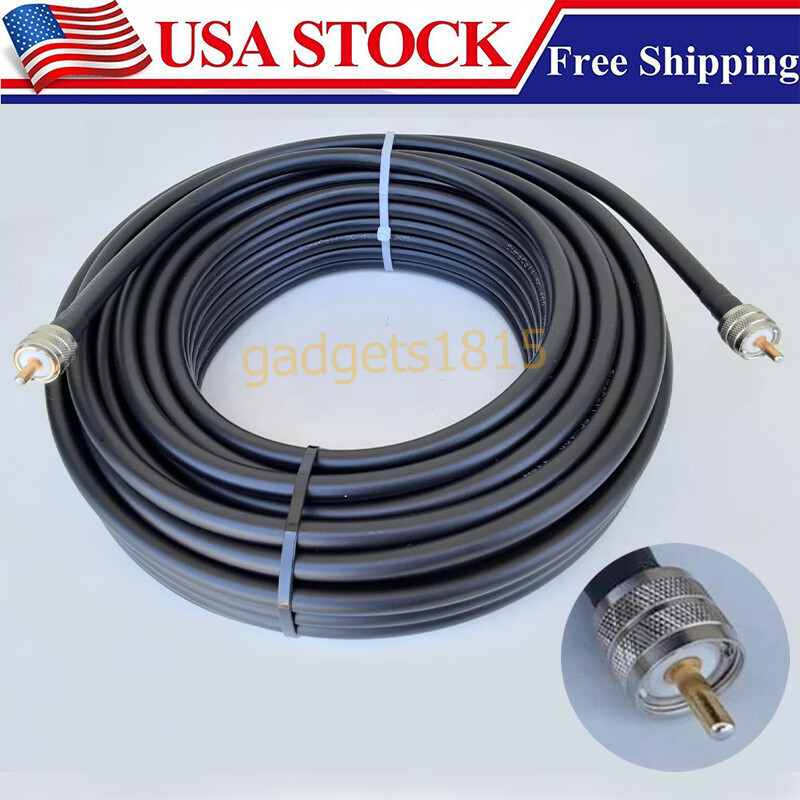

Photos from current listings. Actual item, color, and included accessories may vary.
Coaxial Cable Buying Guide
Coaxial cable is the shielded copper conductor and connector assembly that carries RF signals for internet, TV, and radio. The primary trade-off is between lower-loss, larger-diameter cable (better signal retention over distance) and thin, flexible cable (easier routing but higher attenuation). The decision rule: choose cable by impedance, frequency loss at your longest run, and connector type—never by visual thickness alone.
Key takeaways
- Impedance must match system: 75 ohm for TV, cable modem, and satellite; 50 ohm for ham radio, CB, and Wi-Fi antennas—mismatch causes signal reflection.
- LMR-400-class cable uses a solid bare-copper center conductor and double shield (foil + braid) for about 1.5 dB loss per 100 ft at 900 MHz, far better than RG-58.
- RG-6 quad-shield uses 18 AWG copper-clad steel center; RG-11 uses 14 AWG for longer runs with lower attenuation; RG-59 is thinner and loses more signal at high frequency.
At a glance
- Category
- Coax, Connectors & Portable Cases
- Last updated
- Nov 23, 2026
Current offers
Highlights
- Impedance must match system: 75 ohm for TV, cable modem, and satellite; 50 ohm for ham radio, CB, and Wi-Fi antennas—mismatch causes signal reflection.
- LMR-400-class cable uses a solid bare-copper center conductor and double shield (foil + braid) for about 1.5 dB loss per 100 ft at 900 MHz, far better than RG-58.
- RG-6 quad-shield uses 18 AWG copper-clad steel center; RG-11 uses 14 AWG for longer runs with lower attenuation; RG-59 is thinner and loses more signal at high frequency.
- PL-259 UHF connectors are 50 ohm; F-type connectors are 75 ohm—never mix PL-259 on a cable modem run or F-type on a ham antenna feedline.
Best use cases
- Best for cable modem or TV distribution: pick RG-6 quad-shield with F-type compression connectors; skip RG-59 and push-on connectors for any run over 25 ft.
- Best for ham radio or scanner antenna feed: pick LMR-400-class 50 ohm cable with PL-259 or N-type connectors; skip RG-58 for runs over 50 ft at VHF/UHF.
- Best for short indoor jumper or patch: pick RG-58 or RG-8X with quality crimp connectors; skip large LMR-400 for tight bends behind equipment.
- Wrong fit for direct burial or wet outdoor runs: standard PVC-jacketed coax degrades—specify flooded or gel-filled jacket with UV-rated outer sheath.
Buying tips
- Size the cable by loss budget: LMR-400 loses ~1.5 dB/100 ft at 900 MHz; RG-6 loses ~4.5 dB/100 ft—if your total loss exceeds 6 dB, step up to larger diameter.
- Match connector plating to environment: nickel-plated brass for general use, gold-plated center pins for low-contact-resistance RF, and avoid bare-copper braid exposed to moisture.
- For any run over 100 ft, use RG-11 or LMR-600 rather than RG-6 to keep signal loss under 3 dB at 1 GHz.
- Prefer compression F-connectors over twist-on for 75 ohm runs; they maintain shield continuity critical for DOCSIS 3.1 modem upstream performance.
Specs
| Impedance | 50 ohm RF / 75 ohm video & data |
|---|---|
| Common Types | RG-6, RG-11, RG-58, LMR-400 |
| Connector Standard | F-type (75Ω) / PL-259, N-type (50Ω) |
| Shielding | Single braid to quad-shield foil+braid |
Related searches
What to check before buying
- Measure the exact run length plus 10% service loop; loss and voltage drop scale with distance, so account for every bend and wall penetration.
- Confirm connector gender and type match both devices: F-type female on modem/TV, SO-239 or N-type female on radio equipment.
- Check jacket rating for the environment: CM for in-wall, CMX for outdoor UV exposure, flooded for direct burial.
- Verify impedance of every device in the chain—one 75 ohm splitter in a 50 ohm system creates standing wave problems.
FAQ
Data sources: eBay / Amazon listings and product attribute feeds. Updated Nov 23, 2026.
Some links on this page are affiliate links. If you buy after clicking one, we may earn a commission at no extra cost to you. This does not change which products appear here or their order. Affiliate disclosure.