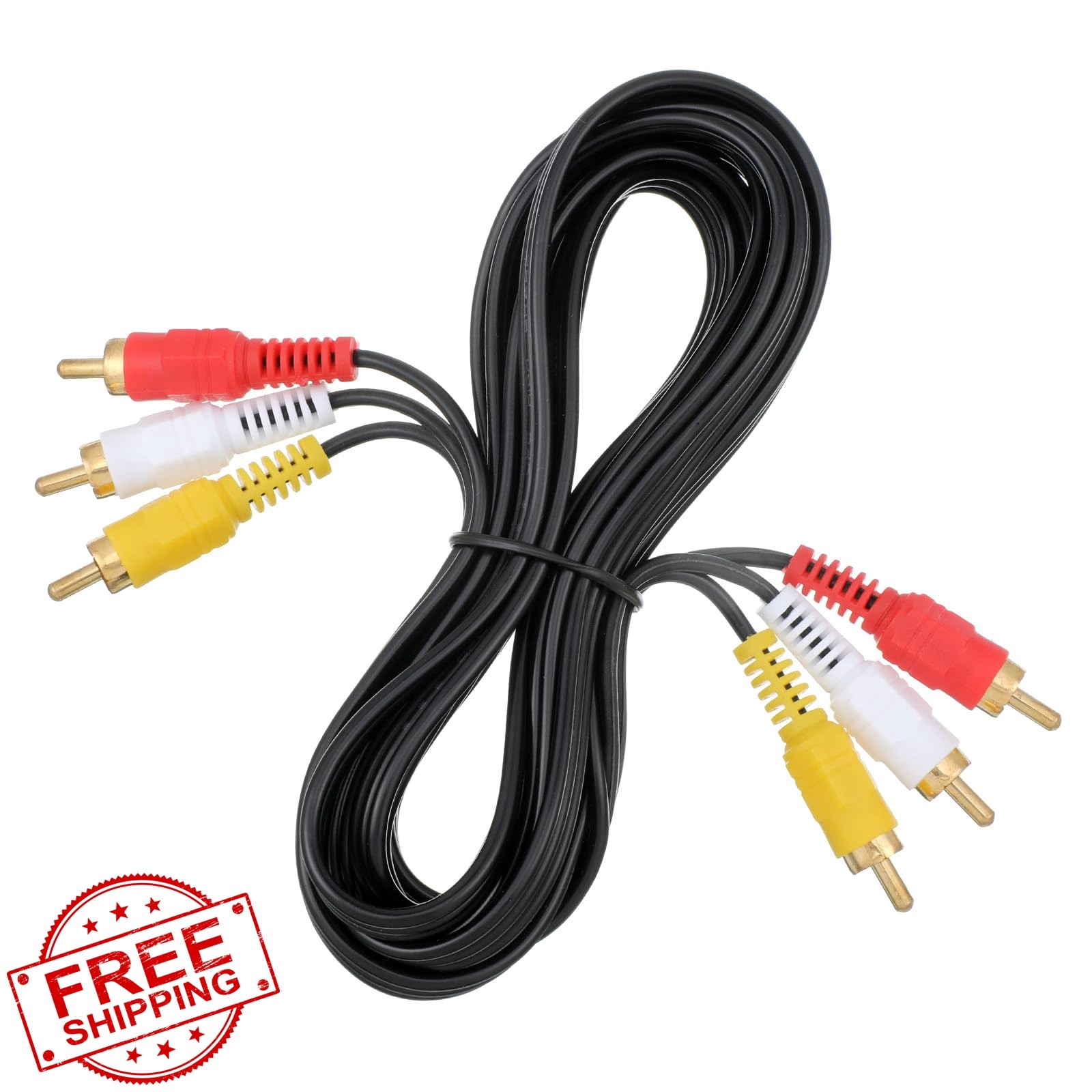

Photos from current listings. Actual item, color, and included accessories may vary.
Av RCA Cable Buying Guide
AV RCA cables are the red/white/yellow composite and stereo-audio interconnects used to carry standard-definition video and two-channel analog audio between TVs, DVD players, game consoles, and older A/V receivers. The core trade-off is pure copper conductor gauge and shielding versus thin copper-clad-aluminum or unshielded zip cord that introduces hum and color bleed. Buy a cable with oxygen-free copper center conductors, a braided or foil shield, and molded strain relief if you need clean composite video; skip the thinnest bundled accessories only for permanent short runs.
Key takeaways
- Composite video (yellow) needs a 75-ohm impedance-matched coax core to avoid ghosting and color fringing; standard stereo audio (red/white) is a separate 2-conductor shielded line.
- Oxygen-free copper (OFC) conductors with 95%+ braided or dual foil-plus-braid shielding reject AC hum and interference on RCA runs longer than about 6 feet.
- Nickel-plated connectors are fine for occasional connect/disconnect; gold plating over a nickel underlayer resists oxidation in humid rooms and survives repeated plugging cycles.
At a glance
- Category
- AV Cables & Interconnects
- Last updated
- Nov 28, 2026
Current offers
Highlights
- Composite video (yellow) needs a 75-ohm impedance-matched coax core to avoid ghosting and color fringing; standard stereo audio (red/white) is a separate 2-conductor shielded line.
- Oxygen-free copper (OFC) conductors with 95%+ braided or dual foil-plus-braid shielding reject AC hum and interference on RCA runs longer than about 6 feet.
- Nickel-plated connectors are fine for occasional connect/disconnect; gold plating over a nickel underlayer resists oxidation in humid rooms and survives repeated plugging cycles.
- Molded strain relief and a flexible PVC jacket matter more than cosmetic nylon braiding for durability at the plug-to-cable junction where most failures occur.
Best use cases
- Best fit: a 3-plug red/white/yellow RCA-to-RCA run from a DVD, VCR, or retro console to a TV's composite input — choose a single cable with color-coded molded plugs and 75-ohm video conductor.
- Wrong fit: converting HDMI or component video to composite with a passive RCA cable — no RCA cable converts signal formats; you need an active HDMI-to-composite or component-to-composite converter box.
- Best fit: a 10 ft stereo-only red/white run from a turntable or CD player to an amplifier — pick a 2-plug OFC cable with foil shield, and keep it under 15 ft to limit capacitance and treble roll-off.
- Wrong fit: routing RCA audio more than roughly 25 ft through walls or across a room — use a shielded cable with heavier gauge, an RCA-to-balanced converter, or a powered extender instead of a long passive run.
Buying tips
- Match plug count to purpose: 3 plugs (red/white/yellow) for composite video plus stereo audio; 2 plugs (red/white) for audio-only devices; do not buy a 3-plug set if you only need stereo audio.
- For runs up to 6 ft, 26–24 AWG OFC is adequate; for 6–15 ft, choose 24–22 AWG and 95%+ shielding; above 15 ft, move to 22 AWG or heavier low-capacitance cable to preserve video sharpness.
- Pick connectors with a split-tension outer ring and gold plating over nickel if the cable will be plugged into a receiver or TV repeatedly; bare nickel on thin plugs loosens and oxidizes.
- Keep cable capacitance low (often marked pF/ft) for video and long audio runs; high-capacitance thin zip cord rolls off high frequencies and blurs composite video edges.
Specs
| Plugs | 2 (stereo audio) or 3 (composite + stereo) |
|---|---|
| Conductor | OFC copper, 22–26 AWG typical |
| Shielding | Foil + braid, 95%+ coverage |
| Plating | Gold over nickel vs bare nickel |
Related searches
What to check before buying
- Count the jacks on both devices: confirm the TV or receiver has red/white/yellow RCA inputs and the source has matching RCA outputs — SCART and component (red/green/blue) jacks are not interchangeable with composite yellow.
- Measure the actual run from source to display, then add 2–3 ft of slack; avoid tight 90-degree bends and never run RCA cable parallel to AC power cords for long distances.
- Check plug housing diameter against recessed or tightly spaced TV jacks; bulky molded shells can block adjacent ports, so choose slim or right-angle connectors for wall-mounted panels.
- For outdoor or humid rooms, select gold-plated connectors and a jacket rated for the environment; standard PVC RCA cable is indoor-use only.
FAQ
Data sources: eBay / Amazon listings and product attribute feeds. Updated Nov 28, 2026.
Some links on this page are affiliate links. If you buy after clicking one, we may earn a commission at no extra cost to you. This does not change which products appear here or their order. Affiliate disclosure.