Picking a gaming motherboard is rarely about finding the longest feature list. It is about anchoring a PC build to the processor generation and memory type you intend to use, then deciding whether networking, storage expansion, aesthetics, or condition should carry more weight. In cpus, motherboards & memory, the MSI MAG B550 Tomahawk MAX WiFi and AORUS X870E PRO ICE take distinctly different routes. Start with the platform required by the rest of your build; then use the $32 listed price gap and feature set to break the tie.
Quick verdict
Choose the MSI route when your build plan centers on the explicitly supported AMD Ryzen 3000, 4000G, 5000, or 5000 G-Series processors. Choose the AORUS route when AM5 and DDR5 are the foundation of the build. The MSI emphasizes a gaming-focused thermal and network package, while the AORUS emphasizes a silver-and-white build direction alongside its power and storage design. Neither board is a universal substitute for the other, so platform should come before the price difference.
Listed comparison
| Detail | MSI MAG B550 Tomahawk MAX WiFi | AORUS X870E PRO ICE |
|---|---|---|
| Listed price | USD 167.99 | USD 199.99 |
| Platform and memory | AM4; DDR4 | AM5; DDR5 |
| Condition | New | Open box |
| Connectivity and storage | PCIe 4.0; Gen 4 x4 M.2; 2.5G LAN; Wi-Fi 6E | PCIe 5.0 storage; M.2 expansion slots; Wi-Fi 7 |
Where each product wins
MSI MAG B550 Tomahawk MAX WiFi: stated processor coverage and connectivity. MSI names four processor groups-Ryzen 3000, 4000G, 5000, and 5000 G-Series-making it the direct route for a build already centered on one of those families. Its other clearly named strengths are PCIe 4.0, a Lightning Gen 4 x4 M.2 connection with M.2 Shield Frozr, plus 2.5G LAN and Wi-Fi 6E.
AORUS X870E PRO ICE: styling, power design, and storage emphasis. The AORUS board is geared toward a coordinated silver-and-white build, with a listed 16+2+2 twin digital power design and PCIe 5.0 storage options. M.2 expansion slots add another named storage consideration. Pick this direction when those build-specific details matter more than MSI's named Ryzen coverage and network bundle.
Product notes
MSI MAG B550 Tomahawk MAX WiFi
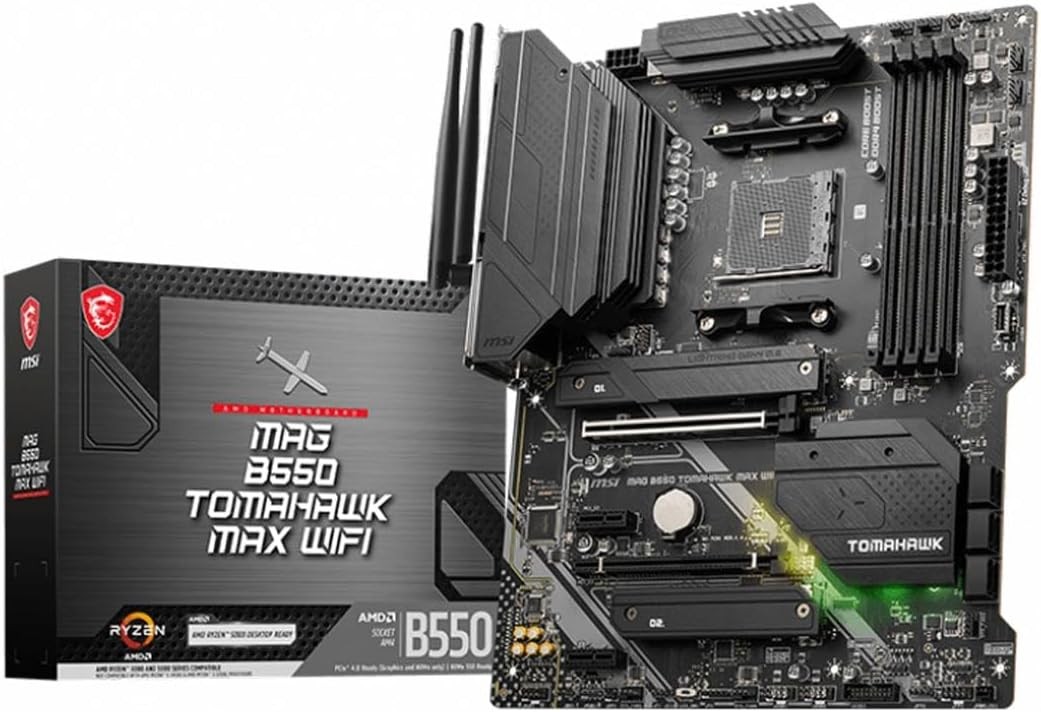
The MSI MAG B550 Tomahawk MAX WiFi is aimed at the builder drawn to its described thermal package: an extended heatsink design, an additional 7W/mk choke thermal pad, and a PCB with 2oz thickened copper. Those are concrete, build-focused details behind its gaming orientation. It is also listed as New, which separates its condition from the AORUS board in this comparison. Make MSI the choice when that thermal design is a priority for your parts plan. Its limitation is configuration specificity: the listed setup is AM4, DDR4, and ATX. That narrows the decision to shoppers deliberately building around those stated terms rather than choosing only by the Tomahawk MAX WiFi name.
AORUS X870E PRO ICE
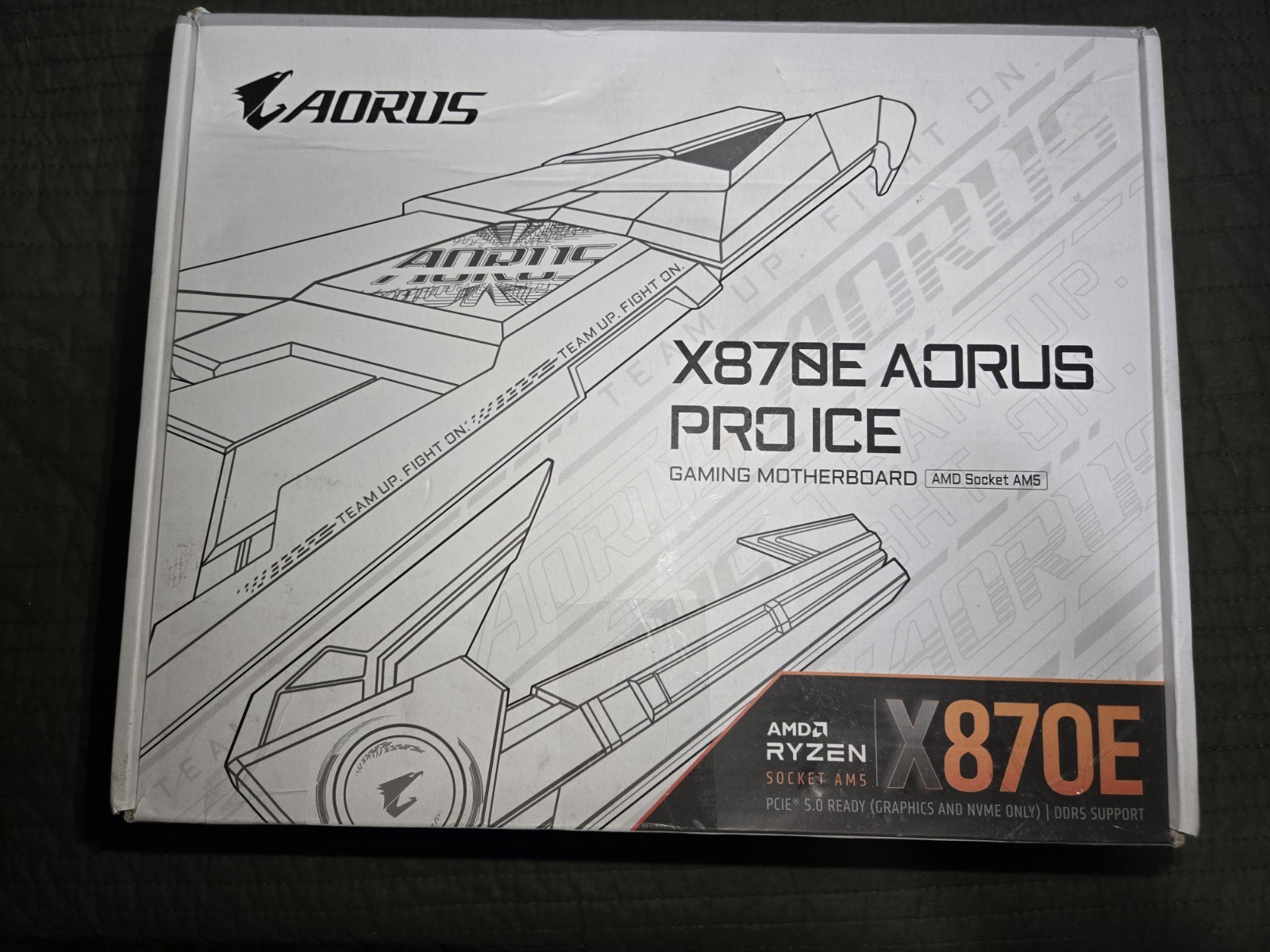
AORUS X870E PRO ICE speaks most clearly to a memory plan built around its four DIMM slots, AMD EXPO compatibility, and listed support up to 8200 MT/s (OC). Those are raw configuration details rather than a promise about results, but they give a shopper clear specifications to match against a planned build. The silver-and-white styling is another concrete reason to choose it for a coordinated-looking system. Its key limitation is condition: it is listed as Open box rather than New. On-board audio is also named, giving the AORUS board another specific component to weigh alongside its memory arrangement and visual direction.
Final choice by use case
Choose the MSI MAG B550 Tomahawk MAX WiFi when the extended heatsink, 7W/mk choke pad, and thickened-copper PCB are the details you want to prioritize. Choose the AORUS X870E PRO ICE when four DIMM slots and AMD EXPO compatibility better describe your memory plan. The $32 listed gap is a sensible tiebreaker only after those use-case differences; it should not replace platform matching.