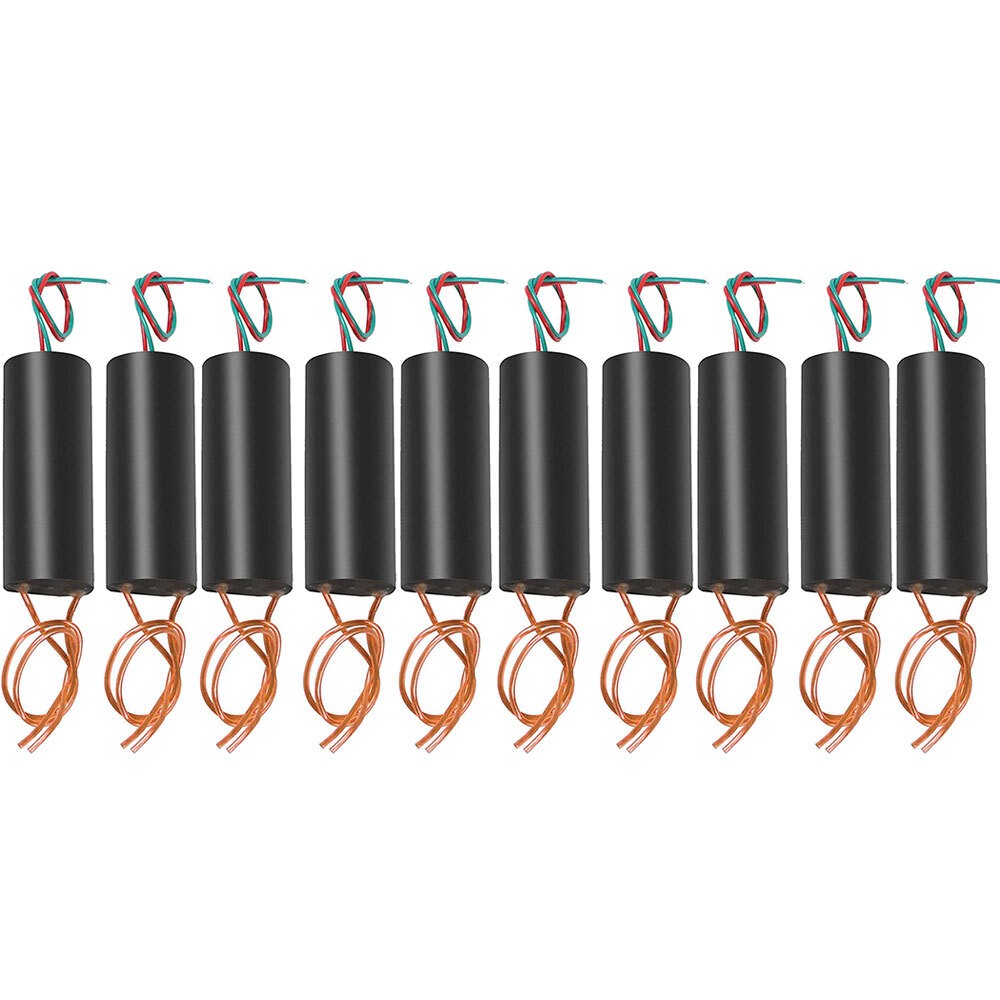

Photos from current listings. Actual item, color, and included accessories may vary.
High Voltage Generator Module Buying Guide
A high-voltage generator module is a compact DC-to-DC boost converter that steps up a low input voltage (typically 3–12 V) to kilovolts for tasks like arc generation, electrostatic experiments, and ion propulsion. The core trade-off is between voltage rating and current delivery: modules that advertise extreme voltages (100 kV–400 kV) deliver only microamps and are for spark/ion effects, while lower-voltage modules (1–20 kV) supply enough current for continuous arcs or capacitor charging. The decision rule: match the module's continuous output current and insulation rating to your load, and never trust a voltage headline without a current spec.
Key takeaways
- Output voltage ratings from 1 kV to 400 kV are open-circuit peaks; continuous current typically ranges from 0.5 mA (low-kV) down to 10–50 µA (high-kV).
- Most modules use a flyback transformer driven by a transistor oscillator; input 3.7–6 V DC is common, with 12 V versions available for higher duty cycles.
- Insulation and arc distance scale with voltage: 10 kV arcs ~3–10 mm, 100 kV arcs ~30–100 mm, 400 kV arcs ~100–200 mm in air at standard humidity.
At a glance
- Category
- Sensors, Modules & Components
- Last updated
- Nov 23, 2026
Current offers
Highlights
- Output voltage ratings from 1 kV to 400 kV are open-circuit peaks; continuous current typically ranges from 0.5 mA (low-kV) down to 10–50 µA (high-kV).
- Most modules use a flyback transformer driven by a transistor oscillator; input 3.7–6 V DC is common, with 12 V versions available for higher duty cycles.
- Insulation and arc distance scale with voltage: 10 kV arcs ~3–10 mm, 100 kV arcs ~30–100 mm, 400 kV arcs ~100–200 mm in air at standard humidity.
- Potting, conformal coating, and lead spacing determine durability; unported modules are prone to corona discharge and failure in humid or dusty environments.
Best use cases
- Best fit: plasma/arc experiments and ion lifters — choose a 10–30 kV module with ≥1 mA output and potted construction for continuous operation.
- Best fit: capacitor charging for Marx generators or coil guns — pick a 1–10 kV module rated for continuous current and add a bleed resistor; skip 100 kV+ modules that cannot charge capacitance quickly.
- Wrong fit: powering electronics or motors — high-voltage modules are not regulated power supplies; use a proper DC-DC converter instead.
- Wrong fit: outdoor or humid installations — skip unported modules; choose fully encapsulated units rated for the environment or derate voltage by 30–50%.
Buying tips
- Match continuous output current to load: arc/plasma needs ≥0.5 mA; capacitor charging needs ≥1 mA; ion propulsion can work with 50–200 µA at 20–50 kV.
- Derate open-circuit voltage by 30–50% for continuous duty; a 400 kV module may only sustain 200–250 kV without overheating or arcing over.
- Prefer modules with input reverse-polarity protection and a clearly marked input voltage range; 3.7–6 V modules are common, but 12 V versions offer better efficiency for higher power.
- Check insulation: potted or silicone-coated modules resist humidity and corona better than bare PCB types; lead length and spacing should exceed the arc distance you plan to use.
Specs
| Output Voltage | 1 kV to 400 kV (open-circuit) |
|---|---|
| Input Voltage | 3.7–12 V DC typical |
| Continuous Current | 0.05–2 mA (voltage-dependent) |
| Insulation | Potted vs bare PCB; arc distance 3–200 mm |
Related searches
What to check before buying
- Confirm your power source can supply the module's peak input current (often 1–3 A for high-kV modules) and that voltage is within the stated range.
- Measure the maximum arc gap you need; ensure the module's realistic derated voltage exceeds that gap's breakdown voltage (≈3 kV/mm in air).
- Plan for thermal management: continuous operation above 50% rated voltage requires airflow or heat sinking on the transformer/transistor.
- Verify safety: high-voltage modules require isolation, bleed resistors on capacitors, and enclosures to prevent shock; ensure your workspace can accommodate clearances.
FAQ
Data sources: eBay / Amazon listings and product attribute feeds. Updated Nov 23, 2026.
Some links on this page are affiliate links. If you buy after clicking one, we may earn a commission at no extra cost to you. This does not change which products appear here or their order. Affiliate disclosure.