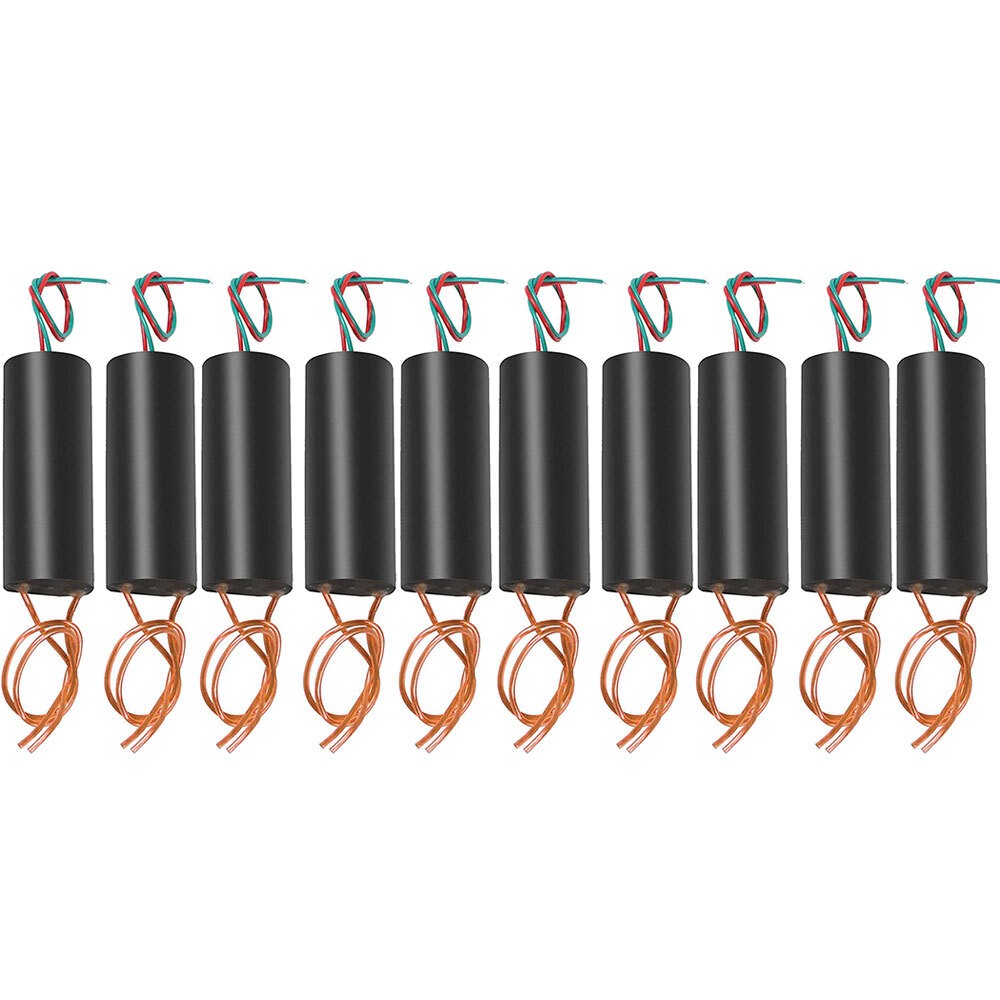

Photos from current listings. Actual item, color, and included accessories may vary.
High Voltage Generator Buying Guide
A high-voltage generator is a compact step-up module or supply that converts low DC input (typically 3–12 V) into kilovolt-to-megavolt potentials for arc, ion, electrostatic, and pulse experiments. The core trade-off is between the module's voltage rating, insulation/creepage distance, and sustained current capability versus its size, input sensitivity, and thermal limits. Buy only modules with clearly rated input voltage, output polarity, and potting/clearance for your target kV; skip unrated 'boost' boards that quote peak open-circuit voltage without current or duty-cycle specs.
Key takeaways
- Open-circuit voltage ratings (e.g., 400 kV-class modules) describe the arc-strike potential, not continuous output; sustained current is typically microamps and collapses under load.
- Insulation and creepage dominate safety and reliability: output leads need HV-rated silicone or PTFE wire, and the module must be potted or spaced for the full kV potential.
- Input tier dictates behavior: 3–6 V modules suit battery/USB experiments, while 12 V input modules deliver higher primary current and longer arc duty cycles.
At a glance
- Category
- Sensors, Modules & Components
- Last updated
- Nov 23, 2026
Current offers
Highlights
- Open-circuit voltage ratings (e.g., 400 kV-class modules) describe the arc-strike potential, not continuous output; sustained current is typically microamps and collapses under load.
- Insulation and creepage dominate safety and reliability: output leads need HV-rated silicone or PTFE wire, and the module must be potted or spaced for the full kV potential.
- Input tier dictates behavior: 3–6 V modules suit battery/USB experiments, while 12 V input modules deliver higher primary current and longer arc duty cycles.
- Driver architecture splits into self-oscillating flyback (simple, cheap, heat-limited) versus dedicated driver IC/transformer stages (stable frequency, better efficiency, higher duty cycle).
Best use cases
- Best fit: battery-powered arc/lift experiments and classroom demos — choose a 3–6 V input module with a clearly rated kV output and potted transformer.
- Best fit: continuous ionization or electrostatic charging — pick a 12 V input supply-rated module with heatsinking and specified duty cycle, not a bare open-board booster.
- Wrong fit: any application needing defined output current or regulated kV (e.g., capacitor charging to a precise voltage) — these modules are unregulated and current-limited; use a proper HV supply.
- Wrong fit: mains-powered or long-duration indoor use without enclosure — exposed HV leads and ozone generation make bare modules unsafe; select an enclosed, potted supply tier instead.
Buying tips
- Match input to your source: use 3–6 V modules for USB/battery packs, and step to 12 V input only when you can supply adequate current and heatsinking.
- Treat quoted output kV as arc-strike potential: for any real load, expect microamp-level current drop and plan spacing/insulation for the full rated voltage.
- Choose potted or silicone-potted transformer modules for repeated arcing; open-frame boost boards are for brief, intermittent demonstrations only.
- Verify output polarity and whether the module is isolated or referenced to input ground before wiring it into any measurement or electrode setup.
Specs
| Input Voltage Tier | 3–6 V DC vs 12 V DC |
|---|---|
| Output Rating | kV-class open-circuit arc potential |
| Driver Architecture | Self-oscillating flyback vs driver IC |
| Insulation Class | Potted vs open-frame HV output |
Related searches
What to check before buying
- Confirm your input source can deliver the module's rated current at 3–12 V; weak batteries cause low arc voltage and overheating.
- Plan insulation and clearance for the full rated kV — use HV silicone wire and keep ≥ the rated creepage distance from any conductor or user.
- Check output polarity and isolation: know whether the HV output is floating or ground-referenced before connecting electrodes or instruments.
- Verify duty cycle and thermal path: add heatsinking or forced air if the module will arc for more than brief bursts.
FAQ
Data sources: eBay / Amazon listings and product attribute feeds. Updated Nov 23, 2026.
Some links on this page are affiliate links. If you buy after clicking one, we may earn a commission at no extra cost to you. This does not change which products appear here or their order. Affiliate disclosure.