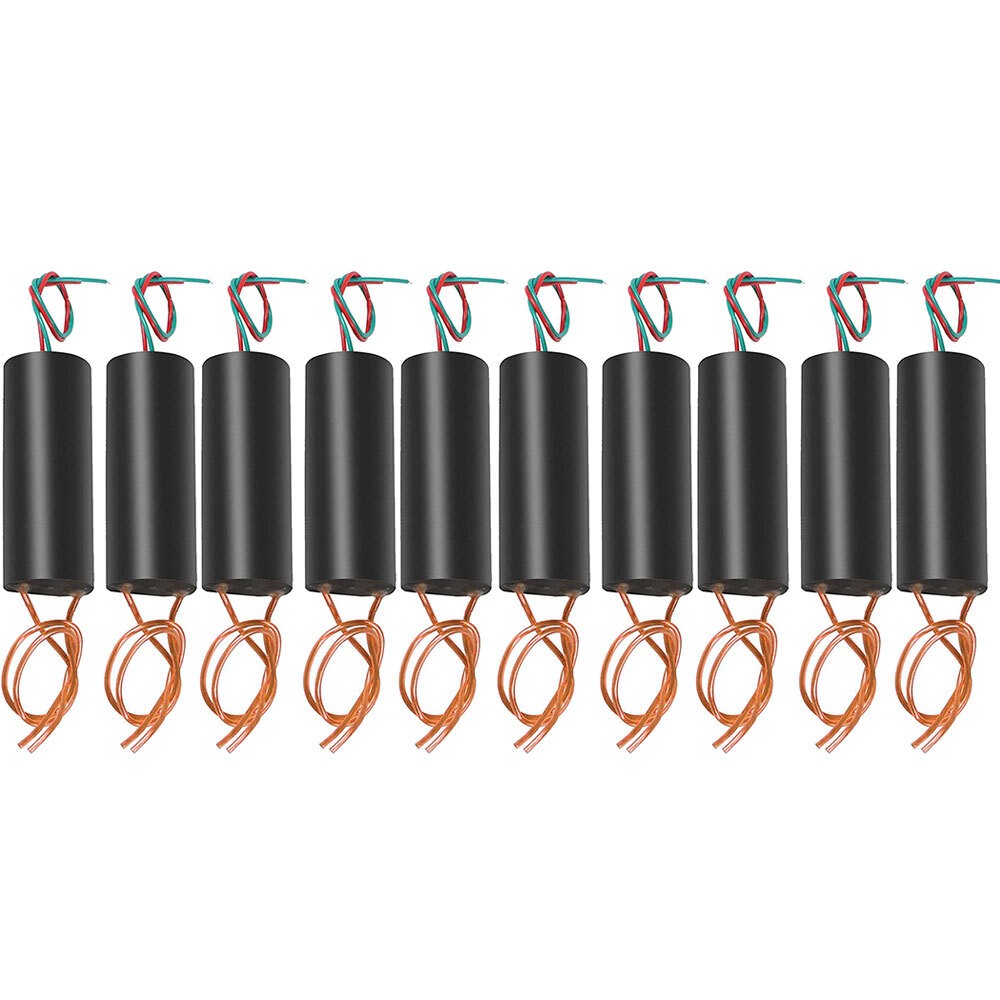

Photos from current listings. Actual item, color, and included accessories may vary.
DC High Voltage Generator Buying Guide
A DC high voltage generator is a compact step-up module that converts low-voltage DC (typically 3–6V or 12V) into kilovolt-range pulses for tasks like arcing, ion generation, and small electrostatic experiments. The primary trade-off is between voltage rating and current/thermal headroom: higher-voltage modules use thinner wire and lower duty cycles, so they deliver sparks but not sustained power. The decision rule is simple: choose a module whose input voltage matches your supply and whose output current and duty cycle suit continuous operation—avoid any unit that only lists an open-circuit voltage without a current or duty-cycle spec.
Key takeaways
- Input voltage tiers: 3–6V (single-cell or USB) vs 12V (car/bench supply); matching the input to your source prevents immediate saturation or failure.
- Output is typically pulsed high-voltage (kV range) at very low current (microamps to a few milliamps), so it can arc but cannot drive sustained loads.
- Construction quality hinges on potted transformer insulation and wire gauge: unpotted coils arc internally and fail early under humidity.
At a glance
- Category
- Sensors, Modules & Components
- Last updated
- Nov 23, 2026
Current offers
Highlights
- Input voltage tiers: 3–6V (single-cell or USB) vs 12V (car/bench supply); matching the input to your source prevents immediate saturation or failure.
- Output is typically pulsed high-voltage (kV range) at very low current (microamps to a few milliamps), so it can arc but cannot drive sustained loads.
- Construction quality hinges on potted transformer insulation and wire gauge: unpotted coils arc internally and fail early under humidity.
- Duty cycle matters more than peak voltage: continuous-rated modules use larger cores and heat sinks; intermittent modules require rest periods.
Best use cases
- Best fit: pick a 3–6V input module for battery-powered demonstrations, ion fans, or small arc experiments where a USB power bank or 18650 cell is the source.
- Best fit: pick a 12V input module for bench or automotive use when you need higher repetition rate and have a stable supply with current limiting.
- Wrong fit: skip any high-voltage generator for powering motors, LEDs, or audio—these modules output negligible current and will not drive loads.
- Wrong fit: avoid open-frame or unpotted coils for humid or outdoor environments; choose a fully encapsulated module with sealed leads.
Buying tips
- Match input voltage exactly: a 3–6V module on a 12V supply will overheat instantly; a 12V module on 3V will not start.
- Prioritize listings that state output current or power (even approximate) alongside voltage; voltage-only specs hide weak, intermittent designs.
- For continuous operation, derate: run at 50–70% of rated input voltage and add a small fan if the transformer core exceeds hand-warm temperature.
- Insulation grade determines lifespan: silicone-potted or epoxy-encapsulated units resist arcing better than bare enamel wire coils.
Specs
| Input Voltage | 3–6V DC / 12V DC / 24V DC |
|---|---|
| Output Type | Pulsed HV, kV range, µA–mA |
| Duty Cycle | Intermittent vs continuous-rated |
| Insulation | Potted/epoxy vs bare coil |
Related searches
What to check before buying
- Confirm your power source can supply the module's input current—3–6V modules often draw 1–3A at peak, which a weak USB port cannot deliver.
- Measure the space around the output terminals: high-voltage arcs need clearance (often 10mm+ per 10kV) to avoid shorting to nearby metal.
- Check lead length and connector type: short bare leads require soldering; pre-tinned or JST-terminated leads simplify bench setup.
- Verify environmental sealing if used outdoors or in humid rooms; unsealed coils absorb moisture and arc over within hours.
FAQ
Data sources: eBay / Amazon listings and product attribute feeds. Updated Nov 23, 2026.
Some links on this page are affiliate links. If you buy after clicking one, we may earn a commission at no extra cost to you. This does not change which products appear here or their order. Affiliate disclosure.