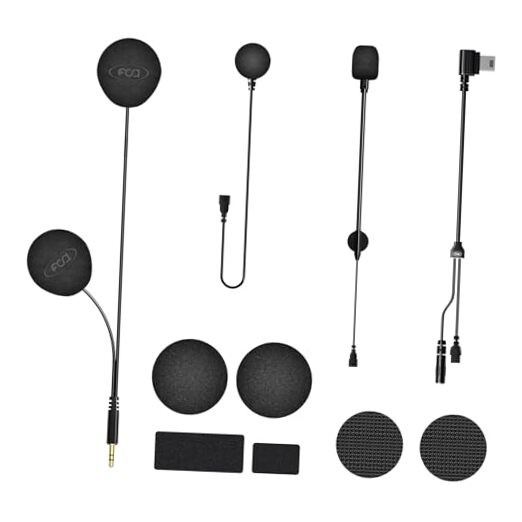

Photos from current listings. Actual item, color, and included accessories may vary.
Headphone Cable Replacement Buying Guide
A headphone cable replacement restores or upgrades the signal path between your headphones and source, where the decisive trade-offs are connector standard, conductor material, and strain-relief build quality rather than cosmetic braiding. The rule that separates durable options from compromises: buy a cable whose connector type, wiring scheme, and plug housing are explicitly specified and mechanically anchored, not a generic 'compatible' cable with molded ends and unstated conductors.
Key takeaways
- Conductor grade drives signal integrity: OFC copper is the baseline, OCC/UPOCC copper and silver-plated OFC reduce skin-effect losses at high frequencies; pure silver is lowest resistance but stiff and costly.
- Connector standard is non-negotiable: 3.5 mm TRS (unbalanced), 2.5 mm/4.4 mm TRRS (balanced), and 6.35 mm TRS each require matching source and headphone termination — never adapt impedance-critical paths with passive plugs.
- Headphone-side terminations differ by model family: 2-pin 0.78 mm IEM, MMCX, HD600-series 2-pin, and Beyerdynamic 3-pin each need the exact plug, and reversible 2-pin cables must match polarity markers.
At a glance
- Category
- IEM Cables & Ear Tips
- Last updated
- Nov 23, 2026
Current offers
Highlights
- Conductor grade drives signal integrity: OFC copper is the baseline, OCC/UPOCC copper and silver-plated OFC reduce skin-effect losses at high frequencies; pure silver is lowest resistance but stiff and costly.
- Connector standard is non-negotiable: 3.5 mm TRS (unbalanced), 2.5 mm/4.4 mm TRRS (balanced), and 6.35 mm TRS each require matching source and headphone termination — never adapt impedance-critical paths with passive plugs.
- Headphone-side terminations differ by model family: 2-pin 0.78 mm IEM, MMCX, HD600-series 2-pin, and Beyerdynamic 3-pin each need the exact plug, and reversible 2-pin cables must match polarity markers.
- Strain relief and plug housing determine lifespan: metal-barrel plugs with internal glue or screw clamps and braided aramid/Kevlar reinforcement outlast molded PVC ends that crack at the bend point.
Best use cases
- Best fit for IEM owners with a failed stock cable: pick an MMCX or 2-pin 0.78 mm cable matched to your earpiece, with a 3.5 mm TRS or 4.4 mm TRRS plug for your player — skip generic 3.5 mm-to-3.5 mm cables that cannot attach to IEM shells.
- Best fit for desktop headphone users with a long run: choose a 6.35 mm TRS or 4-pin XLR cable in OFC with a 2–3 m length and reinforced Y-split; skip thin 1.2 m portable cables if you sit more than arm's length from the amp.
- Best fit for balanced portable setups: select a 4.4 mm TRRS or 2.5 mm TRRS cable built from four discrete conductors and pair it only with a balanced output; skip if your source is single-ended 3.5 mm.
- Wrong fit to avoid: buying a cable 'only for' one specific model (e.g., an FX8 PRO-only cable) for a different headphone — the headphone-side connector will not mate regardless of plug type.
Buying tips
- Match the headphone-side connector exactly: measure 2-pin spacing (0.75 mm vs 0.78 mm), confirm MMCX male/female gender, and count pins on HD600-family and Beyerdynamic sockets before ordering.
- For runs over 2 m, choose OFC or OCC copper at 24–26 AWG per conductor; thinner 30–32 AWG wire raises resistance and can roll off low-impedance IEMs.
- Buy balanced cable only when the source has a matching balanced output: 4.4 mm TRRS for modern DAPs, 2.5 mm TRRS for older players, 4-pin XLR for desktop amps.
- Inspect plug construction: metal barrel with screw or glue strain relief, heat-shrink at the Y-split, and braided outer jacket rated for repeated flex — molded rubber ends are the first failure point.
Specs
| Headphone Connector | 2-pin 0.78 mm / MMCX / HD600 / 3-pin |
|---|---|
| Source Plug | 3.5 mm TRS / 4.4 mm TRRS / 6.35 mm TRS |
| Conductor Material | OFC / OCC copper / silver-plated OFC |
| Cable Length | 1.2 m portable / 2–3 m desktop |
Related searches
What to check before buying
- Confirm the headphone-side connector type and polarity: 2-pin 0.78 mm (with L/R markers), MMCX, HD600 2-pin, or Beyerdynamic 3-pin.
- Match the source plug to your output: 3.5 mm TRS single-ended, 4.4 mm or 2.5 mm TRRS balanced, or 6.35 mm TRS desktop.
- Measure required length from headband to source and add 15–20 cm slack; standard portable cables are 1.2 m and desktop cables 2–3 m.
- Check plug housing diameter against your device case or jack recess — right-angle or slim-barrel plugs fit recessed jacks that straight barrels block.
FAQ
Data sources: eBay / Amazon listings and product attribute feeds. Updated Nov 23, 2026.
Some links on this page are affiliate links. If you buy after clicking one, we may earn a commission at no extra cost to you. This does not change which products appear here or their order. Affiliate disclosure.