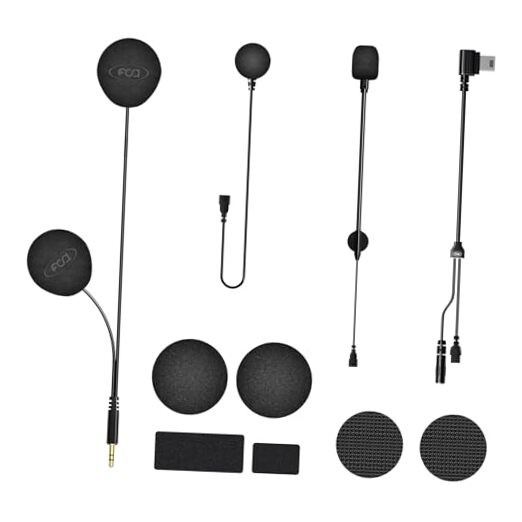

Photos from current listings. Actual item, color, and included accessories may vary.
Headphone Cable Buying Guide
A headphone cable is a passive electrical link whose conductor gauge, shielding, and connector plating determine noise rejection, microphonics, and long-term reliability. The core trade-off is stranded OFC copper with robust strain relief versus thin enameled wire and molded plugs that fail at the jack. Buy a cable only when it matches your headphone's exact connector type (2-pin 0.78 mm, MMCX, or proprietary) and termination standard; skip generic 'upgrade' cables without verified pin geometry.
Key takeaways
- Conductor material drives conductivity: OFC copper and silver-plated OFC outperform CCA (copper-clad aluminum), which oxidizes and cracks under repeated flexing.
- Shielding separates cables: braided or spiral copper shields reject EMI in dense urban/office RF environments; unshielded twisted pairs suit stationary desktop use only.
- Connector tier dictates lifespan: gold-plated brass barrels with molded strain relief survive thousands of insert cycles; nickel-plated or crimped plastic plugs fail at the solder joint.
At a glance
- Category
- IEM Cables & Ear Tips
- Last updated
- Nov 23, 2026
Current offers
Highlights
- Conductor material drives conductivity: OFC copper and silver-plated OFC outperform CCA (copper-clad aluminum), which oxidizes and cracks under repeated flexing.
- Shielding separates cables: braided or spiral copper shields reject EMI in dense urban/office RF environments; unshielded twisted pairs suit stationary desktop use only.
- Connector tier dictates lifespan: gold-plated brass barrels with molded strain relief survive thousands of insert cycles; nickel-plated or crimped plastic plugs fail at the solder joint.
- Pin geometry is non-negotiable: 0.78 mm 2-pin, MMCX, and proprietary recessed sockets are not interchangeable, and reversed polarity or oversized pins damage the IEM socket.
Best use cases
- Choose a 2-pin 0.78 mm or MMCX cable with a 3.5 mm TRS or 4.4 mm balanced plug for wired IEM monitoring; skip if your IEM uses a recessed proprietary connector unless the cable explicitly matches that shell depth.
- Pick a shielded, low-microphonic braided cable for commuting or office use where RF interference and cable noise are audible; a thin unshielded cable is wrong-fit for active environments.
- Buy a replacement cable with verified pin type and strain-relieved plugs for daily wear; do not buy a 'high resolution' cable that names only a specific model (e.g., FX8 PRO) unless that is your exact headphone.
Buying tips
- Match the connector first: measure your IEM socket pin spacing (0.75 mm vs 0.78 mm) and shell recess depth; an oversized 0.78 mm pin in a 0.75 mm socket spreads the contact spring permanently.
- Count conductors for balanced use: a 4-wire cable supports 2.5 mm/4.4 mm balanced TRRS; a 3-wire cable is single-ended 3.5 mm only and cannot be reterminated to balanced without a ground split.
- Verify the plug standard: 3.5 mm TRS (3-pole) works with all single-ended sources; 4.4 mm Pentaconn and 2.5 mm TRRS are balanced-only and will not fit 3.5 mm jacks without an adapter.
- Prefer 24-28 AWG stranded OFC for IEM cables: thinner enameled wire raises resistance and microphonics; thicker 20-22 AWG is for full-size headphone cables, not IEM shells.
Specs
| Connector Type | 2-pin 0.78mm / MMCX / proprietary |
|---|---|
| Plug Termination | 3.5mm TRS / 2.5mm & 4.4mm balanced |
| Conductor Material | OFC copper / silver-plated OFC / CCA |
| Shielding & Jacket | Braided shield / PVC / TPE low-microphonic |
Related searches
What to check before buying
- Confirm your IEM connector type and recess depth (0.78 mm 2-pin, MMCX, or proprietary) before ordering; measure pin spacing with calipers if unmarked.
- Check your source output: 3.5 mm single-ended, 2.5 mm/4.4 mm balanced, or USB-C dongle; the cable termination must match the jack without adapters.
- Inspect the cable's strain relief and plug barrel material; molded plastic plugs and unrelieved solder joints are the primary failure point on daily-wear cables.
- For balanced wiring, confirm the cable has four discrete conductors and a TRRS plug; a 3-pole cable cannot deliver a balanced signal.
FAQ
Data sources: eBay / Amazon listings and product attribute feeds. Updated Nov 23, 2026.
Some links on this page are affiliate links. If you buy after clicking one, we may earn a commission at no extra cost to you. This does not change which products appear here or their order. Affiliate disclosure.