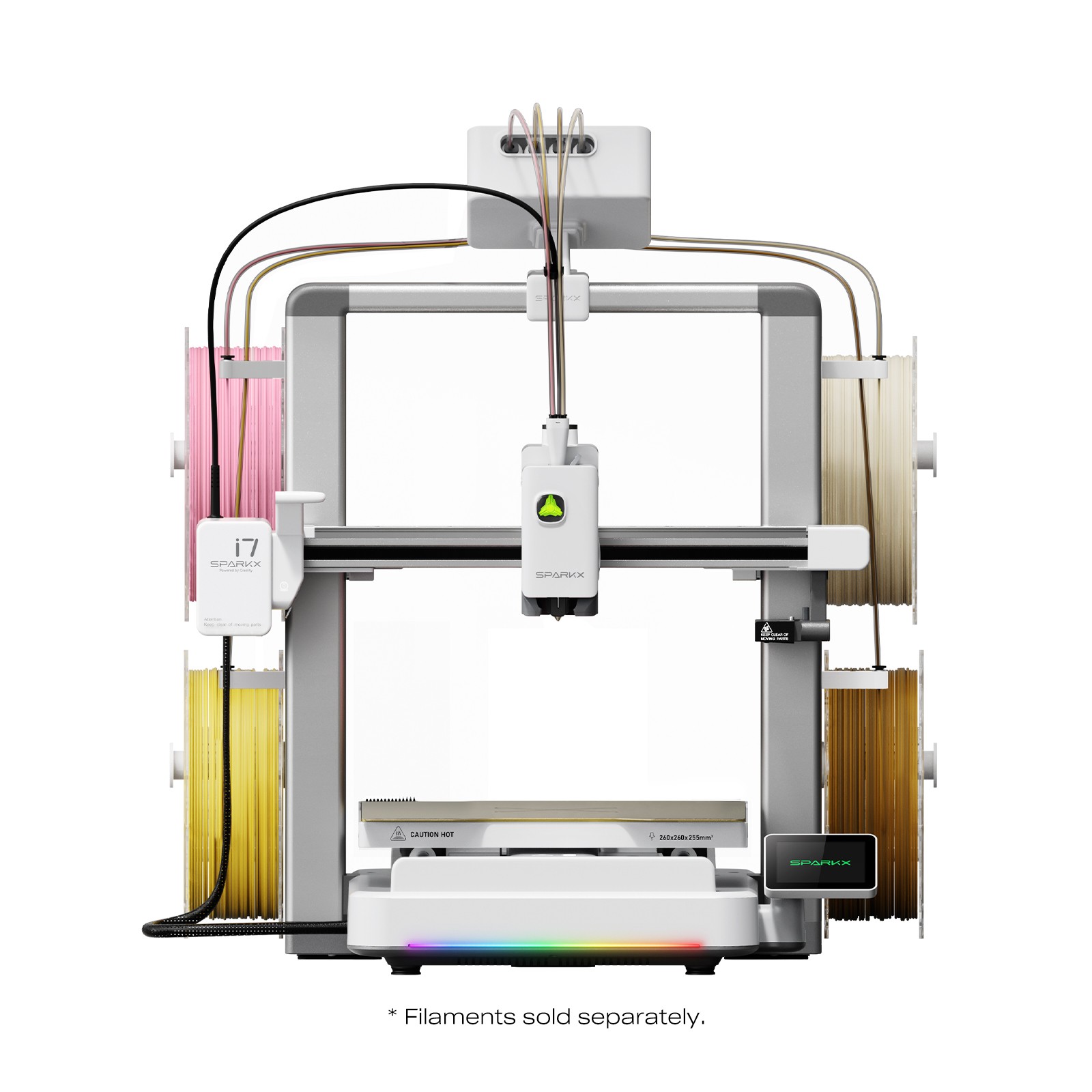

Photos from current listings. Actual item, color, and included accessories may vary.
Creality I7 Nano Buying Guide
The Creality I7 Nano (sold as the SPARKX i7 Nano Combo) is a fast, compact FDM printer aimed at hobbyists and small-shop makers who want CoreXY-class speed in a desk-friendly footprint. The core trade-off is speed versus rigidity: a 500 mm/s rated motion system only delivers clean prints if the frame and hotend keep up, so buyers must distinguish true high-flow configurations from budget bedslingers that merely advertise fast numbers. The decision rule is simple: buy a fully enclosed, all-metal hotend, direct-drive CoreXY machine if you print functional parts daily; skip bedslinger clones with part-cooling and frame flex limits if dimensional accuracy and ABS/CF work matter.
Key takeaways
- CoreXY motion architecture with 500 mm/s max print speed and high acceleration enables fast traversal, but real speed is limited by hotend flow rate and part cooling.
- 260 × 260 × 255 mm build volume covers most functional parts and helmets, while keeping the frame compact enough for a 60 cm deep desk.
- Direct-drive extruder with all-metal hotend is required for flexible TPU, abrasive PLA-CF/PETG-CF/CR-carbon, and sustained 250–300 °C ABS printing.
At a glance
- Category
- FDM 3D Printers
- Status
- Listings available
- Last updated
- Nov 28, 2026
Current offers
Highlights
- CoreXY motion architecture with 500 mm/s max print speed and high acceleration enables fast traversal, but real speed is limited by hotend flow rate and part cooling.
- 260 × 260 × 255 mm build volume covers most functional parts and helmets, while keeping the frame compact enough for a 60 cm deep desk.
- Direct-drive extruder with all-metal hotend is required for flexible TPU, abrasive PLA-CF/PETG-CF/CR-carbon, and sustained 250–300 °C ABS printing.
- Supported filaments PLA, TPU, PETG, ABS, PLA-CF, PETG-CF, and CR-carbon indicate a hardened nozzle and high-flow hotend; stock brass nozzles wear quickly on carbon-filled materials.
Best use cases
- Best fit: a maker printing PLA/PETG functional parts and occasional ABS who wants 500 mm/s-class speed and a 260 mm cube on a desk—pick the enclosed, all-metal hotend tier with hardened nozzle.
- Best fit: a small shop producing carbon-fiber reinforced jigs and fixtures—buy the Combo with hardened nozzle and filament system, and skip any brass-nozzle base configuration.
- Wrong fit: a buyer wanting a large-format 300+ mm printer for helmets or furniture parts—260 × 260 × 255 mm will force slicing and gluing; choose a 350 mm-class CoreXY instead.
- Wrong fit: a beginner on a tight budget printing only PLA—a slower bedslinger at the same size prints equally well for less; the 500 mm/s premium is wasted without tuning skill.
Buying tips
- Check hotend flow: 500 mm/s only holds with a high-flow hotend around 20–30 mm³/s; a standard V6-class hotend caps real speed near 150–200 mm/s on 0.4 mm nozzles.
- For PLA-CF, PETG-CF, and CR-carbon, require a hardened steel or ruby nozzle—brass wears out in tens of hours and ruins extrusion consistency.
- Confirm direct-drive extrusion for TPU; Bowden setups struggle below 95A shore hardness and produce stringing at speed.
- Verify the Combo includes the multi-filament or accessory unit; the base I7 Nano name alone does not guarantee the bundled system.
Specs
| Motion System | CoreXY, 500 mm/s rated |
|---|---|
| Build Volume | 260 × 260 × 255 mm |
| Hotend / Nozzle | All-metal, hardened for CF |
| Filament Range | PLA, TPU, PETG, ABS, CF-filled |
Alternatives to compare
What to check before buying
- Measure desk depth: a 260 mm-class CoreXY frame typically needs 45–55 cm depth plus 10 cm rear clearance for the bed and cable chain.
- Confirm 100–240 V input and regional plug type; high-wattage heated beds and enclosures may need a dedicated 10 A circuit.
- Check room ventilation for ABS and carbon-filled filaments—an enclosed printer with filter is required, not optional, for indoor ABS use.
- Verify slicer compatibility (Orca, PrusaSlicer, Creality Print) and that the Combo's accessory has profiles for your chosen material.
FAQ
Data sources: eBay / Amazon listings and product attribute feeds. Updated Nov 28, 2026.
Some links on this page are affiliate links. If you buy after clicking one, we may earn a commission at no extra cost to you. This does not change which products appear here or their order. Affiliate disclosure.