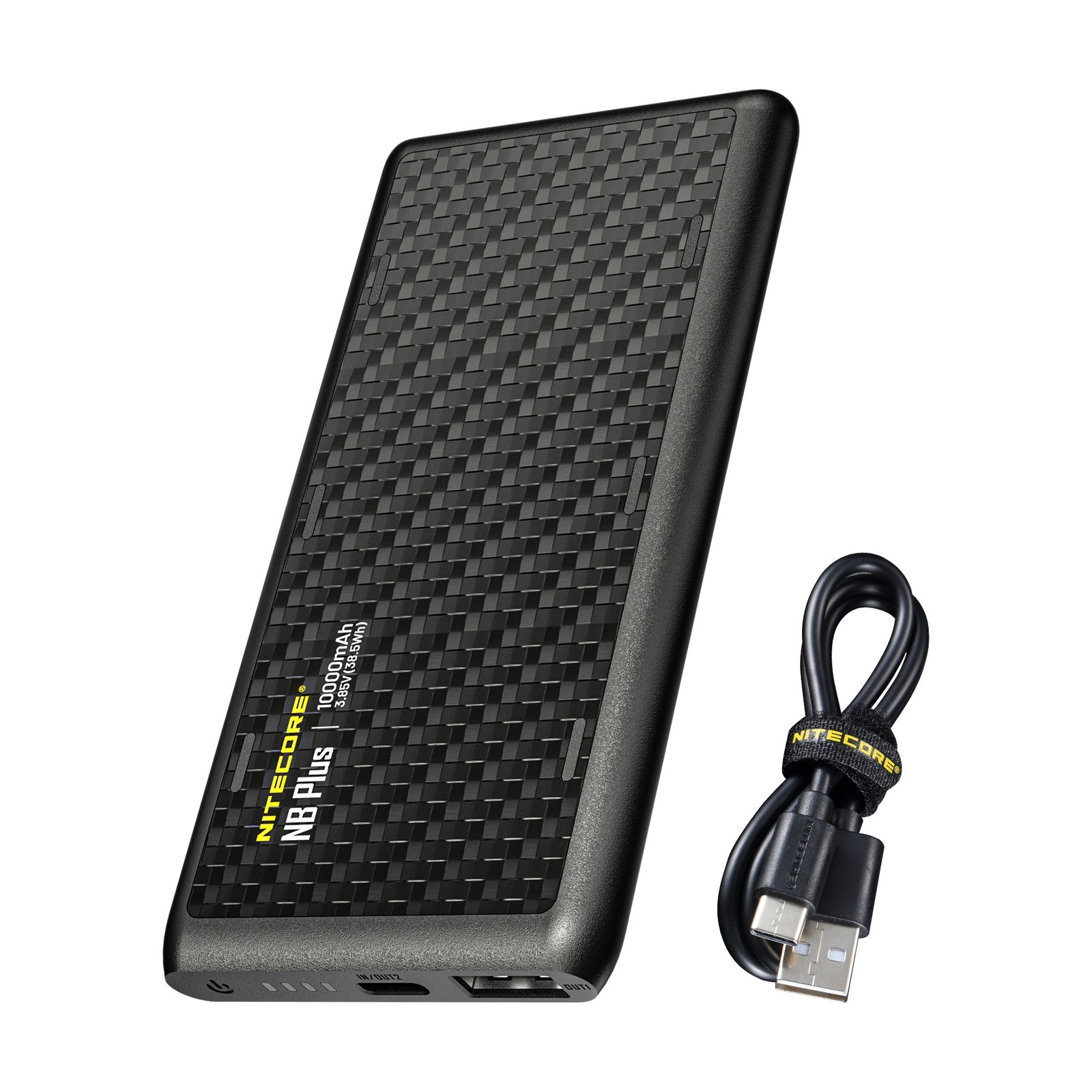

Photos from current listings. Actual item, color, and included accessories may vary.
Nitecore Power Bank Buying Guide
Nitecore power banks are built around ultra-light carbon-fiber or polycarbonate shells and high-density cells, targeting outdoor, EDC, and travel users who prioritize grams over raw capacity. The core trade-off is weight versus capacity: Nitecore's NB-series and NPB-series trade total mAh for carry comfort, while their higher-capacity models add weight and sometimes proprietary fast-charge protocols. Buy the lightest model that meets your device's charge-cycle needs, and skip any unit that lacks USB-C PD output if you carry modern phones or laptops.
Key takeaways
- NB-series (e.g., NB10000, NB Plus) uses carbon-fiber composite shells at roughly 150-160 g for 10,000 mAh, versus 220-250 g for typical aluminum 10,000 mAh banks.
- NPB-series adds built-in USB-C cables and higher output (up to 30 W PD) but weighs more; output wattage, not capacity, determines laptop charging viability.
- Carry-on compliance is capacity-based: all 10,000-20,000 mAh Nitecore banks fall under the 100 Wh airline limit, but 20,000 mAh models approach it and must be in carry-on, never checked.
At a glance
- Category
- Chargers, Power Banks & Adapters
- Last updated
- Nov 28, 2026
Current offers
Highlights
- NB-series (e.g., NB10000, NB Plus) uses carbon-fiber composite shells at roughly 150-160 g for 10,000 mAh, versus 220-250 g for typical aluminum 10,000 mAh banks.
- NPB-series adds built-in USB-C cables and higher output (up to 30 W PD) but weighs more; output wattage, not capacity, determines laptop charging viability.
- Carry-on compliance is capacity-based: all 10,000-20,000 mAh Nitecore banks fall under the 100 Wh airline limit, but 20,000 mAh models approach it and must be in carry-on, never checked.
- Cold-weather performance degrades lithium cells; Nitecore rates most banks for discharge down to -10°C to -20°C depending on model, but charging below 0°C is restricted.
Best use cases
- Best fit: ultralight backpacking or thru-hiking where every gram counts—pick the NB10000 or NB Plus (10,000 mAh, ~150 g) to recharge a phone 2-2.5 times.
- Best fit: daily commute or travel with a laptop—choose an NPB or higher-wattage model with 30 W USB-C PD output; 10,000 mAh at 18 W will not reliably charge a laptop.
- Wrong fit: charging multiple devices for a weekend off-grid—skip the 10,000 mAh ultralight tier and step up to a 20,000 mAh model, accepting the added weight.
- Wrong fit: leaving a bank in a hot car or direct sun—Nitecore's lightweight shells and cell chemistry are not designed for sustained high-temperature storage.
Buying tips
- Match output wattage to your device: phones need 18-20 W PD, tablets 20-30 W, and USB-C laptops 30-65 W; a 10,000 mAh bank with 18 W output will charge a laptop very slowly or not at all.
- Calculate real charge cycles: divide bank mAh by device battery mAh and multiply by 0.6-0.7 for conversion loss; a 10,000 mAh bank yields roughly 2 phone charges, not 3.
- Check the input port: USB-C PD input at 18 W or higher recharges the bank in 2-3 hours; micro-USB input models take 5-6 hours and are a generation behind.
- Verify airline compliance by watt-hours, not mAh: Wh = mAh × V ÷ 1000; 10,000 mAh at 3.7 V is 37 Wh, 20,000 mAh is 74 Wh—both under the common 100 Wh carry-on limit.
Specs
| Capacity Tier | 10,000 / 20,000 mAh |
|---|---|
| Output Power | 18 W / 30 W USB-C PD |
| Shell Material | Carbon fiber / polycarbonate |
| Weight Class | 150 g (10K) / 350 g (20K) |
Related searches
What to check before buying
- Weigh your tolerance: if you will carry the bank on-body all day, stay under 200 g (NB-series); if it lives in a bag, 20,000 mAh models are acceptable.
- Confirm your device's charging protocol (USB-C PD, QC, or proprietary) and that the bank's output matches it; Nitecore's proprietary fast-charge modes only benefit specific devices.
- Measure your cable and port needs: built-in-cable models save packing space but add bulk; separate-cable models require you to carry a USB-C cable.
- Check storage climate: avoid hot cars and direct sun; if you need cold-weather reliability, confirm the model's discharge temperature rating before relying on it below freezing.
FAQ
Data sources: eBay / Amazon listings and product attribute feeds. Updated Nov 28, 2026.
Some links on this page are affiliate links. If you buy after clicking one, we may earn a commission at no extra cost to you. This does not change which products appear here or their order. Affiliate disclosure.