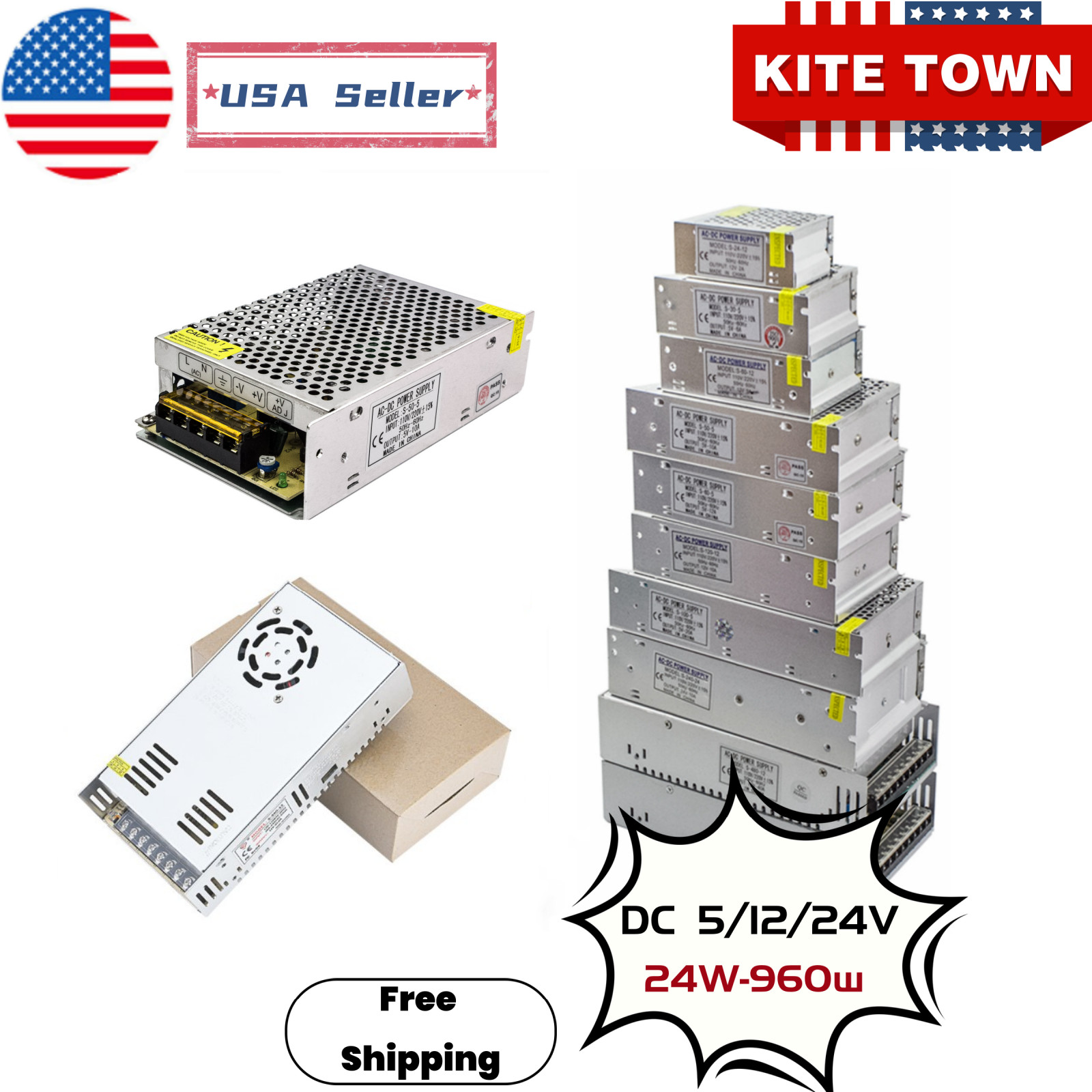

Photos from current listings. Actual item, color, and included accessories may vary.
AC DC Charger Buying Guide
AC DC chargers convert mains AC into regulated DC for electronics, and the key trade-off is continuous current capacity versus thermal design and safety certification. Choose an UL/CE-listed regulated switching adapter with headroom above your device's peak draw; avoid unlisted 'wall wart' bricks whose voltage sags or overheats at rated load.
Topology:Switching (SMPS) vs LinearOutput Regulation:Regulated ±5% vs UnregulatedInput Voltage:100–240V AC universalSafety Certification:UL/ETL, CE, UKCA, BSMI
Typical price range$50.99
Key takeaways
- Switching (SMPS) adapters hit 85–90% efficiency and are universal-input; linear bricks are heavier, 50–60% efficient, and limited to single voltage.
- Continuous current rating is the hard limit: a 12V 2A supply runs 85–90% of load at 2A; sustained overload causes thermal shutdown or failure.
- Regulated output holds ±5% under load; unregulated '12V' bricks drift to 15–17V at no load, damaging sensitive electronics.
At a glance
- Category
- Chargers, Power Banks & Adapters
- Last updated
- Nov 28, 2026
Current offers
Highlights
- Switching (SMPS) adapters hit 85–90% efficiency and are universal-input; linear bricks are heavier, 50–60% efficient, and limited to single voltage.
- Continuous current rating is the hard limit: a 12V 2A supply runs 85–90% of load at 2A; sustained overload causes thermal shutdown or failure.
- Regulated output holds ±5% under load; unregulated '12V' bricks drift to 15–17V at no load, damaging sensitive electronics.
- Safety marks matter: UL/ETL (US), CE/UKCA (EU/UK), and BSMI (Taiwan) indicate tested isolation and overcurrent protection.
Best use cases
- Pick a 12V 5A regulated supply for LED strips drawing 4A total; skip a 12V 2A unit that will run hot and dim the strip.
- For laptops and USB-C devices, use a USB-C PD charger with the right wattage tier (45W/65W/100W); skip fixed-barrel 19V bricks for USB-C laptops.
- For routers, modems, and small appliances, match the barrel plug polarity and voltage exactly; skip universal multi-tip adapters for 24/7 devices unless polarity is confirmed.
- For outdoor or humid areas, choose an IP65-rated or potted supply; skip open-frame or unsealed bricks in wet locations.
Buying tips
- Size current at 1.25× your device's peak draw: a 3A device needs at least a 3.75A-rated supply.
- Match barrel plug dimensions exactly: common sizes are 5.5×2.1mm and 5.5×2.5mm; a loose fit causes arcing and failure.
- Verify polarity: center-positive is standard, but some audio gear and routers use center-negative.
- Voltage must match within ±5%; do not substitute 19V for 18V or 12V for 9V without checking device tolerance.
Specs
| Topology | Switching (SMPS) vs Linear |
|---|---|
| Output Regulation | Regulated ±5% vs Unregulated |
| Input Voltage | 100–240V AC universal |
| Safety Certification | UL/ETL, CE, UKCA, BSMI |
Related searches
What to check before buying
- Measure your device's barrel jack inner/outer diameter and confirm polarity before ordering.
- Confirm the supply's input voltage range covers your mains (100–240V universal is safest for travel).
- Check the plug type matches your wall outlet (US NEMA 1-15, EU CEE 7/16, UK Type G).
- Ensure the supply has ventilation clearance and is not enclosed in a sealed cabinet.
FAQ
Data sources: eBay / Amazon listings and product attribute feeds. Updated Nov 28, 2026.
Some links on this page are affiliate links. If you buy after clicking one, we may earn a commission at no extra cost to you. This does not change which products appear here or their order. Affiliate disclosure.