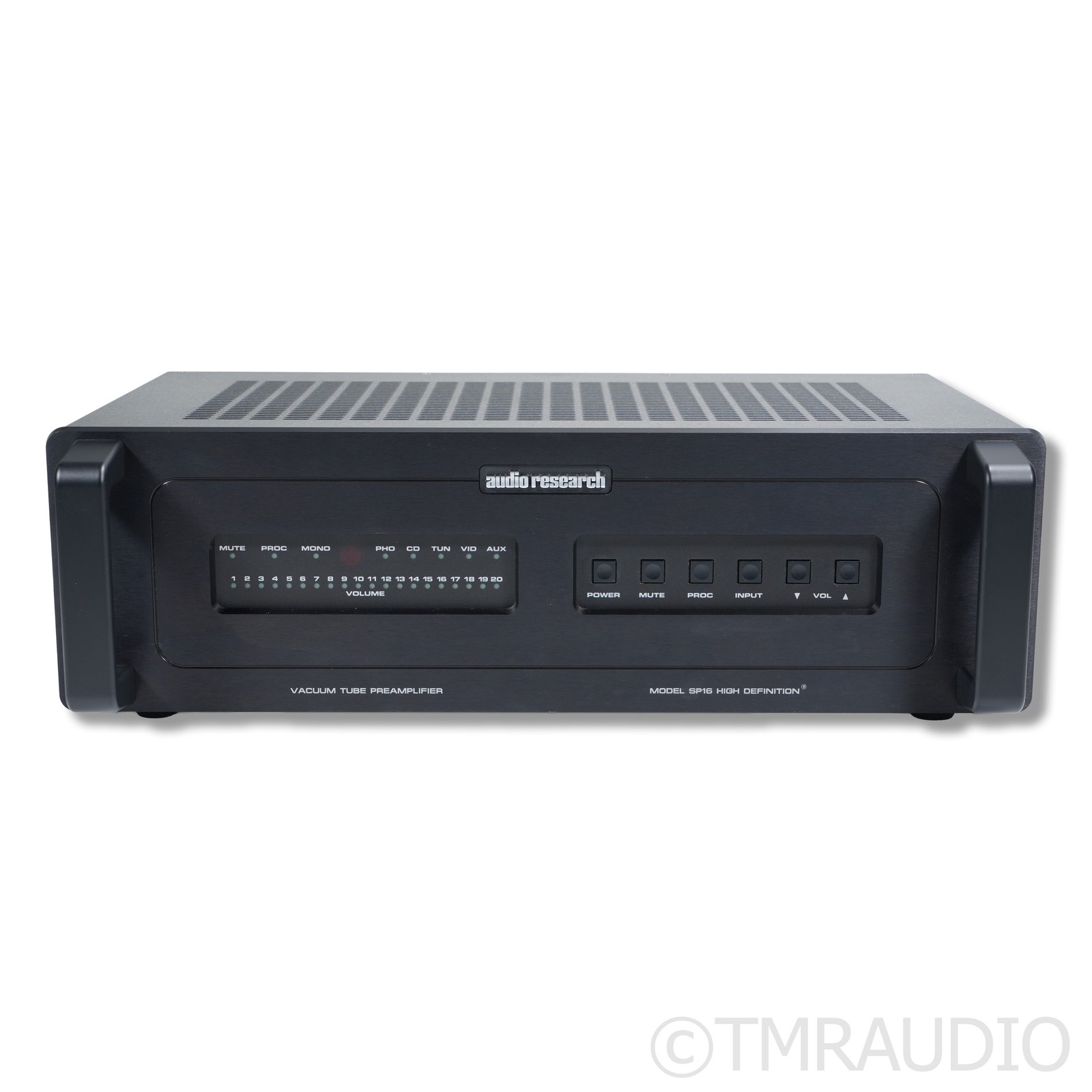

Photos from current listings. Actual item, color, and included accessories may vary.
Audio Research SP16 Buying Guide
The Audio Research SP16 is a line-stage tube preamplifier with an integrated MM phono stage, built to add vacuum-tube harmonic richness and high gain to a separates hi-fi system. Its core trade-off is tube warmth and voltage swing versus the lower noise floor, lower maintenance, and balanced connectivity of solid-state preamps. Buy it only if you run a separate power amp and want classic Audio Research tube voicing with a built-in moving-magnet phono input; skip it if you need balanced XLR outputs, moving-coil cartridge support, or a one-box integrated solution.
Key takeaways
- Genuine vacuum-tube line stage using dual-triode tubes, delivering the high voltage gain and even-order harmonic profile solid-state preamps lack.
- Integrated moving-magnet (MM) phono stage, so a turntable with a standard MM cartridge plugs straight in without an external phono preamp.
- Unbalanced RCA inputs and outputs only — no balanced XLR connections — which limits cable runs and pairing with fully balanced power amps.
At a glance
- Category
- AV Receivers & Amplifiers
- Status
- Listings available
- Last updated
- Nov 24, 2026
Current offers
Highlights
- Genuine vacuum-tube line stage using dual-triode tubes, delivering the high voltage gain and even-order harmonic profile solid-state preamps lack.
- Integrated moving-magnet (MM) phono stage, so a turntable with a standard MM cartridge plugs straight in without an external phono preamp.
- Unbalanced RCA inputs and outputs only — no balanced XLR connections — which limits cable runs and pairing with fully balanced power amps.
- Single-ended tube topology with user-replaceable tubes, meaning tube rolling and periodic replacement are part of long-term ownership cost and maintenance.
Best use cases
- Best fit: you own a separate solid-state or tube power amplifier and a turntable with an MM cartridge, and want a two-box tube front end with built-in phono.
- Best fit: you are assembling a high-efficiency speaker system where the preamp's tube gain and voicing are the intended tonal centerpiece.
- Wrong fit: you need balanced XLR signal paths, a moving-coil phono stage, or a single-box integrated amp — the SP16 supplies none of these.
- Wrong fit: you want zero-maintenance, set-and-forget operation — tube replacement and warm-up time are inherent to this design.
Buying tips
- Confirm your power amp accepts single-ended RCA input; the SP16 has no XLR outputs, so a balanced-only amp requires an adapter or a different preamp.
- Match the phono stage to your cartridge type: this unit handles moving-magnet only — a low-output moving-coil cartridge needs a step-up transformer or a separate MC phono stage.
- Check the tube complement and current tube condition on any used unit; budget for a matched replacement set, since tube life is finite and bias drift affects channel balance.
- Verify the unit's mains voltage matches your local supply (100–120 V or 220–240 V versions exist), as Audio Research shipped region-specific models.
Specs
| Preamplifier Type | Tube line-stage preamp |
|---|---|
| Phono Stage | MM only (no MC) |
| Outputs | Single-ended RCA only |
| Tube Complement | User-replaceable dual triodes |
Alternatives to compare
Related searches
What to check before buying
- Measure your rack depth and clearance: tube preamps run warm and need open ventilation above and behind the chassis.
- Confirm your turntable cartridge is moving-magnet (MM) with standard 47 kΩ loading, or plan an external MC step-up.
- Check that your power amplifier has RCA single-ended inputs and appropriate input sensitivity for the SP16's gain.
- Verify local mains voltage and plug type before buying a used unit, since Audio Research builds region-specific voltage versions.
FAQ
Data sources: eBay / Amazon listings and product attribute feeds. Updated Nov 24, 2026.
Some links on this page are affiliate links. If you buy after clicking one, we may earn a commission at no extra cost to you. This does not change which products appear here or their order. Affiliate disclosure.